
Hello everyone,
we are now finalizing our factory planning and I have an important question before we complete the selection and factory planning.
Here is the situation:
To improve the insulation of the living area in the basement, we have added a package for interior insulation of the basement exterior walls. In the attached drawing, you can see the areas that will now have this additional interior insulation (53mm (2 inches)).
The package includes:
For better clarity, I have also added a sketch of the basement.
My questions are:
1. Is this additional (not inexpensive) interior insulation measure sensible/necessary, or is the existing perimeter and slab insulation sufficient? The two living spaces are only hobby rooms but are expected to be used 2–3 times per week (each time for several hours).
2. Do you have better suggestions regarding the interior wall finishing? / Would it also be sufficient to simply chase grooves for the electrical installation into the concrete wall and then plaster/tape over them?
Thank you in advance for your tips and advice.
Best regards
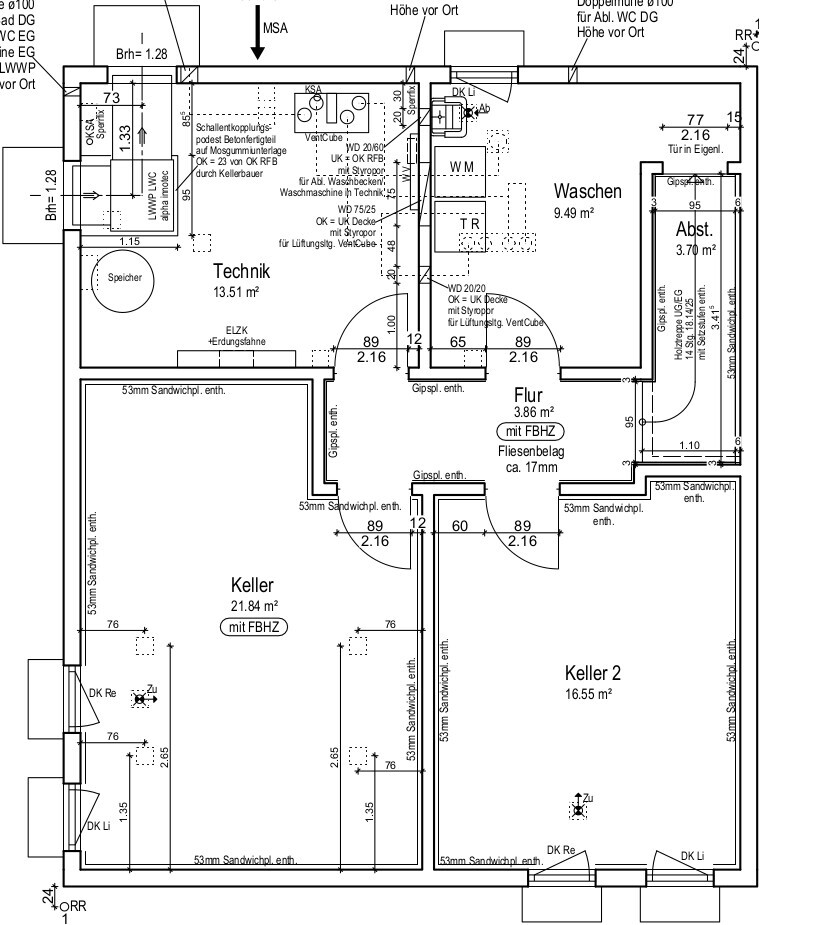
we are now finalizing our factory planning and I have an important question before we complete the selection and factory planning.
Here is the situation:
- we are having a prefabricated house built with a finished basement
- the basement has a double-shell exterior wall with a thickness of 20cm (8 inches)
- additionally, the basement walls will be insulated on the outside with 100mm (4 inches) perimeter insulation (thermal conductivity 0.035 W/m·K)
- under the basement slab there will be 120mm (5 inches) insulation (thermal conductivity 0.040 W/m·K)
- the rooms Basement(1) and Basement2 are intended to be used as living spaces
- Basement(1) will have underfloor heating, Basement2 will have infrared heating
- the basement corridor is open to the ground floor above via the basement stairs and will also be heated with underfloor heating
- we also have a ventilation system (Basement1: supply air, Basement2: supply air, laundry room: exhaust air)
- on the ground floor, almost the entire living area is also open (without doors)
To improve the insulation of the living area in the basement, we have added a package for interior insulation of the basement exterior walls. In the attached drawing, you can see the areas that will now have this additional interior insulation (53mm (2 inches)).
The package includes:
- 40mm (1.5 inches) polystyrene insulation boards (sandwich panels)
- 125mm (5 inches) plasterboard panels
- according to the offer, only plasterboard will be installed on the interior walls of the basement corridor (except for the exterior wall behind the basement stairs—there the sandwich panels and plasterboard will also be installed)
For better clarity, I have also added a sketch of the basement.
My questions are:
1. Is this additional (not inexpensive) interior insulation measure sensible/necessary, or is the existing perimeter and slab insulation sufficient? The two living spaces are only hobby rooms but are expected to be used 2–3 times per week (each time for several hours).
2. Do you have better suggestions regarding the interior wall finishing? / Would it also be sufficient to simply chase grooves for the electrical installation into the concrete wall and then plaster/tape over them?
Thank you in advance for your tips and advice.
Best regards

This insulation on the inside has another purpose as well: to hide electrical wiring.
Simply chasing the concrete walls as you plan will not work well. How deep is the box supposed to be, for example? Or you could install everything surface-mounted.
Our basement apartment is also set up like this, but what I would change is to add another board, as attaching a wall cabinet, for example, becomes much easier this way.
Simply chasing the concrete walls as you plan will not work well. How deep is the box supposed to be, for example? Or you could install everything surface-mounted.
Our basement apartment is also set up like this, but what I would change is to add another board, as attaching a wall cabinet, for example, becomes much easier this way.
@tomtom79 and Zaba12: Thank you for your input. I have since learned that my basement contractor can also create the openings for the electrical wiring directly in the factory for each concrete element (this was not communicated to us by our prefab house supplier). So currently, I am considering three options:
1. Concrete elements with electrical preparation already done at the factory. This seems to be the most cost-effective and simplest solution since you basically only need to paint or wallpaper afterwards, and no additional internal insulation is required. I also find this solution to be the cleanest regarding the electrical installation. However, my contractor admitted that this option results in less favorable indoor climate and acoustics compared to options 2 and 3. Since at least one room will be a home theater, I might consider option 2 or 3 for that room.
2. Gypsum drywall with vapor barrier foil. This allows for flush-mounted boxes and switches. Additionally, the indoor climate and acoustics would likely be better. This option would also be less expensive than option 3.
3. The aforementioned sandwich panels combined with gypsum drywall. This is the most expensive option but potentially the best in terms of soundproofing, insulation, and indoor climate.
Which option would you ultimately recommend? / What experiences do you have with habitable basements?
Additional question: My prefab house supplier may also install underfloor heating in the area beneath the basement stairs, even though the stairwell is entirely "closed off" from below by risers and surrounding walls. They admitted this is not necessarily required technically, but it would add more heat to the ground floor and also result in warmer stair treads. For this solution, I would of course install a door at the entrance to the storage room under the stairs. What do you think? Does this make sense (technically)?
Thank you in advance.
1. Concrete elements with electrical preparation already done at the factory. This seems to be the most cost-effective and simplest solution since you basically only need to paint or wallpaper afterwards, and no additional internal insulation is required. I also find this solution to be the cleanest regarding the electrical installation. However, my contractor admitted that this option results in less favorable indoor climate and acoustics compared to options 2 and 3. Since at least one room will be a home theater, I might consider option 2 or 3 for that room.
2. Gypsum drywall with vapor barrier foil. This allows for flush-mounted boxes and switches. Additionally, the indoor climate and acoustics would likely be better. This option would also be less expensive than option 3.
3. The aforementioned sandwich panels combined with gypsum drywall. This is the most expensive option but potentially the best in terms of soundproofing, insulation, and indoor climate.
Which option would you ultimately recommend? / What experiences do you have with habitable basements?
Additional question: My prefab house supplier may also install underfloor heating in the area beneath the basement stairs, even though the stairwell is entirely "closed off" from below by risers and surrounding walls. They admitted this is not necessarily required technically, but it would add more heat to the ground floor and also result in warmer stair treads. For this solution, I would of course install a door at the entrance to the storage room under the stairs. What do you think? Does this make sense (technically)?
Thank you in advance.
Hello khb70
I can only speak from my own experience as an installer, but I would still like to share it with you.
The second option seems best to me, provided that care is taken to prevent mold by ensuring everything is properly sealed and insulated behind the drywall panels. I am always very cautious about interior insulation because the risk of mold growth is quite high. Are you sure about using wallpaper in the basement? Wallpaper can prevent the walls from breathing, which greatly promotes mold growth. My recommendation is to use breathable paint, especially considering the drywall and the cool walls of the basement.
As an electrician, I can tell you that the option with drywall walls is easier for the tradespeople, which speeds up the process significantly (saving money, time, and stress).
As a plumber, I would like to ask why one side is heated with an infrared heater and the other with underfloor heating (purely out of interest). However, you should definitely thoroughly check with the contracting company to ensure they guarantee no mold will develop.
I can only speak from my own experience as an installer, but I would still like to share it with you.
The second option seems best to me, provided that care is taken to prevent mold by ensuring everything is properly sealed and insulated behind the drywall panels. I am always very cautious about interior insulation because the risk of mold growth is quite high. Are you sure about using wallpaper in the basement? Wallpaper can prevent the walls from breathing, which greatly promotes mold growth. My recommendation is to use breathable paint, especially considering the drywall and the cool walls of the basement.
As an electrician, I can tell you that the option with drywall walls is easier for the tradespeople, which speeds up the process significantly (saving money, time, and stress).
As a plumber, I would like to ask why one side is heated with an infrared heater and the other with underfloor heating (purely out of interest). However, you should definitely thoroughly check with the contracting company to ensure they guarantee no mold will develop.
@Ricco: Thank you very much! Of course, I want to avoid mold growth at all costs. A colleague of mine simply wallpapered the walls directly in his prefabricated basement because the electrical installation was already integrated into the delivered wall panels. In my view, that would have been the easiest and most cost-effective solution.
Regarding Option 2: I would not insulate this construction but rather consider just a subframe for the electrical installation, plus a vapor barrier and drywall panels.
About the infrared heater in Hobby Room 2 (fitness room): we will spend at most one hour a day in this room. The temperature shouldn’t be too high anyway, as this room will mainly be used for sports activities. Hobby Room 1 will be used for much longer periods during the day, so I have planned for underfloor heating there.
I am currently quite uncertain which option to choose. I think (and hope) that the basement is already sufficiently insulated with 120mm (4.7 inches) of insulation under the basement floor plus 100mm (3.9 inches) perimeter insulation on the exterior walls. Additional interior insulation might be better for indoor climate, but ultimately I believe the underfloor heating will provide enough warmth here.
Regarding Option 2: I would not insulate this construction but rather consider just a subframe for the electrical installation, plus a vapor barrier and drywall panels.
About the infrared heater in Hobby Room 2 (fitness room): we will spend at most one hour a day in this room. The temperature shouldn’t be too high anyway, as this room will mainly be used for sports activities. Hobby Room 1 will be used for much longer periods during the day, so I have planned for underfloor heating there.
I am currently quite uncertain which option to choose. I think (and hope) that the basement is already sufficiently insulated with 120mm (4.7 inches) of insulation under the basement floor plus 100mm (3.9 inches) perimeter insulation on the exterior walls. Additional interior insulation might be better for indoor climate, but ultimately I believe the underfloor heating will provide enough warmth here.
Similar topics