
ᐅ Basement exterior wall waterproofing with an overhanging floor slab
Created on: 17 Nov 2025 09:13
0
007sascha0
007sascha17 Nov 2025 09:13Hello,
here is the current situation:
We have occasional moisture intrusion on the basement wall (built in 1978) and would therefore like to fully waterproof and insulate the basement walls.
However, there are two major challenges for which we have not yet found a practical solution and hope to get experience-based ideas:
- Basement stairs: Is it possible to effectively waterproof under/behind a basement staircase, or does the entire staircase need to be removed for proper waterproofing?
- Overhanging terrace/basement ceiling: On the terrace side, the basement ceiling extends about 1.5m (5 feet) beyond the foundation, so the basement wall is covered and difficult to access. Since the additional masonry is also built on this ceiling, it cannot be shortened. Even if we excavate a trench with support for waterproofing, the trench must be refilled and compacted afterward. Is there a practical solution for this situation, or is internal waterproofing the only option for this wall? And if this wall is waterproofed from the inside, how is the sealing connection made to the other walls that are waterproofed from the outside?
Side view:
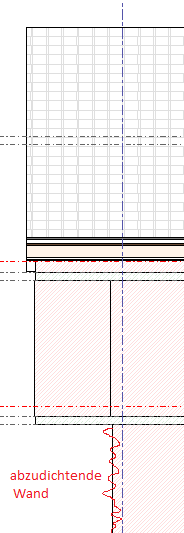
here is the current situation:
We have occasional moisture intrusion on the basement wall (built in 1978) and would therefore like to fully waterproof and insulate the basement walls.
However, there are two major challenges for which we have not yet found a practical solution and hope to get experience-based ideas:
- Basement stairs: Is it possible to effectively waterproof under/behind a basement staircase, or does the entire staircase need to be removed for proper waterproofing?
- Overhanging terrace/basement ceiling: On the terrace side, the basement ceiling extends about 1.5m (5 feet) beyond the foundation, so the basement wall is covered and difficult to access. Since the additional masonry is also built on this ceiling, it cannot be shortened. Even if we excavate a trench with support for waterproofing, the trench must be refilled and compacted afterward. Is there a practical solution for this situation, or is internal waterproofing the only option for this wall? And if this wall is waterproofed from the inside, how is the sealing connection made to the other walls that are waterproofed from the outside?
Side view:
Hi,
your sketch clearly shows that both the basement stairs and the cantilevered terrace slab make a continuous exterior waterproofing almost impossible. You won’t achieve a standard-compliant waterproofing behind an attached concrete staircase. If it fits tightly or is even connected to the wall, the only solution is demolition; otherwise, it will remain patchy. Have you checked whether it is actually cast monolithically?
The terrace slab is the bigger obstacle. You simply cannot access the covered basement wall. Even a secured shaft won’t provide continuous waterproofing up to the underside of the ceiling. That is precisely why only an interior waterproofing remains an option here. It can work but requires a carefully planned transition to the externally waterproofed walls; otherwise, moisture will simply travel around the corner. One tiny correction: the “wall” must be completely sealed on the inside.
My question in return: Are you actually sure whether you are dealing with rising damp or with water pooling? Without this information, any solution is only half right 😉.
your sketch clearly shows that both the basement stairs and the cantilevered terrace slab make a continuous exterior waterproofing almost impossible. You won’t achieve a standard-compliant waterproofing behind an attached concrete staircase. If it fits tightly or is even connected to the wall, the only solution is demolition; otherwise, it will remain patchy. Have you checked whether it is actually cast monolithically?
The terrace slab is the bigger obstacle. You simply cannot access the covered basement wall. Even a secured shaft won’t provide continuous waterproofing up to the underside of the ceiling. That is precisely why only an interior waterproofing remains an option here. It can work but requires a carefully planned transition to the externally waterproofed walls; otherwise, moisture will simply travel around the corner. One tiny correction: the “wall” must be completely sealed on the inside.
My question in return: Are you actually sure whether you are dealing with rising damp or with water pooling? Without this information, any solution is only half right 😉.
0
007sascha20 Nov 2025 15:35Hi, thank you for your comments. The property has not been fully purchased yet, but it is currently in the, hopefully final, stages of agreement.
The newly received foundation plan also includes the basement stairs, so I assume they are directly connected. However, further verification is still pending.
The cause of the moisture issue is unfortunately not easy to pinpoint. The house was affected by flooding last year, so there could still be some residual moisture in the masonry. Moisture measurements show that the values are decreasing, but according to the expert report, with values around 70, this is still within the acceptable range for a basement. Only near the basement stairs are the values significantly higher, and there are also visible damages on the exterior masonry. The flood repair work in this area was simply not done properly.
Therefore, we are considering renovating the entire masonry if one side needs to be addressed anyway. Aside from the stair area, there is no immediate need. However, the upcoming winter is concerning since no measures can be taken before then.
The newly received foundation plan also includes the basement stairs, so I assume they are directly connected. However, further verification is still pending.
The cause of the moisture issue is unfortunately not easy to pinpoint. The house was affected by flooding last year, so there could still be some residual moisture in the masonry. Moisture measurements show that the values are decreasing, but according to the expert report, with values around 70, this is still within the acceptable range for a basement. Only near the basement stairs are the values significantly higher, and there are also visible damages on the exterior masonry. The flood repair work in this area was simply not done properly.
Therefore, we are considering renovating the entire masonry if one side needs to be addressed anyway. Aside from the stair area, there is no immediate need. However, the upcoming winter is concerning since no measures can be taken before then.
Similar topics