
ᐅ Basement Construction with High Groundwater Levels (2 meters)
Created on: 27 Sep 2023 11:18
P
pxrunes2
Hello everyone,
This is our first house, so we lack some experience. The soil survey revealed a groundwater level of 2.2 meters (7 feet) during midsummer. Throughout the year, there are probably levels around 1.6 meters (5 feet). Otherwise, the soil is sandy.
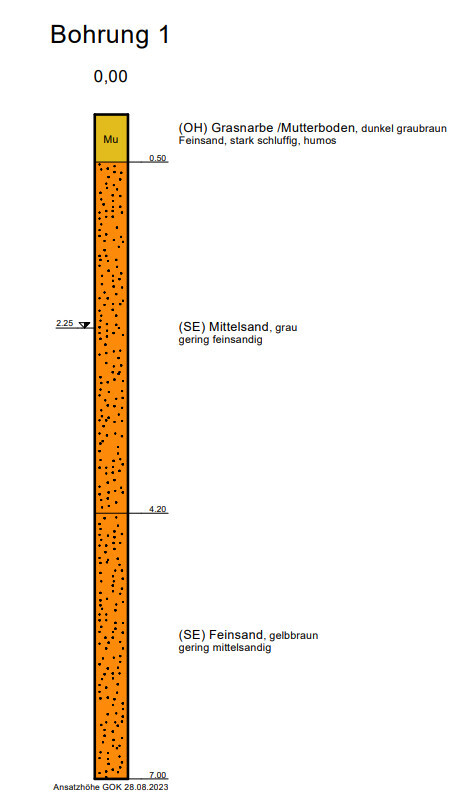
We would like to build a basement anyway, with small windows above ground level. A lower ceiling height of 2.2 meters (7 feet) would still be acceptable for us, since it will not be a living basement.
Our question now is whether building a basement is still financially feasible.
- How deep is an excavation typically dug?
- Does anyone have experience with how much more expensive a basement can become due to high groundwater?
- Any other advice?
Many thanks!
This is our first house, so we lack some experience. The soil survey revealed a groundwater level of 2.2 meters (7 feet) during midsummer. Throughout the year, there are probably levels around 1.6 meters (5 feet). Otherwise, the soil is sandy.
We would like to build a basement anyway, with small windows above ground level. A lower ceiling height of 2.2 meters (7 feet) would still be acceptable for us, since it will not be a living basement.
Our question now is whether building a basement is still financially feasible.
- How deep is an excavation typically dug?
- Does anyone have experience with how much more expensive a basement can become due to high groundwater?
- Any other advice?
Many thanks!
A
Allthewayup28 Sep 2023 17:47The question of whether to use open or closed dewatering is immediately clear with such groundwater levels. Of course, we implemented a closed dewatering system. You often read that open dewatering could still work with up to 0.5m (1.5 feet) of drawdown. However, I have never seen this in practice, and there is relatively little information about it online. It requires a lot of space on the construction site because you need a pump sump, drainage trenches, and a very low slope angle. In other words, a lot of soil must be moved. This quickly becomes uneconomical since not everyone has the space to store the additional excavated soil on the property. This whole dewatering process usually only lasts about two weeks (for a typical single-family home). We also did not lower the groundwater 0.5m (1.5 feet) below the excavation bottom as often suggested; 20-30cm (8-12 inches) is actually sufficient here. The 0.5m (1.5 feet) figure is a safety margin from theoretical calculations found in some formulas.
A hydraulic conductivity (Kf) value alone is not enough to help you. Do you have a soil report? The geologist should have commented on the prevailing estimated Kf value under the groundwater/dewatering section. Did they provide a recommendation for the dewatering method? All of this was described in detail in my report. Does your report include a grain size distribution diagram? Based on the borehole profile you showed, your soil seems more sandy and less gravelly, which makes choosing the correct dewatering method more challenging. If I could see more data from your geological report, I could tell you whether gravity drainage (wells) is possible or if vacuum-assisted methods must already be used.
In general, when planning groundwater drawdown, you should choose the season with the lowest water level, but a good planner will advise you of this early on. Could you discharge the water into a nearby stream, river, or large agricultural field, or must it be directed into a sewer system? Also, which federal state (region) is the construction located in?
A hydraulic conductivity (Kf) value alone is not enough to help you. Do you have a soil report? The geologist should have commented on the prevailing estimated Kf value under the groundwater/dewatering section. Did they provide a recommendation for the dewatering method? All of this was described in detail in my report. Does your report include a grain size distribution diagram? Based on the borehole profile you showed, your soil seems more sandy and less gravelly, which makes choosing the correct dewatering method more challenging. If I could see more data from your geological report, I could tell you whether gravity drainage (wells) is possible or if vacuum-assisted methods must already be used.
In general, when planning groundwater drawdown, you should choose the season with the lowest water level, but a good planner will advise you of this early on. Could you discharge the water into a nearby stream, river, or large agricultural field, or must it be directed into a sewer system? Also, which federal state (region) is the construction located in?