
ᐅ Basement Construction with High Groundwater Levels (2 meters)
Created on: 27 Sep 2023 11:18
P
pxrunes2Hello everyone,
This is our first house, so we lack some experience. The soil survey revealed a groundwater level of 2.2 meters (7 feet) during midsummer. Throughout the year, there are probably levels around 1.6 meters (5 feet). Otherwise, the soil is sandy.
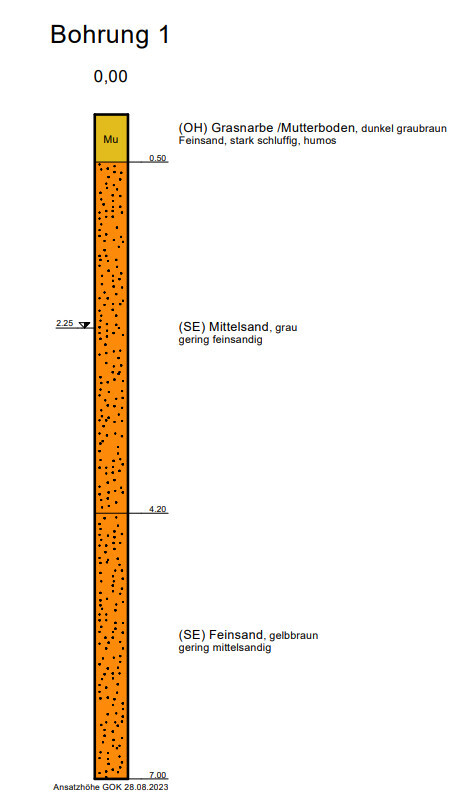
We would like to build a basement anyway, with small windows above ground level. A lower ceiling height of 2.2 meters (7 feet) would still be acceptable for us, since it will not be a living basement.
Our question now is whether building a basement is still financially feasible.
- How deep is an excavation typically dug?
- Does anyone have experience with how much more expensive a basement can become due to high groundwater?
- Any other advice?
Many thanks!
This is our first house, so we lack some experience. The soil survey revealed a groundwater level of 2.2 meters (7 feet) during midsummer. Throughout the year, there are probably levels around 1.6 meters (5 feet). Otherwise, the soil is sandy.
We would like to build a basement anyway, with small windows above ground level. A lower ceiling height of 2.2 meters (7 feet) would still be acceptable for us, since it will not be a living basement.
Our question now is whether building a basement is still financially feasible.
- How deep is an excavation typically dug?
- Does anyone have experience with how much more expensive a basement can become due to high groundwater?
- Any other advice?
Many thanks!

Here, a flat rate of 80,000–100,000 EUR is often assumed for a waterproof concrete basement ("white tank").
Whether a white tank alone is sufficient or if additional measures are needed, I don’t know.
With this groundwater level, I would seriously reconsider having a basement. Even if money is not an issue (in which case you could simply build larger or taller), a white tank won’t remain watertight forever. It is basically constantly submerged, and groundwater also exerts upward pressure. That is quite different from rainwater slowly seeping away.
Depth:
2.2 m (7 ft) clear room height
+ 20 cm (8 inches) floor slab (if that is enough)
+ 10 cm (4 inches) insulation (usually more)
+ 2 cm (1 inch) finished floor covering
So, at least 2.5 m (8 ft 2 in), meaning the basement wall is already surrounded by water at its base, unless you significantly raise the ground floor level.
The excavation pit itself will be even deeper, as a gravel base layer will probably be required despite the sandy soil.
If the basement is not already recommended due to the slope according to @11ant’s basement rule (then it would rather be a lower ground floor, meaning it could still be used as a partly above-ground living basement on the open side), I would seriously consider just leaving it out.
Whether a white tank alone is sufficient or if additional measures are needed, I don’t know.
With this groundwater level, I would seriously reconsider having a basement. Even if money is not an issue (in which case you could simply build larger or taller), a white tank won’t remain watertight forever. It is basically constantly submerged, and groundwater also exerts upward pressure. That is quite different from rainwater slowly seeping away.
Depth:
2.2 m (7 ft) clear room height
+ 20 cm (8 inches) floor slab (if that is enough)
+ 10 cm (4 inches) insulation (usually more)
+ 2 cm (1 inch) finished floor covering
So, at least 2.5 m (8 ft 2 in), meaning the basement wall is already surrounded by water at its base, unless you significantly raise the ground floor level.
The excavation pit itself will be even deeper, as a gravel base layer will probably be required despite the sandy soil.
If the basement is not already recommended due to the slope according to @11ant’s basement rule (then it would rather be a lower ground floor, meaning it could still be used as a partly above-ground living basement on the open side), I would seriously consider just leaving it out.
O
Osnabruecker27 Sep 2023 11:52pxrunes2 schrieb:
Our question now is whether it is still financially feasible to build a basement. We don’t know your financial framework, so it’s not possible to comment on feasibility.
Information about the intended use and whether a basement makes sense, or if it would be better to increase the building’s footprint, is also missing.
pxrunes2 schrieb:
- How deep is an excavation site usually dug? How deep should the house be embedded into the ground? In the past, basements were often only partially underground.
It also depends on the thickness of the foundations, load-bearing layers, and possibly insulation. Your point of contact should be an architect and structural engineer.
pxrunes2 schrieb:
Does anyone have experience with how much more expensive a basement can become due to high groundwater? Very roughly, around 20,000.
pxrunes2 schrieb:
Other advice “Not all drilling is the same”

Tolentino schrieb:
If a basement is not already indicated by the terrain according to @11ant’s basement rule (which then would rather be considered a lower ground floor, meaning at least for the open side it would have living basement features), I would really just leave it as is. By the way, you can currently find this on "Bauen jetzt" as a four-part series: last week the first part of 11ant’s basement rule addressing the question of whether to include a basement or not, the day after tomorrow the discussion will focus on partial basements, next week on living basements, and the week after on technical basements, followed by a summary of which approach to the basement question applies to different terrain situations.
https://www.instagram.com/11antgmxde/
https://www.linkedin.com/company/bauen-jetzt/
Osnabruecker schrieb:
"A borehole is not just a borehole" That’s true, but don’t we already have the “worst case”?
Regarding groundwater control: the groundwater level must be lowered to at least 0.5 m (20 inches) below the deepest excavation level. Lowering the water table by 0.5 m (20 inches) can still be managed with open groundwater control methods. For greater depths, closed groundwater control systems, such as vacuum wells or similar, must be planned. This gets quite expensive. Additionally, lowering the groundwater can affect neighboring buildings. It is strongly recommended to perform damage documentation beforehand (if there are neighbors). Then there are also fees for water discharge, plus a significantly longer construction period.
I don’t even want to mention the costs for waterproofing... If it’s not absolutely necessary, I wouldn’t take that on. Or else go deep enough so that the intervention is minimal.
Thank you all in advance for your responses!
There were a total of two boreholes, and the situation looks the same there. There is also a groundwater monitoring point nearby that measures similar values.
Until now, I assumed that you need a waterproof concrete basement anyway and that it is simply “watertight,” so you could basically build it under water, but apparently that’s not the case?
Financially, we are in a good position, but building a basement “at all costs” doesn’t make sense financially, for example, if you could build a larger house instead. The plot would allow for a bigger house, but living space is expensive, and it would be nice to have this basement.
Basically, it will be used for technical equipment, a gym, storage, and a hobby room.
I had hoped that raising the basement slightly would still be cheaper than increasing the living area of the house. But as you describe it, and as I feared, the construction work is especially costly and hard to estimate.
There were a total of two boreholes, and the situation looks the same there. There is also a groundwater monitoring point nearby that measures similar values.
Tolentino schrieb:
I’m not sure whether a waterproof concrete basement (“white tank”) will be enough or if additional measures are necessary.
With that groundwater level, I would seriously reconsider building a basement. Even if money is no issue (in which case you could just build bigger or add more stories), a waterproof concrete basement won’t stay watertight forever. It is basically constantly submerged, and groundwater pressure pushes upward. That’s quite different from rainwater slowly soaking away.
Until now, I assumed that you need a waterproof concrete basement anyway and that it is simply “watertight,” so you could basically build it under water, but apparently that’s not the case?
Osnabruecker schrieb:
We don’t know your financial constraints, so we can’t comment on what’s possible.
There’s also no information about how you plan to use the space or whether having a basement makes sense, or if it would be better to increase the building footprint.
Financially, we are in a good position, but building a basement “at all costs” doesn’t make sense financially, for example, if you could build a larger house instead. The plot would allow for a bigger house, but living space is expensive, and it would be nice to have this basement.
Basically, it will be used for technical equipment, a gym, storage, and a hobby room.
I had hoped that raising the basement slightly would still be cheaper than increasing the living area of the house. But as you describe it, and as I feared, the construction work is especially costly and hard to estimate.
Similar topics