
ᐅ Plinth at the refrigerator and countertop above the refrigerator
Created on: 22 Jan 2014 19:37
N
Nordkäppchen
Hello,
we bought an IKEA kitchen and now face a problem that wasn’t really clear to us before.
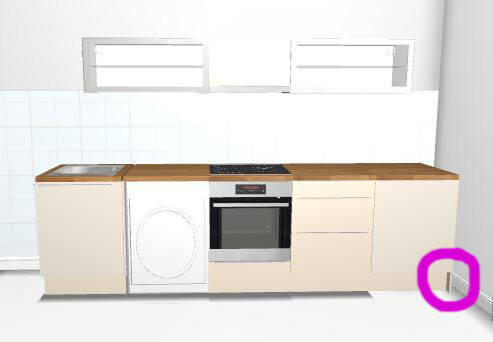
Here is the kitchen layout first:

1. Problem: How do I secure the countertop above the refrigerator? Should there always be a small gap between the fridge and the countertop, or can it simply rest on it? I originally thought I would install a side panel next to the fridge, on top of which I would screw the countertop. But I have now noticed that on the right side of the fridge the side panel cannot be screwed on, only glued. I don’t want to do that. It’s unfortunate that we were sold a side panel without any indication of this.
2. Problem: The baseboard at the bottom needs to connect with the refrigerator legs. However, these are different from the Faktum legs, meaning the clips of the baseboard do not fit. Are there special clips for the Frostig refrigerator?
Are there any solutions for these problems, or only DIY workarounds?
I would be grateful for any tips!
we bought an IKEA kitchen and now face a problem that wasn’t really clear to us before.
Here is the kitchen layout first:
1. Problem: How do I secure the countertop above the refrigerator? Should there always be a small gap between the fridge and the countertop, or can it simply rest on it? I originally thought I would install a side panel next to the fridge, on top of which I would screw the countertop. But I have now noticed that on the right side of the fridge the side panel cannot be screwed on, only glued. I don’t want to do that. It’s unfortunate that we were sold a side panel without any indication of this.
2. Problem: The baseboard at the bottom needs to connect with the refrigerator legs. However, these are different from the Faktum legs, meaning the clips of the baseboard do not fit. Are there special clips for the Frostig refrigerator?
Are there any solutions for these problems, or only DIY workarounds?
I would be grateful for any tips!
I
IKEA-Experte26 Jan 2014 11:43It is first important to know whether the countertop will extend all the way to the wall or if a gap should be left.
The gap should/must remain for various reasons. The countertop has already been cut (the centimeters for the side panel or end panel on the left and right are already included). I think on the left there should be a standard end panel or plinth at the bottom (which is straightforward), and on the right a custom-cut side panel, although I’m a bit bothered by the overhang at the bottom. See photo:
N
Nordkäppchen26 Jan 2014 14:32Well, the side panel still supports the countertop if you don’t want to screw it flush with the refrigerator...... Isn’t the refrigerator supposed to be attached to the countertop? That wouldn’t make much sense. Sooner or later, the refrigerator will move forward when opening if it’s only fixed to the side panels.
I have to admit, the whole description is getting more confusing to me. The gap to the wall doesn’t look good visually but apparently isn’t a problem... In that case, all the effort could be avoided if no seamless solution is planned anyway. You have to improvise with the left side panel, the right side panel, the plinth, and the countertop...
Here, only the plinth is divided:
1. Attach the countertop to the wall with brackets
2. Attach the plinth normally to the legs up to the last cabinet
3. Glue a matching plinth piece under the refrigerator, edge the plinth sides left and right with an edgeband
4. Slide the refrigerator flush with the plinth, fasten it to the adjacent cabinet and the countertop, done.
Time required: approximately 1 hour
Best regards
Nordkäppchen
I
IKEA-Experte26 Jan 2014 15:42The refrigerator is firmly placed on the floor, and I have never experienced a freestanding refrigerator moving forward when opening or closing it.
It is a built-in appliance without a fully enclosed cabinet; otherwise, the insulation would not be visible. That is why a right side panel is necessary. The left one is not required but is already installed or at least the countertop has been cut accordingly.
For some reason, the countertop could not be installed all the way to the wall, so it cannot be fixed there either. Personally, I do not like this solution, as dowel holes cannot be drilled with millimeter accuracy, making height adjustment difficult.
If I understand correctly, the only remaining issue is that the right side panel does not have a recessed baseboard. This simply needs to be cut out accordingly. The baseboard cover panel can then conceal the cut edge. However, I would still apply edge banding to the cut surface.
There does not need to be a gap between the countertop and the refrigerator, but the refrigerator should not support the countertop, as otherwise, the insulation would remain exposed. It would all be clearer if it were possible to see this in person.
I created a supporting panel by screwing an aluminum U-profile to the underside of the countertop to carry the top panel. The bottom edge of the top panel also sits in an aluminum profile, to which Pax feet are attached. The entire construction is height-adjustable. However, this solution is not ideal if it is visible from the side.
It is a built-in appliance without a fully enclosed cabinet; otherwise, the insulation would not be visible. That is why a right side panel is necessary. The left one is not required but is already installed or at least the countertop has been cut accordingly.
For some reason, the countertop could not be installed all the way to the wall, so it cannot be fixed there either. Personally, I do not like this solution, as dowel holes cannot be drilled with millimeter accuracy, making height adjustment difficult.
If I understand correctly, the only remaining issue is that the right side panel does not have a recessed baseboard. This simply needs to be cut out accordingly. The baseboard cover panel can then conceal the cut edge. However, I would still apply edge banding to the cut surface.
There does not need to be a gap between the countertop and the refrigerator, but the refrigerator should not support the countertop, as otherwise, the insulation would remain exposed. It would all be clearer if it were possible to see this in person.
I created a supporting panel by screwing an aluminum U-profile to the underside of the countertop to carry the top panel. The bottom edge of the top panel also sits in an aluminum profile, to which Pax feet are attached. The entire construction is height-adjustable. However, this solution is not ideal if it is visible from the side.
The refrigerator stands firmly on the floor, and I have never experienced a freestanding fridge moving forward when opening or closing it.
It is a built-in unit that doesn’t have a “properly enclosed” casing; otherwise, the insulation wouldn’t be exposed. That’s why a right side panel is necessary. On the left side it’s unnecessary, but it’s already installed or at least the countertop has been cut to fit.
For some reason, the countertop could not be extended all the way to the wall, so it cannot be fixed to the wall either. Personally, I don’t like this solution because dowel holes can’t be drilled precisely to the millimeter, which can make height adjustments difficult.
If I understand correctly, the only real remaining issue is that the right side panel has no recessed toe kick. This simply needs to be cut out accordingly. The toe kick cover can then hide the cut edge. However, I would still edge-band the cut edge.
There doesn’t need to be a gap between the countertop and the refrigerator, but the fridge should not bear the weight of the countertop; otherwise, the insulation would be exposed. It would be somewhat clearer if we could see a picture here.
I created a support panel by screwing an aluminum U-profile to the countertop, which holds the top panel. At the bottom, the top panel also sits in an aluminum profile, and PAX feet are attached to this. The entire construction is height-adjustable. However, this setup isn’t ideal if there is a side view of it.You speak my mind regarding the countertop next to the wall. I will simply have the toe kick recess cut to fit so it will be flush, and use two brackets to connect the toe kick from behind to the side panel.
I went to the hardware store today and saw how they cut IKEA toe kicks and fronts into multiple pieces for some reason. All edges were clean. So I assume it’s perfectly fine to have it cut at the hardware store.
I
IKEA-Experte26 Jan 2014 22:19Maybe they just have a new saw blade, or you’re lucky with a good branch.
I don’t know the exact details of the fridge, but I imagine it would be difficult to attach the brackets. Where else would you be able to reach?
It might also be possible to use a plug-in connection to clip them together. You can also find these at a hardware store.
I don’t know the exact details of the fridge, but I imagine it would be difficult to attach the brackets. Where else would you be able to reach?
It might also be possible to use a plug-in connection to clip them together. You can also find these at a hardware store.
Similar topics