
Hello dear experts,
I would like to ask for your opinion on the following situation:
Image 1:
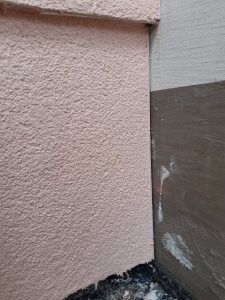
- On the building to the right, there is a base coat with mesh reinforcement.
- The lower area has been treated with a waterproof slurry.
Image 2:
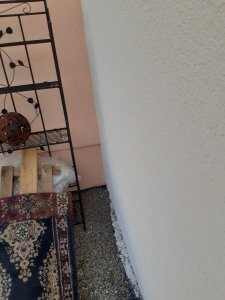
- On the building to the right, a topcoat (colored silicone resin render) has now been applied.
- The waterproof slurry is also covered by the render.
Question:
Now backfilling is planned and a drainage membrane (dimpled membrane) will be installed.
But what about the waterproof slurry?
Does it need to be reapplied up to at least 5 cm (2 inches) above the final ground level?
Thank you very much for your input.
Good luck
Matthias
I would like to ask for your opinion on the following situation:
Image 1:
- On the building to the right, there is a base coat with mesh reinforcement.
- The lower area has been treated with a waterproof slurry.
Image 2:
- On the building to the right, a topcoat (colored silicone resin render) has now been applied.
- The waterproof slurry is also covered by the render.
Question:
Now backfilling is planned and a drainage membrane (dimpled membrane) will be installed.
But what about the waterproof slurry?
Does it need to be reapplied up to at least 5 cm (2 inches) above the final ground level?
Thank you very much for your input.
Good luck
Matthias
Thank you very much for the reply.
Well, the 5cm (2 inches) offset doesn’t bother me – after all, it’s the neighbor’s terrace (although I also have this 5cm (2 inches) thick visual flaw on the other sides of the building).
Therefore, completely omitting the waterproofing slurry on the pink house obviously seems to me to be incorrect.
Which standard is this about? DIN 18195?
Well, the 5cm (2 inches) offset doesn’t bother me – after all, it’s the neighbor’s terrace (although I also have this 5cm (2 inches) thick visual flaw on the other sides of the building).
Therefore, completely omitting the waterproofing slurry on the pink house obviously seems to me to be incorrect.
Which standard is this about? DIN 18195?
Hi,
I still owe you the information:
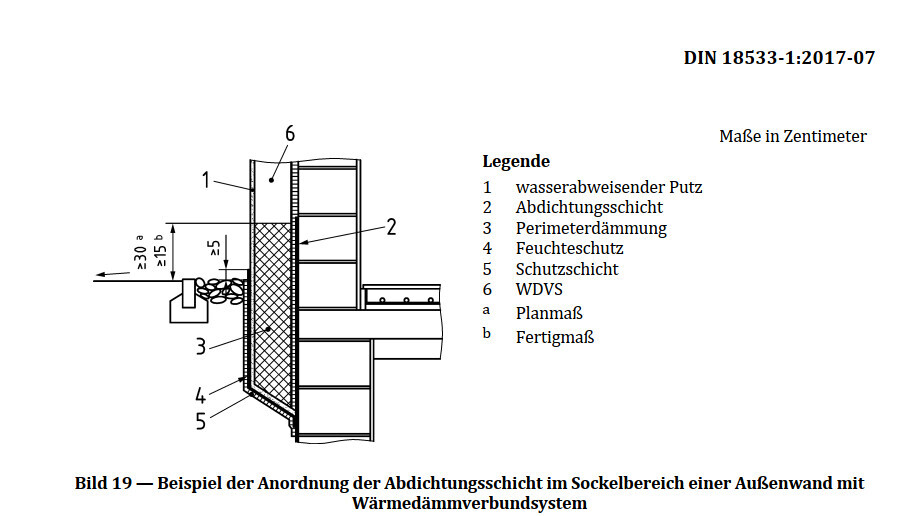
Here is the relevant detail from DIN 18533 Part 1 – shown with a basement below, but this does not affect the connection of the ETICS to the surrounding ground space.
You can see a "moisture protection" layer that must extend 5 cm (2 inches) above ground level (GOK). This moisture protection can be, for example, Sto’s product StoFlexyl – you can download the datasheet from their website if you search for the product.
It is a so-called flexible waterproofing slurry, which is also available from other manufacturers, but since you have used products from Sto, I strongly recommend always using products from the same system.
Normally, it is gray and can be painted over with the facade color.
Best regards,
Jann
I still owe you the information:
Here is the relevant detail from DIN 18533 Part 1 – shown with a basement below, but this does not affect the connection of the ETICS to the surrounding ground space.
You can see a "moisture protection" layer that must extend 5 cm (2 inches) above ground level (GOK). This moisture protection can be, for example, Sto’s product StoFlexyl – you can download the datasheet from their website if you search for the product.
It is a so-called flexible waterproofing slurry, which is also available from other manufacturers, but since you have used products from Sto, I strongly recommend always using products from the same system.
Normally, it is gray and can be painted over with the facade color.
Best regards,
Jann
Similar topics