
ᐅ Single-family home floor plan, accessible for aging in place, with a master bedroom for parents on the ground floor
Created on: 13 Jul 2021 22:17
N
NagučkiHello dear forum,
I am currently focused solely on the ground floor layout, as I've been stuck on this for weeks. We want to build barrier-free from the start and live on the ground floor, so the children have the first floor. Unfortunately, I can’t find any floor plans that match this requirement at all.
The consultant drew a floor plan for us, but I find the solution with the master bathroom awkward. Also, because the ground floor is so large, the upper floor becomes correspondingly big, even though we don’t need that much space there.
Maybe you have suggestions on how to improve this.
Thanks in advance
Development plan/restrictions
approx. 650sqm (33m (108 feet) wide, 22m (72 feet) deep) pure building land
no slope
2 floors
gable roof
Owners’ requirements
The exterior appearance does not matter to us at all
2 floors
no basement
2 adults & 2 children
office: home office
open architecture
modern construction
open kitchen, kitchen island
6 dining seats
fireplace
garage, carport
pool
smart home
KfW40+ standard
House design
Who created the design:
– Planner from a construction company
What do you particularly like? Why?
It is a clear floor plan and recognizable as such.
What do you not like? Why?
The living area seems too small, 2 bathrooms are not necessary.
Price estimate according to architect/planner: $480K
Personal price limit for the house, including furnishings: $600K
preferred heating technology: heat pump
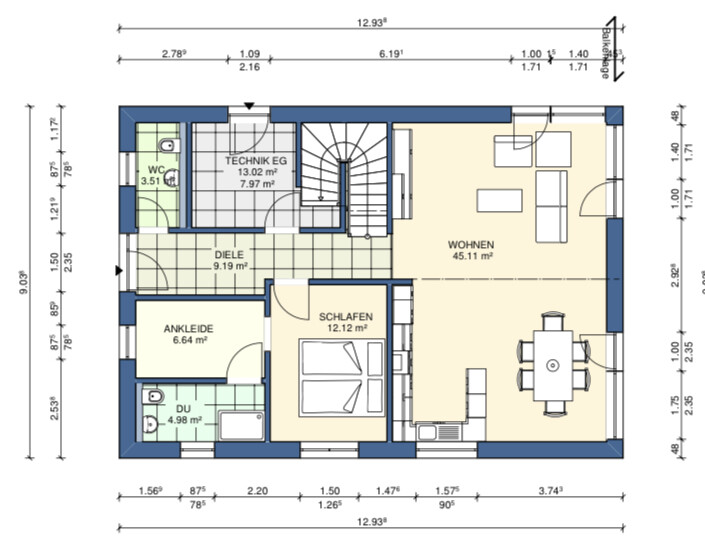
I am currently focused solely on the ground floor layout, as I've been stuck on this for weeks. We want to build barrier-free from the start and live on the ground floor, so the children have the first floor. Unfortunately, I can’t find any floor plans that match this requirement at all.
The consultant drew a floor plan for us, but I find the solution with the master bathroom awkward. Also, because the ground floor is so large, the upper floor becomes correspondingly big, even though we don’t need that much space there.
Maybe you have suggestions on how to improve this.
Thanks in advance
Development plan/restrictions
approx. 650sqm (33m (108 feet) wide, 22m (72 feet) deep) pure building land
no slope
2 floors
gable roof
Owners’ requirements
The exterior appearance does not matter to us at all
2 floors
no basement
2 adults & 2 children
office: home office
open architecture
modern construction
open kitchen, kitchen island
6 dining seats
fireplace
garage, carport
pool
smart home
KfW40+ standard
House design
Who created the design:
– Planner from a construction company
What do you particularly like? Why?
It is a clear floor plan and recognizable as such.
What do you not like? Why?
The living area seems too small, 2 bathrooms are not necessary.
Price estimate according to architect/planner: $480K
Personal price limit for the house, including furnishings: $600K
preferred heating technology: heat pump

First of all, may I ask how old you are?
We also initially wanted to build with our age in mind (43, 41, and 5), but eventually realized that we are building for now, not for 30 years from now. Accessibility can become necessary at any time, due to an accident or not at all.
It might be wiser to build in a way that makes living comfortable both now and in the medium term, and later suits the needs of your heirs.
Having a huge house in old age is usually impractical anyway.
Just a thought to consider.
We also initially wanted to build with our age in mind (43, 41, and 5), but eventually realized that we are building for now, not for 30 years from now. Accessibility can become necessary at any time, due to an accident or not at all.
It might be wiser to build in a way that makes living comfortable both now and in the medium term, and later suits the needs of your heirs.
Having a huge house in old age is usually impractical anyway.
Just a thought to consider.
 SumsumBiene13 Jul 2021 22:39
We viewed a house last week with a floor plan that we found well thought-out. It didn’t have an upper floor, but it did have a full basement.

Addendum. I have looked at the floor plan. And beforehand, I’m definitely not a floor plan expert—there are real professionals here.
My personal impression, however, is that for accessible living on the ground floor, everything seems far too small.
I would remove the dressing room, as it should be unnecessary if accessibility is a priority. Two toilets also seem like a waste of space in this case. Eliminating these two rooms would immediately provide significantly more room for a wheelchair and related needs while keeping the same overall floor area.
By the way, how wide are the doors, meaning the actual door leaf dimension?
My personal impression, however, is that for accessible living on the ground floor, everything seems far too small.
I would remove the dressing room, as it should be unnecessary if accessibility is a priority. Two toilets also seem like a waste of space in this case. Eliminating these two rooms would immediately provide significantly more room for a wheelchair and related needs while keeping the same overall floor area.
By the way, how wide are the doors, meaning the actual door leaf dimension?
Y
Ypsi aus NI13 Jul 2021 22:55I am very familiar with your challenges! We had planned a ground floor with extensions and only built over the main body on the upper floor. However, the exterior didn’t look quite convincing. We then put everything on hold. The floor plan just didn’t work for us, and then COVID happened. Since the exterior appearance doesn’t matter to you anyway, extensions could be an option.
This year, we started planning again: the ground floor as a rectangle, the upper floor built wall on wall, but with a knee wall, no bay window, instead a gallery – an open space on the upper floor – and a second utility room. This results in two sustainable, separable living units, which differ considerably in size due to the design. Upstairs is theoretically 30cm (12 inches) less in square meters than downstairs. It works for us; we’re planning two private rooms upstairs, whether each of us uses them for work, hobbies, or whatever else.
This year, we started planning again: the ground floor as a rectangle, the upper floor built wall on wall, but with a knee wall, no bay window, instead a gallery – an open space on the upper floor – and a second utility room. This results in two sustainable, separable living units, which differ considerably in size due to the design. Upstairs is theoretically 30cm (12 inches) less in square meters than downstairs. It works for us; we’re planning two private rooms upstairs, whether each of us uses them for work, hobbies, or whatever else.
N
nordanney13 Jul 2021 23:15Nagučki schrieb:
Maybe you have suggestions on how to solve this better.Only build barrier-free and age-appropriate when it is actually necessary. Or are you already around 60? In my opinion, anything else doesn’t make sense. I have different needs at different stages of life – so I build differently each time. The “jack of all trades” doesn’t exist (or at least not for about €480,000).Similar topics