
D
draekster4 Mar 2020 15:19Hello,
I am new to the forum and hope I have posted in the right section. If not, I kindly ask for your understanding and for a moderator to correct this.
Here is my situation:
We are currently building a house and have just received the first design from the architect for the building permit / planning permission. It includes raising the ground level around our future house by about one meter (3 feet). This is intended to provide backflow protection for the drainage system without the need for technical equipment. According to the wastewater authority, this solution is preferred, which I agree with.
However, this means that the adjacent garage will be about one meter (3 feet) lower, and a small staircase will need to be installed.
Since we are building our house to be barrier-free on the ground floor, the stairs are undesirable. We would also lose a passage space between the house and the garage, which we had planned to use for garden work. Our plan was to be able to drive a van, excavator, or similar vehicle through there.
The alternative to raising the ground level would be a technical backflow prevention device. From what I have read, it is advisable to include a lifting station as part of this. These systems require electricity (which is probably negligible) and need regular maintenance.
My questions are:
I am not yet fully clear on this topic, so I hope you can help me out.
I am new to the forum and hope I have posted in the right section. If not, I kindly ask for your understanding and for a moderator to correct this.
Here is my situation:
We are currently building a house and have just received the first design from the architect for the building permit / planning permission. It includes raising the ground level around our future house by about one meter (3 feet). This is intended to provide backflow protection for the drainage system without the need for technical equipment. According to the wastewater authority, this solution is preferred, which I agree with.
However, this means that the adjacent garage will be about one meter (3 feet) lower, and a small staircase will need to be installed.
Since we are building our house to be barrier-free on the ground floor, the stairs are undesirable. We would also lose a passage space between the house and the garage, which we had planned to use for garden work. Our plan was to be able to drive a van, excavator, or similar vehicle through there.
The alternative to raising the ground level would be a technical backflow prevention device. From what I have read, it is advisable to include a lifting station as part of this. These systems require electricity (which is probably negligible) and need regular maintenance.
My questions are:
- Is the technical solution practical?
- What are the costs involved? (I have seen figures around 2,500 Euros. Is this realistic?)
- What electricity costs should I expect? (I have only found one specific bill.)
- What about maintenance costs and maintenance intervals?
- How reliable is this technical equipment?
- What happens in case of a power outage?
I am not yet fully clear on this topic, so I hope you can help me out.

draekster schrieb:
Unfortunately, I still don’t fully understand the topic, so I hope you can help me here. We probably can, but thanks to your text without pictures and our overall lack of information about you and your project, we don’t fully understand either.
draekster schrieb:
It is planned to raise the ground around our future house by about one meter. No sewage lifting station can cost as much as raising a plot of land by one meter (about 3 feet).
https://www.instagram.com/11antgmxde/
https://www.linkedin.com/company/bauen-jetzt/
Whether this makes sense depends entirely on your requirements. If you want to avoid backfilling for accessibility reasons, then it will probably be a good solution. It’s not some fancy, modern pumping station. In Germany, drainage doesn’t always just flow downhill.
Costs vary greatly depending on whether wastewater and/or rainwater needs to be pumped, the size of the roof area, expected heavy rainfall amounts for the region, installation location (indoors/outdoors), and many other factors—too many open questions.
Once you have clarified the questions above, you will also know which pumps you need: single or double system (for reliability), flow rates, etc., and how to ensure backup power in case of a power outage.
From this, you can then calculate electricity costs: pump characteristic curves with flow rate and consumption, rainfall volume and/or wastewater per person per year, electricity price... It should be feasible.
A power outage would, of course, be, uh, bad. There are alarm systems with battery backup (remote alert) that send SMS notifications.
Costs vary greatly depending on whether wastewater and/or rainwater needs to be pumped, the size of the roof area, expected heavy rainfall amounts for the region, installation location (indoors/outdoors), and many other factors—too many open questions.
Once you have clarified the questions above, you will also know which pumps you need: single or double system (for reliability), flow rates, etc., and how to ensure backup power in case of a power outage.
From this, you can then calculate electricity costs: pump characteristic curves with flow rate and consumption, rainfall volume and/or wastewater per person per year, electricity price... It should be feasible.
A power outage would, of course, be, uh, bad. There are alarm systems with battery backup (remote alert) that send SMS notifications.
D
draekster5 Mar 2020 07:55Hi.
I admit the information is probably too sparse. But I also have to say that I actually have no idea which details are really necessary for this.
My main concern was more about a general idea of the scale we are talking about.
I basically want to tell my architect just “Yes, we build up the ground” or “No, we solve this technically.”
Thanks. That’s at least a statement I can work with. The technology itself isn’t a problem and nothing to be afraid of, right? That’s what I was hoping for.
I would still like a bit more information so I at least know what I’m getting into.
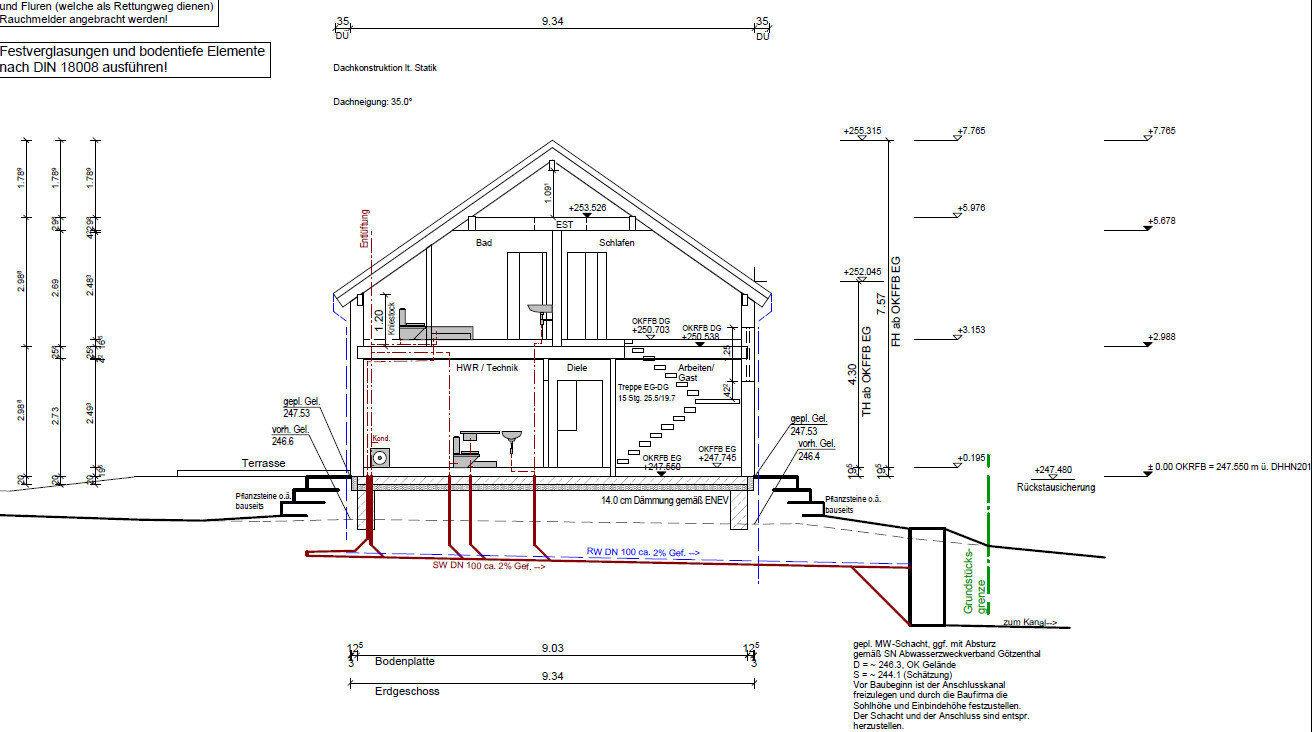
Here is the plan I have of the drainage system.
The house would be a single-family home with 155sqm (1670 sq ft) for 4 people.
If you need more information, please let me know what.
As I said, I don’t want a full design for this here. I would trust my architect for that. I just want to understand what I’m getting into.
I admit the information is probably too sparse. But I also have to say that I actually have no idea which details are really necessary for this.
My main concern was more about a general idea of the scale we are talking about.
I basically want to tell my architect just “Yes, we build up the ground” or “No, we solve this technically.”
teh_M schrieb:
If you don’t want to build up the ground because of accessibility requirements, then it will probably make sense. It’s not some kind of fancy, modern pumping station. It’s not always downhill everywhere in Germany.
Thanks. That’s at least a statement I can work with. The technology itself isn’t a problem and nothing to be afraid of, right? That’s what I was hoping for.
I would still like a bit more information so I at least know what I’m getting into.
Here is the plan I have of the drainage system.
The house would be a single-family home with 155sqm (1670 sq ft) for 4 people.
If you need more information, please let me know what.
As I said, I don’t want a full design for this here. I would trust my architect for that. I just want to understand what I’m getting into.
draekster schrieb:
I basically just want to tell my architect, "Yes, we will raise the ground level," or "No, we will solve it technically." Based on the drawing, I would say neither option; and if you are cautious, maybe 20 to 30 cm (8 to 12 inches), but definitely not a whole meter. It costs a fortune to bring in and spread soil for an almost waist-high (after compaction about 1 meter (3 feet)) fill. This is not paid by the clever ones, but by you.
https://www.instagram.com/11antgmxde/
https://www.linkedin.com/company/bauen-jetzt/
Similar topics