
Hello,
for our new build, we have installed an 8,000-liter (2,113-gallon) concrete rainwater cistern in the garden. Unfortunately, our property is below the backflow level, so we are initially required to protect everything against backflow. For the single-family house, this is handled by a Staufix FKA device.
In our municipality, there is a combined sewer system, meaning that, in theory, wastewater/sewage-contaminated water could flow back into the cistern. The cistern is located 1.2 m (4 feet) below the single-family house, so even if it were to overflow, it would not affect the house itself. However, the neighbor would not be very happy. Strictly speaking, I would therefore also need to protect the cistern electronically against backflow, but honestly, that seems a bit extreme to me... the one electronic backflow protection device has already caused me enough trouble 😀 The likelihood of backflow occurring there is very low anyway, but that’s not the topic here.
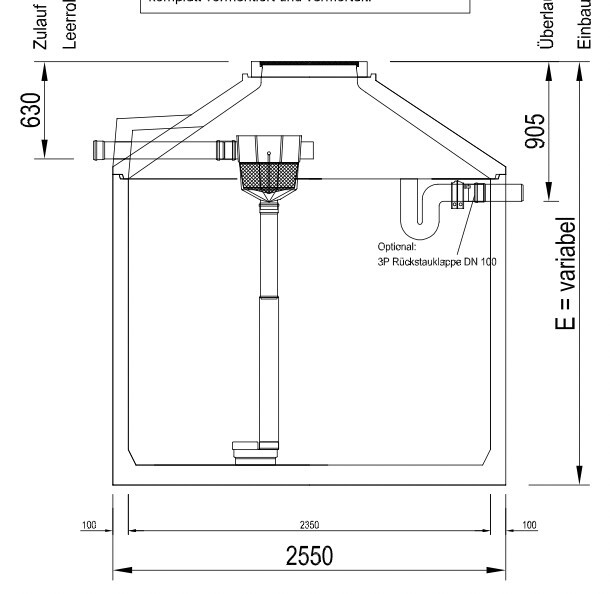
I would like to secure the cistern at least with a double flap valve (e.g., Staufix from Kessel). I have been wondering how best to do this. The manufacturer of the cistern, Finger, sent me the attached document.
However, this leads to two problems/questions for me:
1. In this position, the backflow flap valve is practically inaccessible, neither for maintenance nor for emergency closure.
2. The flap valve is located below the water surface when the cistern is full. Is that really correct?
My idea was to extend the outlet pipe inside, which would bring the whole system closer to the center, but it would also make it less stable.
Or is it not a problem if the flap valve is basically underwater?
for our new build, we have installed an 8,000-liter (2,113-gallon) concrete rainwater cistern in the garden. Unfortunately, our property is below the backflow level, so we are initially required to protect everything against backflow. For the single-family house, this is handled by a Staufix FKA device.
In our municipality, there is a combined sewer system, meaning that, in theory, wastewater/sewage-contaminated water could flow back into the cistern. The cistern is located 1.2 m (4 feet) below the single-family house, so even if it were to overflow, it would not affect the house itself. However, the neighbor would not be very happy. Strictly speaking, I would therefore also need to protect the cistern electronically against backflow, but honestly, that seems a bit extreme to me... the one electronic backflow protection device has already caused me enough trouble 😀 The likelihood of backflow occurring there is very low anyway, but that’s not the topic here.
I would like to secure the cistern at least with a double flap valve (e.g., Staufix from Kessel). I have been wondering how best to do this. The manufacturer of the cistern, Finger, sent me the attached document.
However, this leads to two problems/questions for me:
1. In this position, the backflow flap valve is practically inaccessible, neither for maintenance nor for emergency closure.
2. The flap valve is located below the water surface when the cistern is full. Is that really correct?
My idea was to extend the outlet pipe inside, which would bring the whole system closer to the center, but it would also make it less stable.
Or is it not a problem if the flap valve is basically underwater?
Similar topics