
ᐅ Avoid Mistakes When Building Your Second Home: Builder or Architect?
Created on: 13 Feb 2024 11:39
R
RotesDach
Hello forum,
In 2020, we built a new single-family home. However, for various reasons, we are not completely satisfied and are considering building again. We want to take our time with this (time frame 5-10 years) to be really sure about what exactly we want to change. In the meantime, we can also save more equity and observe everyday life with the children. From our experience, daily life with 3-4 children requires a lot of flexibility in the house because the needs of all family members seem to change quickly. That is why we have set quite a long time frame.
When we started planning the house in 2019, we didn’t always make the right decisions in hindsight. With the first and later the second child, and then the lockdown, we could not view or visit everything that was installed beforehand. Also, contact with the architect from the homebuilding company was quite limited. We often simply lacked proper advice.
My question to you is: How can we avoid making the same mistakes again in the next build? We always had to make decisions very quickly and often had no solid basis to decide. We would have liked to have quick access to prices and services; this just wasn’t available. For example, if we planned an additional window or increased the living area, we received a new total price and could only guess how much the extra cost was.
We found that the homebuilding company only builds in the way they usually do, meaning when we asked for something unusual, they said it wasn’t possible. For example, we wanted a large panoramic glass window wall that could slide open barrier-free. They said this wasn’t possible for structural reasons in our house. It seemed likely that our builder simply did not have this kind of feature in their program, or the profit margin on such a request was too low for them.
What frustrates me most is the roof. It is not usable as living space. It is a low pyramid roof made of nail plate trusses. There is not enough standing height for living space, and the structure is not suitable for conversion. We never discussed the roof with the architect at the time. The catalog house our free planning was based on originally had a gable roof—exactly what we would wish for today. The architect kept talking about a "town villa" we would be building, and we eventually adopted that term. As laypeople, we understood that as a house with two full floors. However, the architect from the building company implied a pyramid roof by "town villa." The change from the original gable roof to this non-convertible pyramid roof was never communicated to us, and we realized this far too late. Sure, you could say we should have noticed, but at some point, we just wanted to finish the project. The two-year construction period with two small children was really exhausting.
For the second build, we want to do everything right or make as few mistakes as possible, so we are allowing ourselves a much longer time for advance planning. We certainly will not build with the same homebuilding company again.
BUT: Is this the typical experience with standard (prefabricated) homebuilders? If you want something special like panoramic window walls, is it better to go to an architect? They are usually paid hourly. I worry that an architect might overall be the more expensive option. If we do go with a homebuilder, should we choose one that specializes in our style? For example, Huf-Haus comes to mind, but they are also very expensive.
Maybe someone here has had similar experiences with poor communication and advice, especially during the corona period?
Is there another solution besides a homebuilding company or an architect that we haven’t thought of? We just want to be involved in every decision and not be treated like we were the first time.
If what you want is above the average in size and features, does it make more sense economically to hire an architect than to modify a catalog house so much that it only ends up being more expensive?
Thanks for reading. I know this post is long.
In 2020, we built a new single-family home. However, for various reasons, we are not completely satisfied and are considering building again. We want to take our time with this (time frame 5-10 years) to be really sure about what exactly we want to change. In the meantime, we can also save more equity and observe everyday life with the children. From our experience, daily life with 3-4 children requires a lot of flexibility in the house because the needs of all family members seem to change quickly. That is why we have set quite a long time frame.
When we started planning the house in 2019, we didn’t always make the right decisions in hindsight. With the first and later the second child, and then the lockdown, we could not view or visit everything that was installed beforehand. Also, contact with the architect from the homebuilding company was quite limited. We often simply lacked proper advice.
My question to you is: How can we avoid making the same mistakes again in the next build? We always had to make decisions very quickly and often had no solid basis to decide. We would have liked to have quick access to prices and services; this just wasn’t available. For example, if we planned an additional window or increased the living area, we received a new total price and could only guess how much the extra cost was.
We found that the homebuilding company only builds in the way they usually do, meaning when we asked for something unusual, they said it wasn’t possible. For example, we wanted a large panoramic glass window wall that could slide open barrier-free. They said this wasn’t possible for structural reasons in our house. It seemed likely that our builder simply did not have this kind of feature in their program, or the profit margin on such a request was too low for them.
What frustrates me most is the roof. It is not usable as living space. It is a low pyramid roof made of nail plate trusses. There is not enough standing height for living space, and the structure is not suitable for conversion. We never discussed the roof with the architect at the time. The catalog house our free planning was based on originally had a gable roof—exactly what we would wish for today. The architect kept talking about a "town villa" we would be building, and we eventually adopted that term. As laypeople, we understood that as a house with two full floors. However, the architect from the building company implied a pyramid roof by "town villa." The change from the original gable roof to this non-convertible pyramid roof was never communicated to us, and we realized this far too late. Sure, you could say we should have noticed, but at some point, we just wanted to finish the project. The two-year construction period with two small children was really exhausting.
For the second build, we want to do everything right or make as few mistakes as possible, so we are allowing ourselves a much longer time for advance planning. We certainly will not build with the same homebuilding company again.
BUT: Is this the typical experience with standard (prefabricated) homebuilders? If you want something special like panoramic window walls, is it better to go to an architect? They are usually paid hourly. I worry that an architect might overall be the more expensive option. If we do go with a homebuilder, should we choose one that specializes in our style? For example, Huf-Haus comes to mind, but they are also very expensive.
Maybe someone here has had similar experiences with poor communication and advice, especially during the corona period?
Is there another solution besides a homebuilding company or an architect that we haven’t thought of? We just want to be involved in every decision and not be treated like we were the first time.
If what you want is above the average in size and features, does it make more sense economically to hire an architect than to modify a catalog house so much that it only ends up being more expensive?
Thanks for reading. I know this post is long.

WilderSueden schrieb:
And apart from that, the benefit of additional square meters is not linear. Moreover, the measure "square meter" itself is not linear; 1.00 square meter of floor area in one place cannot compensate for 1.00 square meter elsewhere. And square meters on paper are not the same as architects’ square meters. The concept of square meters is quite a curious thing. Now I wish the original poster insightful dreams about whether this might also apply, in principle, to panoramic windows.
https://www.instagram.com/11antgmxde/
https://www.linkedin.com/company/bauen-jetzt/
R
RotesDach17 Feb 2024 03:13@kbt09 Thanks for the floor plan. Yes, exactly, I think this way you can really make better use of the space. You don’t have to “waste” the full width over the entire length, for example, if you want the width for the kitchen but not for the living area, or vice versa.
Unfortunately, I can't manage to upload our floor plan here at the moment...
But our open-plan room is a rectangle with a net area of 5.50 x 10 m (18 x 33 ft). And it’s completely filled with furniture. I’d be happy to have even one square meter (about 10 square feet) of “empty” space where no furniture stands, just nothing or maybe only a rug.
Unfortunately, I can't manage to upload our floor plan here at the moment...
But our open-plan room is a rectangle with a net area of 5.50 x 10 m (18 x 33 ft). And it’s completely filled with furniture. I’d be happy to have even one square meter (about 10 square feet) of “empty” space where no furniture stands, just nothing or maybe only a rug.
R
RotesDach17 Feb 2024 03:19By the way, regarding the garage on the west side, it turned out that it does not cause any issues with the sunlight on the terrace. It gets very hot there in the summer and is quite sunny from around 2 p.m. The living area also receives natural light through the west-facing kitchen window and the glazing of the front door (also facing west).
Next time, I would follow the advice to make fuller use of the building envelope and design it a bit more elongated. Thanks for this tip, @ WilderSueden.
Next time, I would follow the advice to make fuller use of the building envelope and design it a bit more elongated. Thanks for this tip, @ WilderSueden.
R
RotesDach17 Feb 2024 03:2711ant schrieb:
Is this already the "Stockholm Syndrome," meaning you actually "like" having a loft-style open space instead of a separate bedroom — or would you even prefer a clothesline stretched diagonally as a room divider?So, you think the Stockholm Syndrome describes my behavior of coming to terms with a poorly planned master bedroom or convincing myself it’s fine? Hmm, I’m wondering if I would really save square meters by dividing our bedroom—which is just one large (multi-functional) space whose functions can be adapted repeatedly to our changing daily life (including with children)—into several separate rooms. I actually think that would create more circulation area, more walls, more doors, and more corners. Feel free to correct me if I’m wrong. But that’s the reasoning behind our preference for larger multi-purpose rooms rather than smaller rooms with more wall surfaces.R
RotesDach17 Feb 2024 03:33@kbt09 What does the upper floor look like with this floor plan, or is it a catalog home or yours? I actually find the ground floor quite suitable for us.
@RotesDach ... this was a floor plan I once created here as a "sketch" for a house situation. The total area is just under 150 sqm (1,615 sq ft) but designed for only 2 children. With the ground floor plan, I mainly wanted to show how smaller spaces for cooking/dining/living can be arranged. If you really become 6 people, for example, the sofa will be rather small, and you would need to enlarge the sofa/TV area.
But for completeness, here is also the upper floor (just click to enlarge)
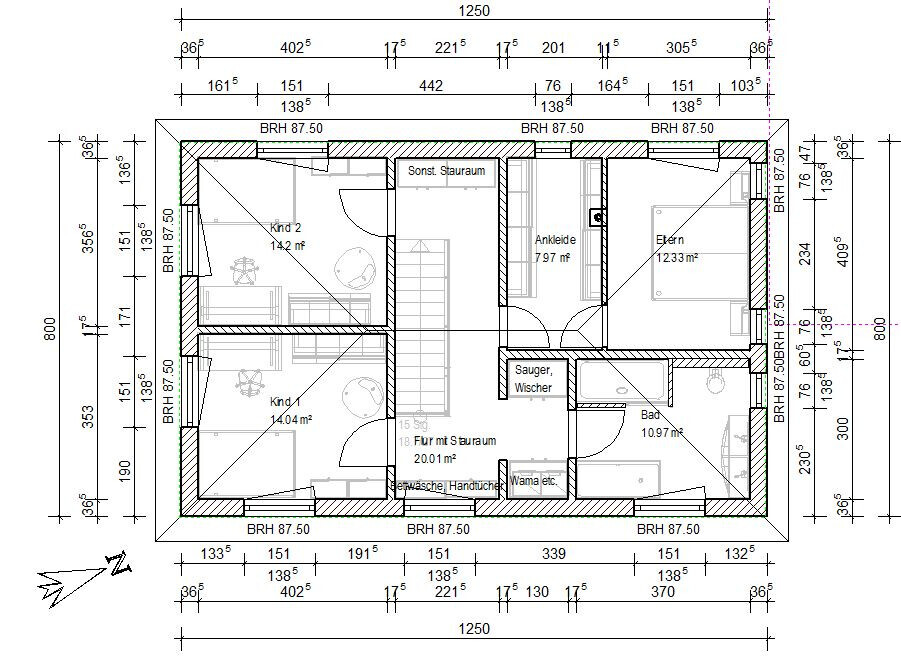
What you can see here is that quite a bit of storage space is created in the upper floor corridor as well. Washing machine etc. right in front of the bathroom.
In the ground floor corridor (I’m attaching it here again), for example, the storage space is a bit limited for 6 people.
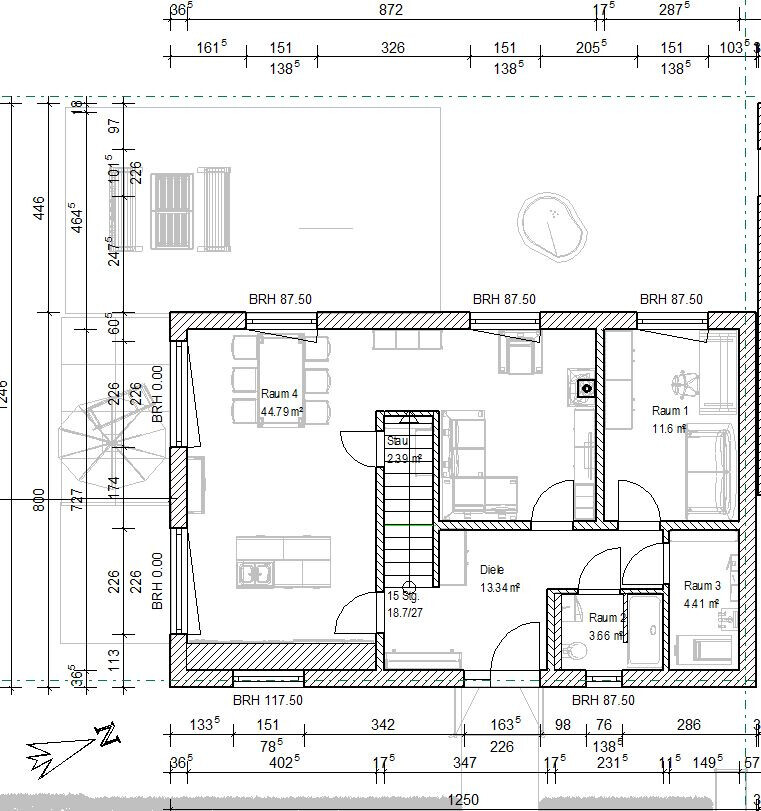
Overall, this is not a good model floor plan for you, but rather an inspiration, moving more toward a rectangular than a square basic shape. Because simply enlarging it is not easy.
And don’t forget, house design is always fundamentally oriented to the available plot of land.
Nevertheless, to get a better sense of spaces in floor plan views, you might now create scaled “paper cutouts” of your most important furniture, so everything you want to place. Then you can print out sample floor plans to the same scale and rearrange your furniture to get a better feeling for sizes. You can even recreate certain furniture arrangements in your own house, if needed with boxes, to get a live sense of distances etc. This is a good preparation for a new plan using a room checklist.
But for completeness, here is also the upper floor (just click to enlarge)
What you can see here is that quite a bit of storage space is created in the upper floor corridor as well. Washing machine etc. right in front of the bathroom.
In the ground floor corridor (I’m attaching it here again), for example, the storage space is a bit limited for 6 people.
Overall, this is not a good model floor plan for you, but rather an inspiration, moving more toward a rectangular than a square basic shape. Because simply enlarging it is not easy.
And don’t forget, house design is always fundamentally oriented to the available plot of land.
Nevertheless, to get a better sense of spaces in floor plan views, you might now create scaled “paper cutouts” of your most important furniture, so everything you want to place. Then you can print out sample floor plans to the same scale and rearrange your furniture to get a better feeling for sizes. You can even recreate certain furniture arrangements in your own house, if needed with boxes, to get a live sense of distances etc. This is a good preparation for a new plan using a room checklist.
Similar topics