
ᐅ Mounting a Satellite Dish on the Wall or the Roof? Timber Frame House
Created on: 25 Nov 2016 13:15
W
world-eHello everyone,
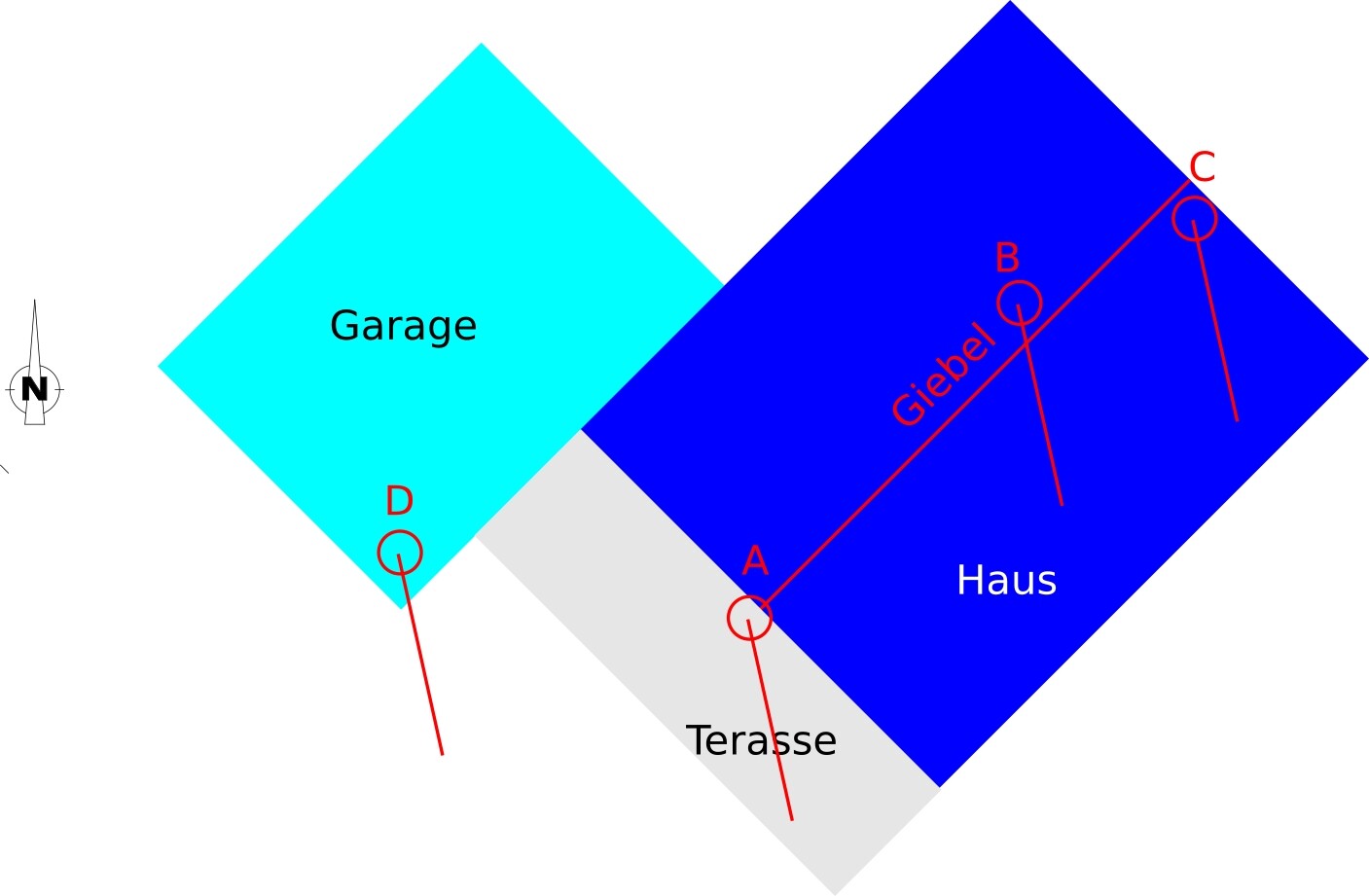
I would like to hear your opinions regarding the installation location of a satellite dish. The corner of the house between the eaves side and the gable side faces almost exactly south. The gable side faces southwest and the eaves side faces southeast. The house will have a pitched roof with two full stories and a 25° roof pitch, built with timber frame construction. Would you rather mount the satellite dish on the roof or on the wall? If the dish were attached to the gable, thermal bridges would probably be negligible since the roof is not insulated. But what about wind load? The externally applied wood fiber insulation panels are 120mm (5 inches) thick. With roof mounting, lightning protection would be more critical, and it would be harder to access. Thank you very much.
I would like to hear your opinions regarding the installation location of a satellite dish. The corner of the house between the eaves side and the gable side faces almost exactly south. The gable side faces southwest and the eaves side faces southeast. The house will have a pitched roof with two full stories and a 25° roof pitch, built with timber frame construction. Would you rather mount the satellite dish on the roof or on the wall? If the dish were attached to the gable, thermal bridges would probably be negligible since the roof is not insulated. But what about wind load? The externally applied wood fiber insulation panels are 120mm (5 inches) thick. With roof mounting, lightning protection would be more critical, and it would be harder to access. Thank you very much.
Alex85 schrieb:
"Professionals" always recommend mounting on the wall rather than the roof. I am an antenna expert and, depending on the specific case, I much more often recommend roof antennas rather than wall antennas. With 12 cm (5 inches) wall insulation, installing a wall bracket, for example using a THERMAX system, is significantly more complex than installing a rafter mount, which is also compatible with any future roof insulation.
Alex85 schrieb:
Easier to access, protected from weather/snow, no hassle bringing anything through the roof membrane, etc. The claim that the antenna is easier to access at the gable position planned by the original poster may or may not be true; stated so generally, that is wishful thinking.
In alpine regions, it might still make sense to install antennas under wide roof overhangs for snow protection. But where in flatland areas does it still snow so heavily that the antenna needs to be cleared regularly? With proper planning, access from a roof window can also be easier than from a façade window.
Antenna cables led through insulation in the roof or on the wall must be equally windproof. A professional resolves this easily and reliably without the need for makeshift solutions.
Alex85 schrieb:
What this means for a timber house, I don’t know. The creators of the so-called safe protection zone on façades according to IEC 60728-11, defined as ≥ 2 m (6.6 feet) distance below the roof edge/gutter and a maximum 1.5 m (5 feet) from the wall, most likely did not consider soft roof coverings or timber construction.
Preventive safety notice:
Antennas installed outside the defined safe façade zone must be capable of carrying lightning current and must be connected and grounded to the building’s equipotential bonding system.
One more addition:
Option A is not very popular with my partner because the satellite dish would be too visible from the terrace. The same issue would likely apply to option D. Perhaps option B would be better after all. Or on the garage, but that could cause sealing problems if the satellite dish is placed on the flat roof, and it would also require longer cable runs.
Option A is not very popular with my partner because the satellite dish would be too visible from the terrace. The same issue would likely apply to option D. Perhaps option B would be better after all. Or on the garage, but that could cause sealing problems if the satellite dish is placed on the flat roof, and it would also require longer cable runs.
S
Schrauberking29 Jan 2017 18:40You can address the issue of thermal bridging by using the appropriate type of anchor. For wind load and varying forces, I would recommend fastening to the exterior facade. This will deliver as promised. It is primarily designed for awnings and other heavy loads. Keep in mind: drilling properly into brick (if present) is half the battle.
Similar topics