
Hello everyone,
I’m not sure if this is the right place or if someone can help me.
We recently completed the renovation/refurbishment of our house (built in 1990).
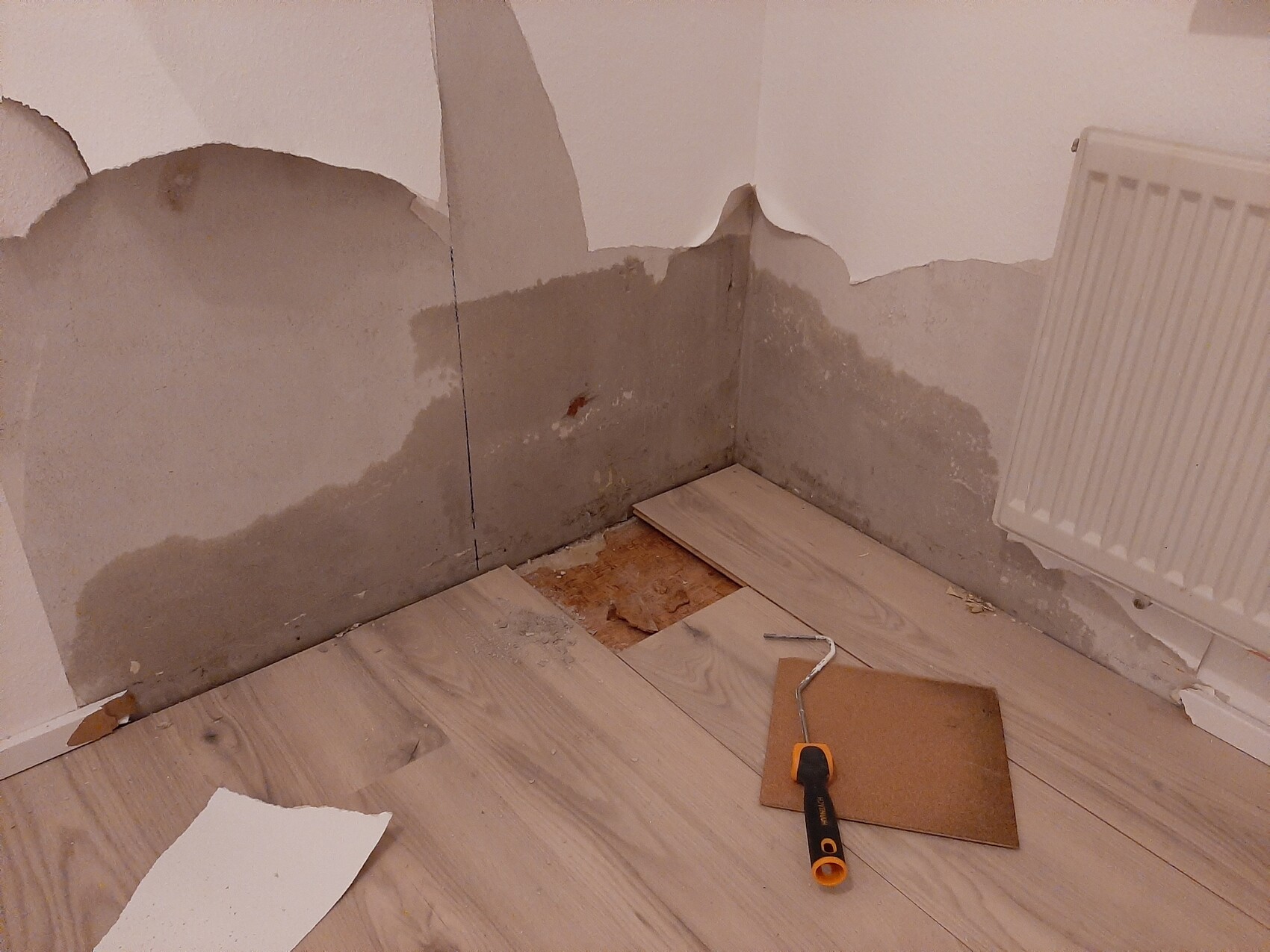
Today, while making the beds in the master bedroom, I noticed that the pillows resting directly against the wall were damp. We moved the bed and found black mold in the corner of the room. We removed the wallpaper and the plaster underneath was soaking wet.
I don’t know—probably the attached picture won’t help much. But maybe someone can still assist us? Is this purely condensation, or could it be an issue with the pipes or other structural defects?
The boundary between the dry and damp wall is very distinct. Behind this wall is the bathroom with a newly installed walk-in shower (done by a professional). The right wall is an exterior wall. Also, the entire corner is above an extension—so the floor there is essentially an exterior wall as well.
Can anyone help us?
I’m not sure if this is the right place or if someone can help me.
We recently completed the renovation/refurbishment of our house (built in 1990).
Today, while making the beds in the master bedroom, I noticed that the pillows resting directly against the wall were damp. We moved the bed and found black mold in the corner of the room. We removed the wallpaper and the plaster underneath was soaking wet.
I don’t know—probably the attached picture won’t help much. But maybe someone can still assist us? Is this purely condensation, or could it be an issue with the pipes or other structural defects?
The boundary between the dry and damp wall is very distinct. Behind this wall is the bathroom with a newly installed walk-in shower (done by a professional). The right wall is an exterior wall. Also, the entire corner is above an extension—so the floor there is essentially an exterior wall as well.
Can anyone help us?
 bauenmk202030 Sep 2021 14:00
I would definitely start by taking photos of all adjacent rooms and, if possible, the exterior views to document the current condition.
If you can, check the water pipe routes to see if any run through the affected area.
Then, expose the floor where it is damp underneath, and if possible, allow it to dry or consider installing new panels right away. After that, I would get in touch with the insurance company, if you have a relevant policy. They might be able to guide you on the next steps.
If you can, check the water pipe routes to see if any run through the affected area.
Then, expose the floor where it is damp underneath, and if possible, allow it to dry or consider installing new panels right away. After that, I would get in touch with the insurance company, if you have a relevant policy. They might be able to guide you on the next steps.