
ᐅ Assessment of a Sloping Site and Basic Considerations for the Floor Plan
Created on: 13 Feb 2019 22:05
N
Nailix1
Zoning Plan / Restrictions
Plot size: 566 m2 (6,094 sq ft)
Slope: Yes
Floor area ratio (FAR): 0.4
Gross floor area ratio (GFAR): 0.7
Building envelope, building line, and boundary
Edge development: Garage only
Number of parking spaces: 2
Number of stories permitted: Maximum 2 full floors
Roof type: Gable roof, 22°
Style direction
Orientation: South
Maximum heights / limits: Ground floor + 1: max. wall height 6.8 m (22 ft); Ground floor + attic max. wall height 4.8 m (16 ft)
Additional requirements
Client Requirements
Style, roof type, building type: Single-family house with gable roof
Basement, number of floors: No basement, 2 full floors
Number of occupants, ages: 4 persons, ages 33, 33, 2, 0
Space requirements on ground floor and upper floor
Office: Family use or home office? Study on the ground floor, large practice room on the ground floor
Overnight guests per year: 0
Open or closed architecture: ?
Conservative or modern construction: ?
Open kitchen, island: see floor plan
Number of dining seats: 1
Fireplace: Yes
Music / stereo wall: TV in the living room
Balcony, roof terrace: Balcony
Garage, carport: Carport (limited space…)
Utility garden, greenhouse: No
Additional wishes / special features / daily routine, also reasons why something should or should not be included
House Design
Who designed the plan: By me (don’t hit me!!)
What do you particularly like? Why? Living on one level (upper floor).
What do you not like? Why? Paths from living area to the garden.
Estimated cost according to architect/planner: ?
Personal price limit for the house, including equipment: 300,000
Preferred heating technology: Gas condensing boiler and solar thermal on the roof, underfloor heating, (water-bearing) wood stove
If you have to give up something, which details / extensions could you do without?
- Difficult to say
Why is the design like it is now? For example:
Whim born from boredom, professional advice has not yet taken place.
What is the most important / fundamental question about the floor plan summarized in 130 characters?
Which basics might I have completely misunderstood or insufficiently considered due to lack of expertise?
Also: Is it even possible to “bury” the house in such a way that I can access the upper part of the garden directly from the upper floor, or does the slope not allow this? (--> see “ZoningPlan.jpg”)
The blue line in the 3D views should represent the building boundaries.
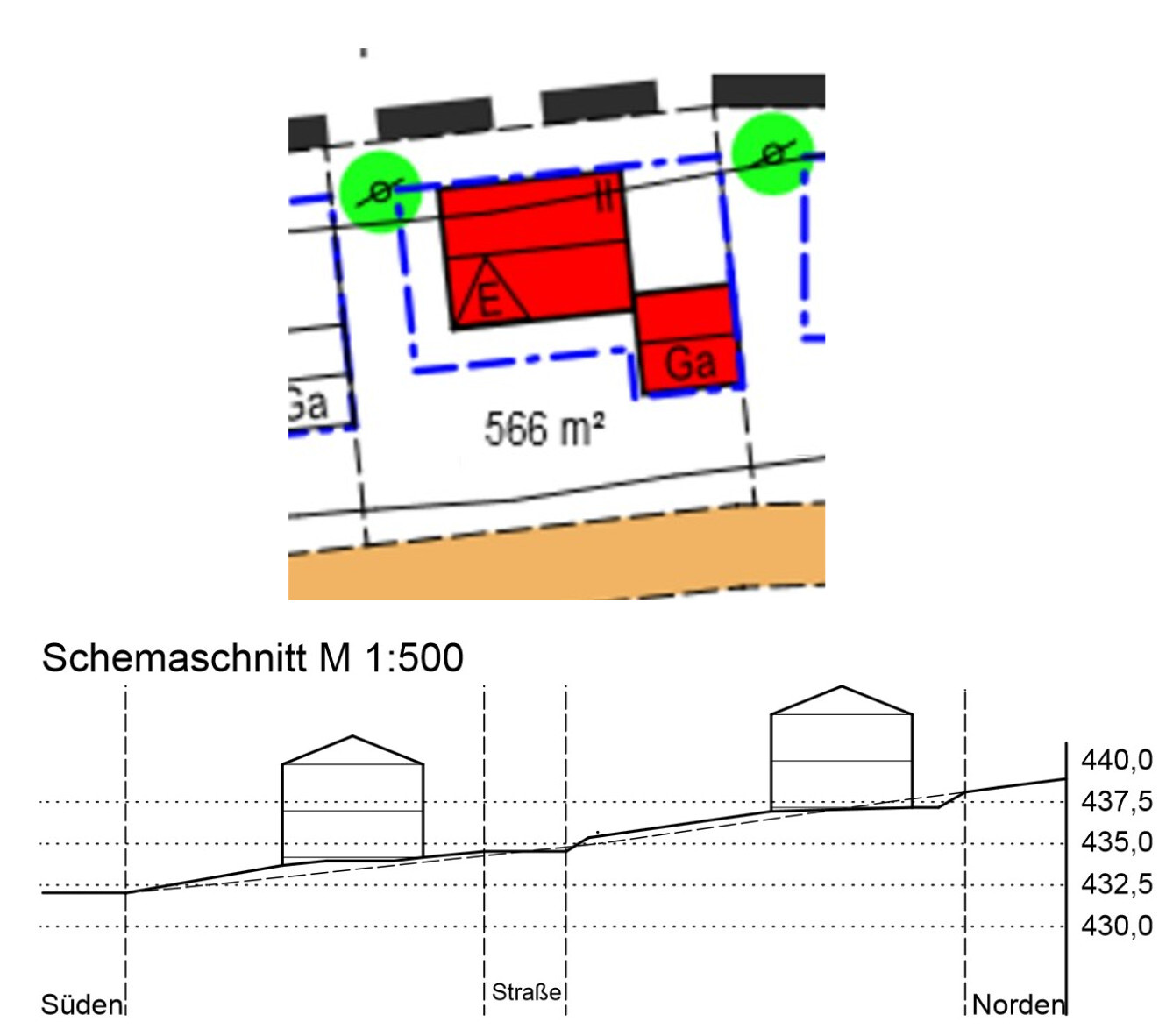
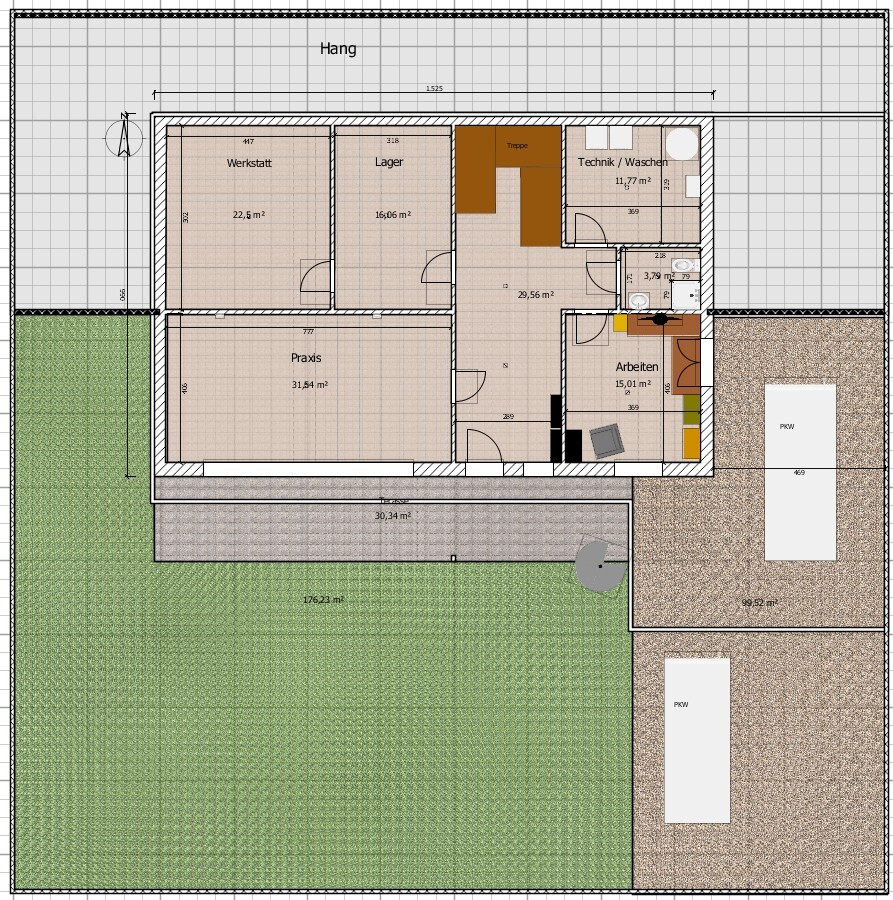
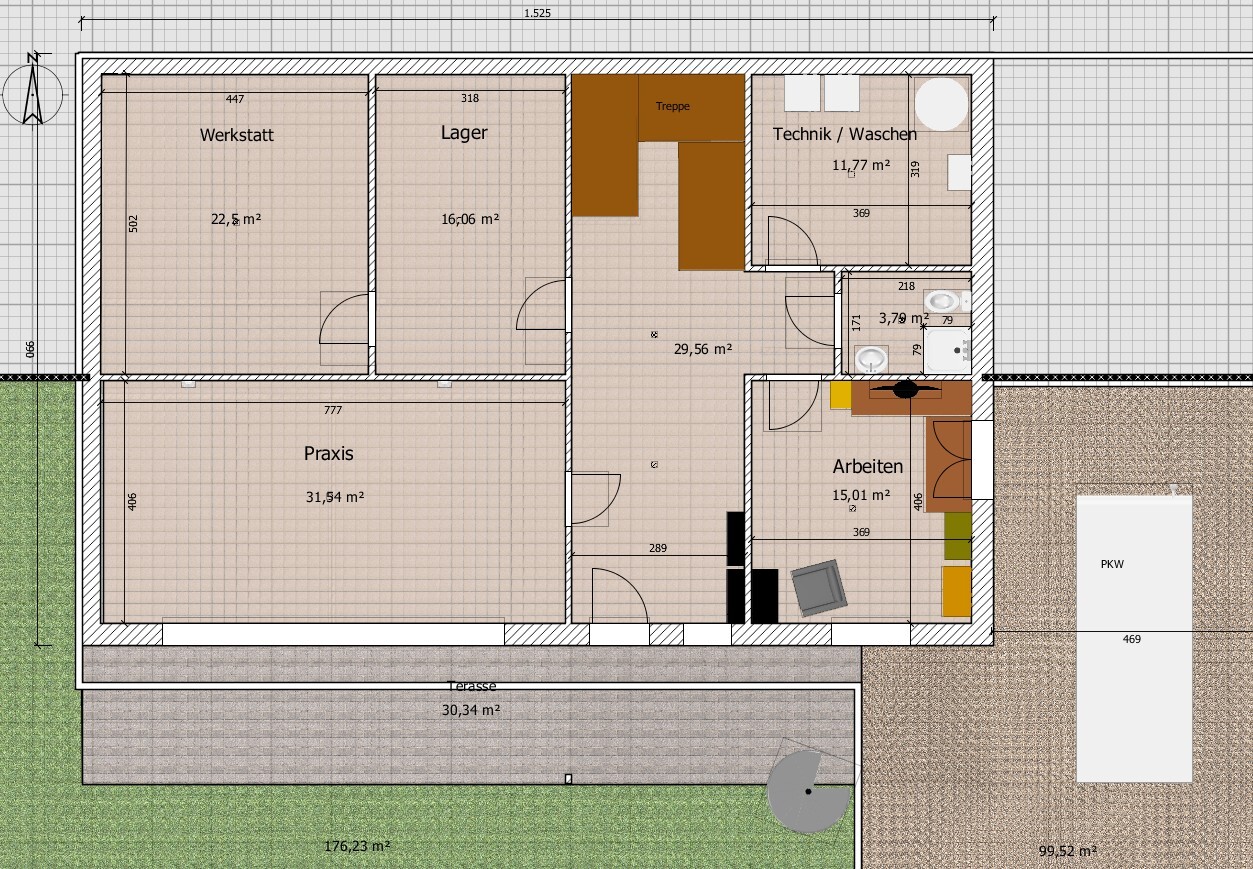
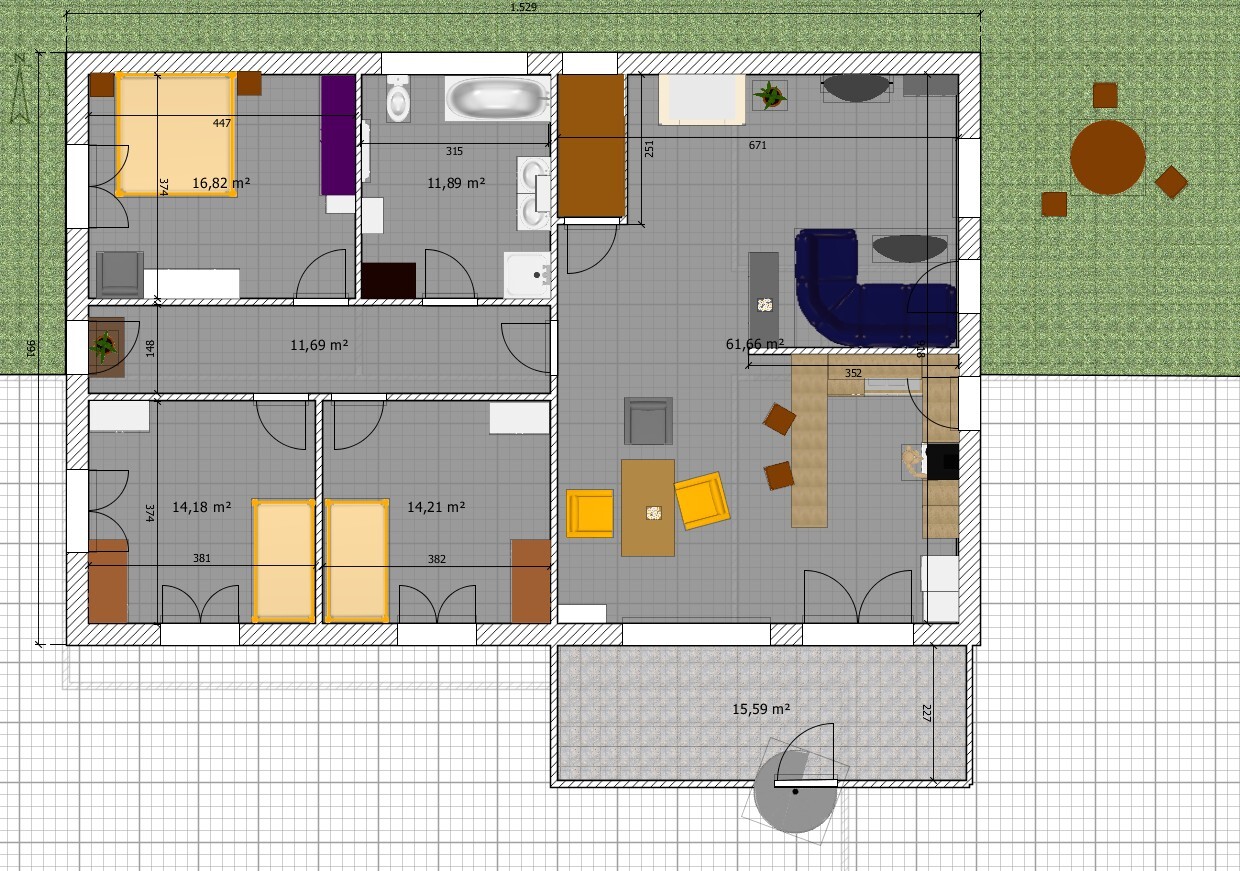
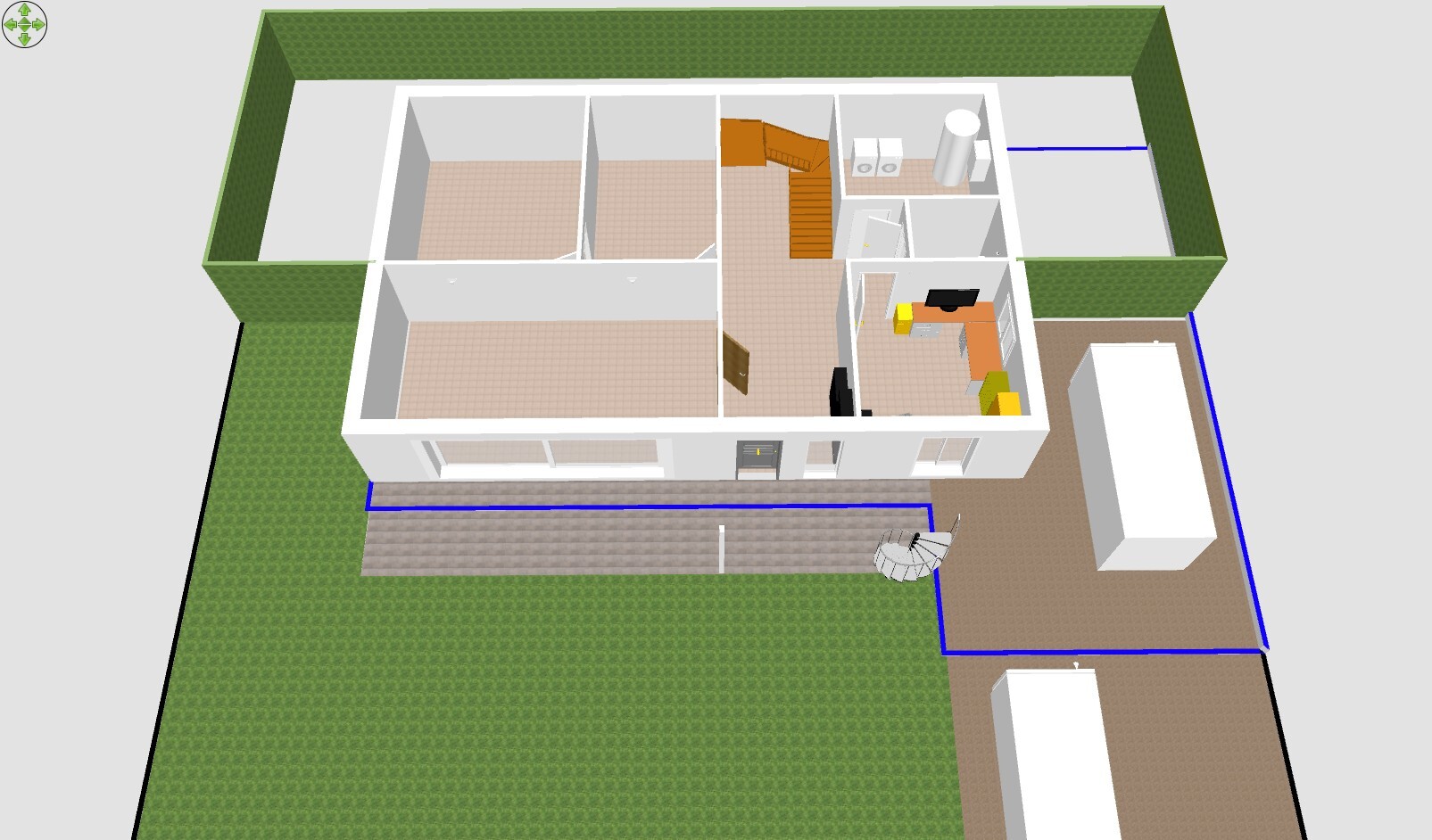
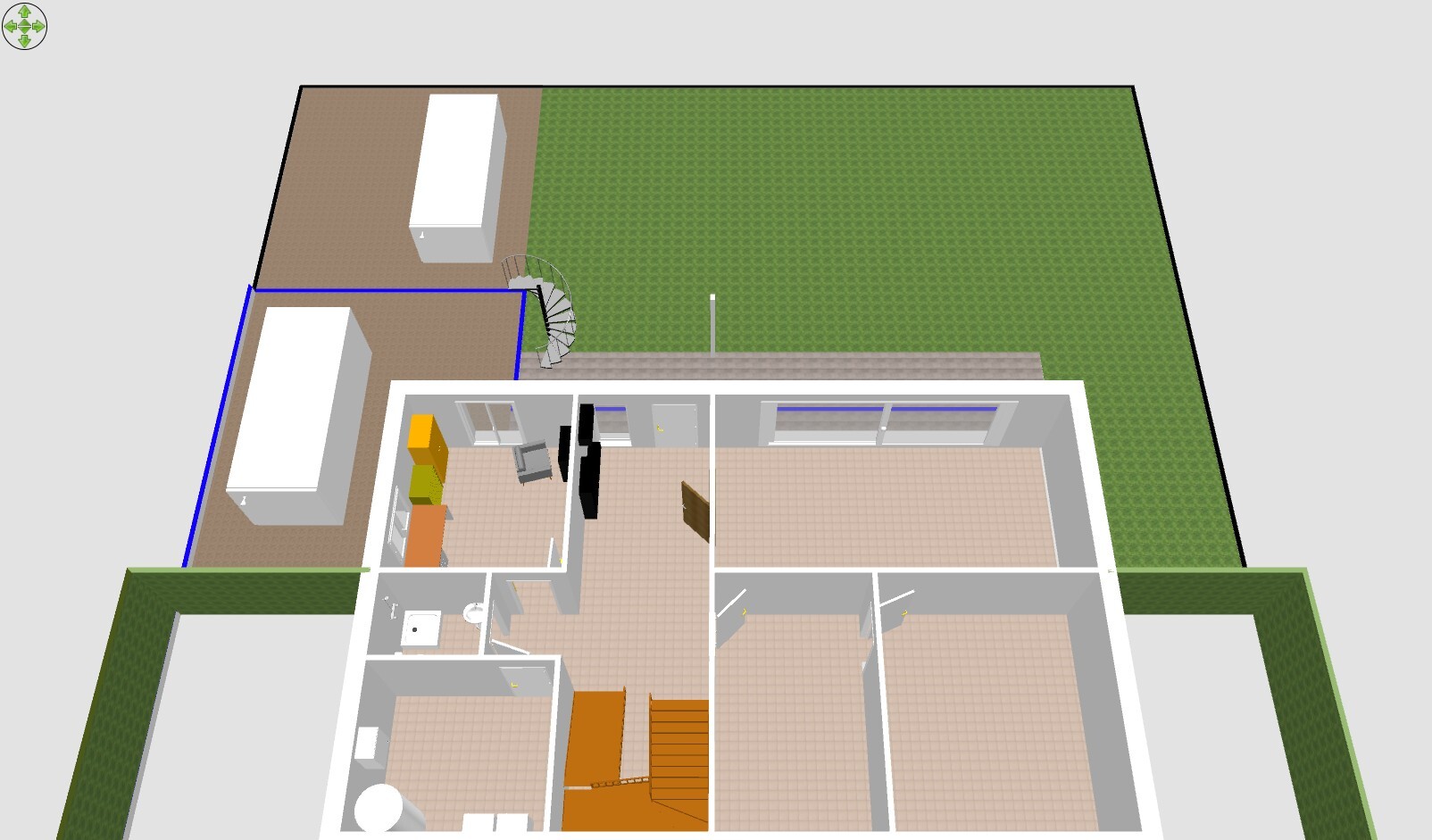
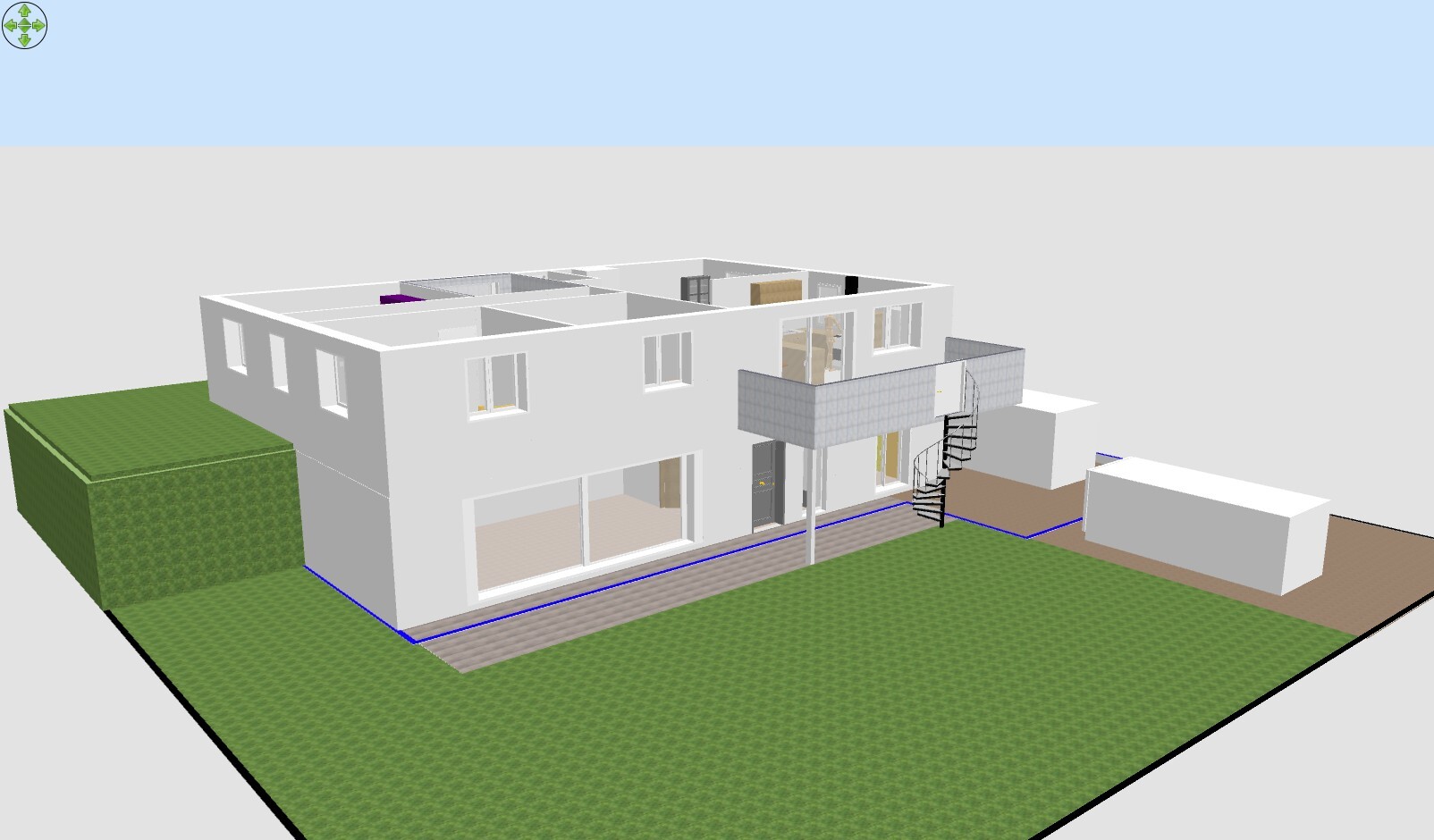
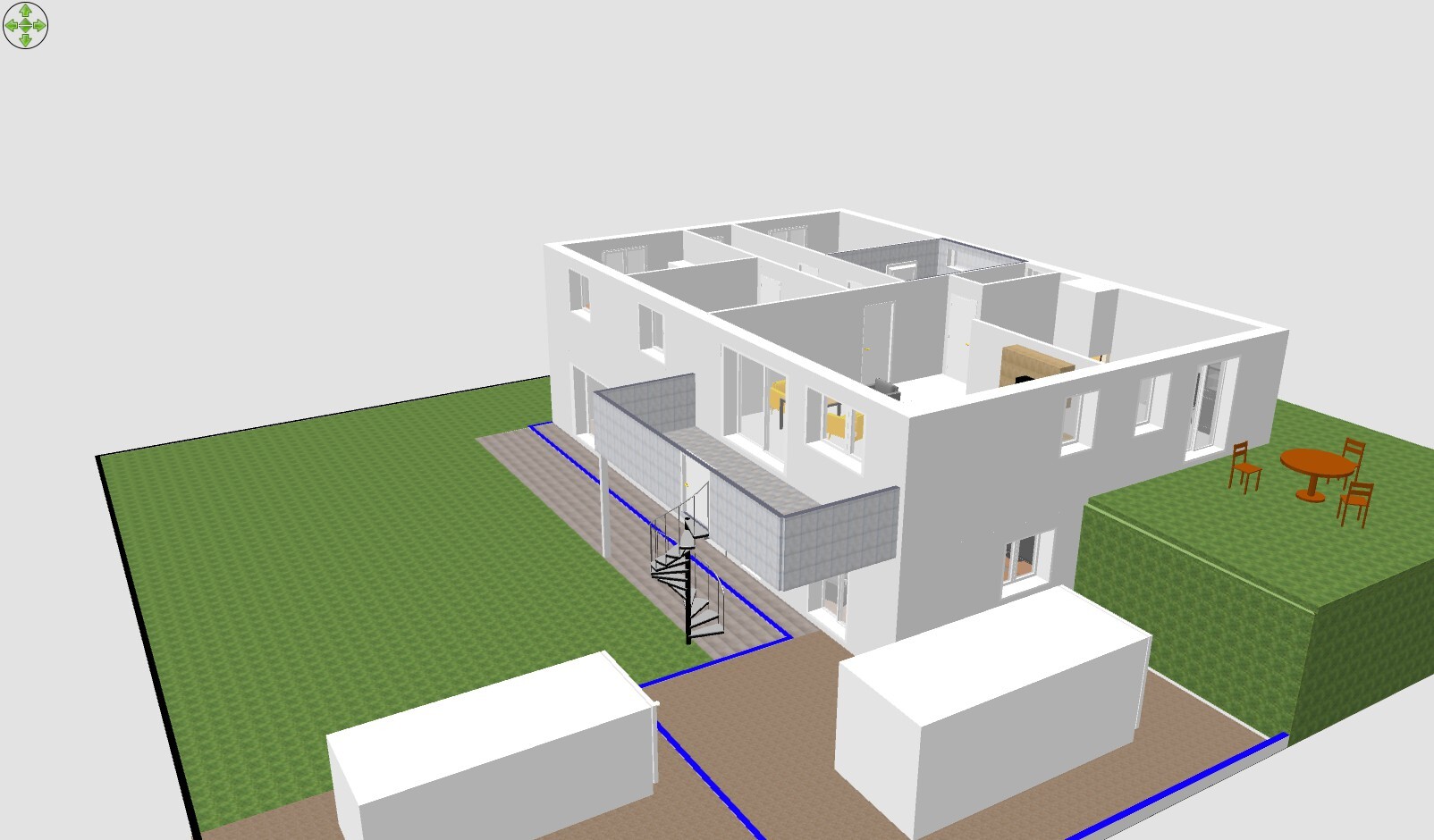
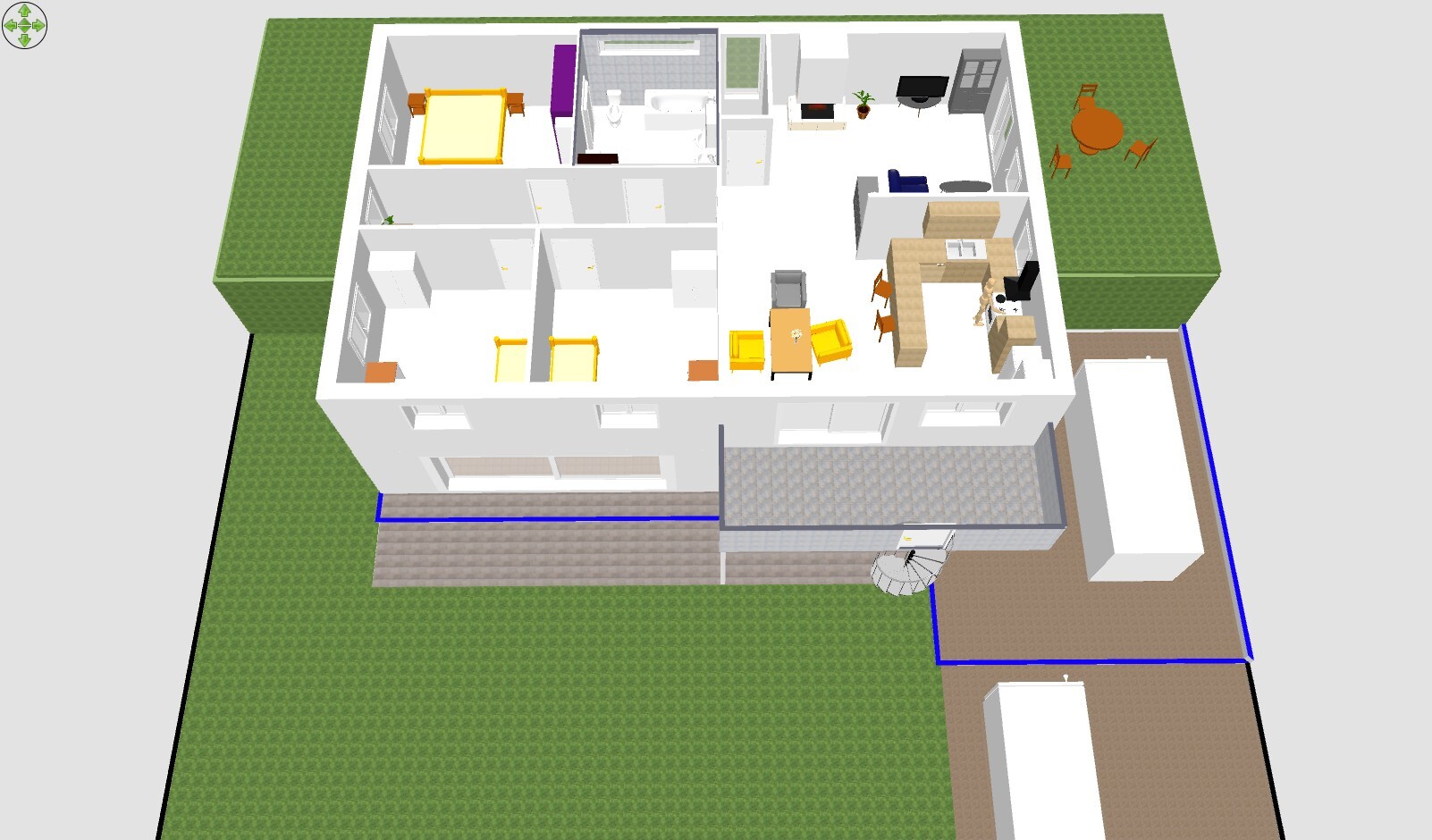
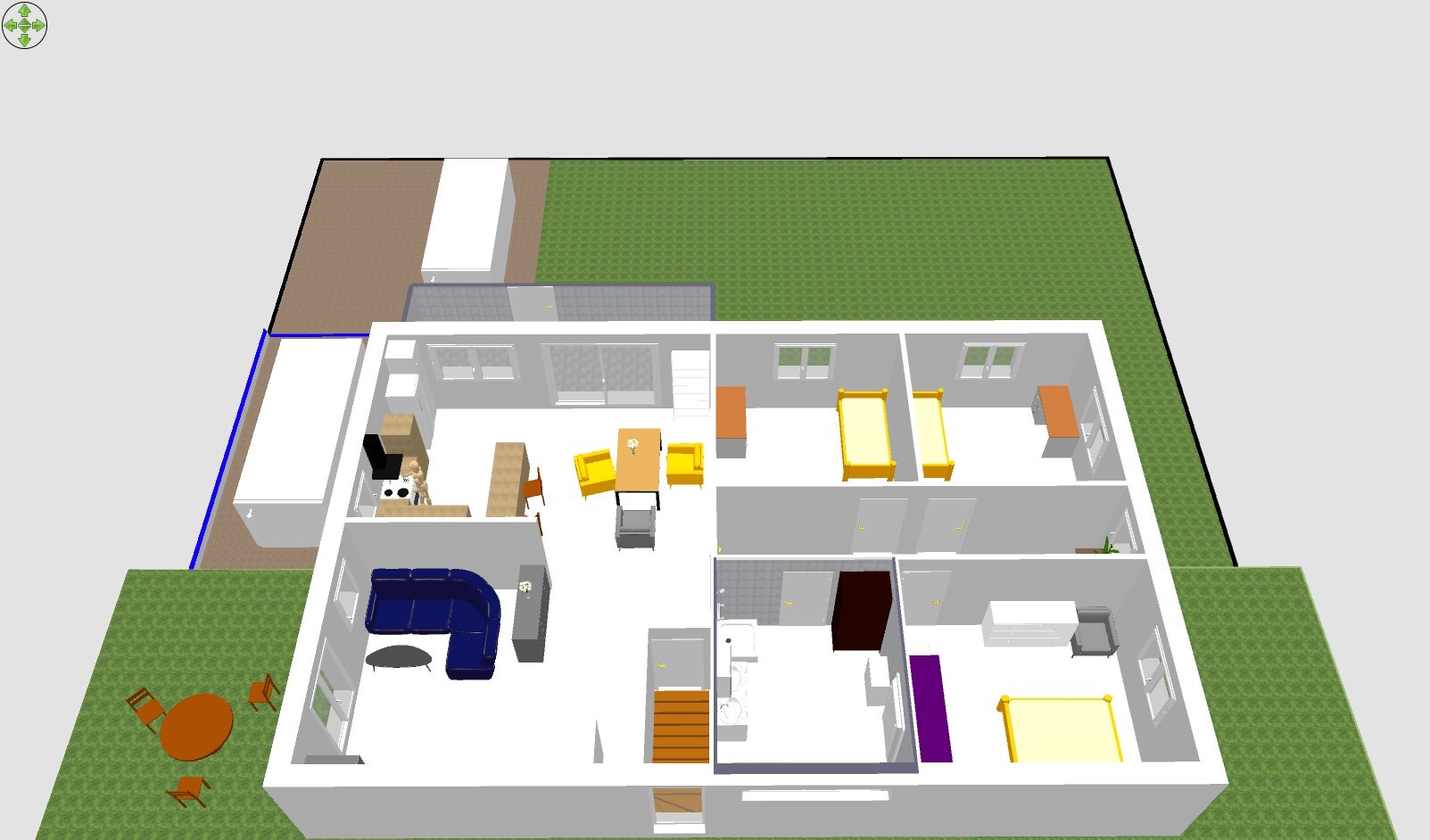
Plot size: 566 m2 (6,094 sq ft)
Slope: Yes
Floor area ratio (FAR): 0.4
Gross floor area ratio (GFAR): 0.7
Building envelope, building line, and boundary
Edge development: Garage only
Number of parking spaces: 2
Number of stories permitted: Maximum 2 full floors
Roof type: Gable roof, 22°
Style direction
Orientation: South
Maximum heights / limits: Ground floor + 1: max. wall height 6.8 m (22 ft); Ground floor + attic max. wall height 4.8 m (16 ft)
Additional requirements
Client Requirements
Style, roof type, building type: Single-family house with gable roof
Basement, number of floors: No basement, 2 full floors
Number of occupants, ages: 4 persons, ages 33, 33, 2, 0
Space requirements on ground floor and upper floor
Office: Family use or home office? Study on the ground floor, large practice room on the ground floor
Overnight guests per year: 0
Open or closed architecture: ?
Conservative or modern construction: ?
Open kitchen, island: see floor plan
Number of dining seats: 1
Fireplace: Yes
Music / stereo wall: TV in the living room
Balcony, roof terrace: Balcony
Garage, carport: Carport (limited space…)
Utility garden, greenhouse: No
Additional wishes / special features / daily routine, also reasons why something should or should not be included
House Design
Who designed the plan: By me (don’t hit me!!)
What do you particularly like? Why? Living on one level (upper floor).
What do you not like? Why? Paths from living area to the garden.
Estimated cost according to architect/planner: ?
Personal price limit for the house, including equipment: 300,000
Preferred heating technology: Gas condensing boiler and solar thermal on the roof, underfloor heating, (water-bearing) wood stove
If you have to give up something, which details / extensions could you do without?
- Difficult to say
Why is the design like it is now? For example:
Whim born from boredom, professional advice has not yet taken place.
What is the most important / fundamental question about the floor plan summarized in 130 characters?
Which basics might I have completely misunderstood or insufficiently considered due to lack of expertise?
Also: Is it even possible to “bury” the house in such a way that I can access the upper part of the garden directly from the upper floor, or does the slope not allow this? (--> see “ZoningPlan.jpg”)
The blue line in the 3D views should represent the building boundaries.
Nailix1 schrieb:
Ahh... I’m bumping my head, aren’t I? But that fits perfectly. It’s well known to increase thinking ability.
We deliberately planned for it to lead into the living room. Although we’re still a bit uncertain about that, yes.
I think that would work. Besides skis, tents, and so on, it should also store beverage crates, milk, etc. I wouldn’t want to always have to go through the workshop for that.
Glad to hear that. Where and how would you reduce the size of the house if you look at the living floor upstairs? To me, it doesn’t seem overly spacious right now (children’s room 14m² (150 sq ft), bedroom 16m² (172 sq ft)...
Would you rather save space in the living/dining/kitchen area?
I have two floors with living-quality rooms. That should fit then 🙂
I thought about doing most of the ground floor myself since it’s not immediately needed for living purposes.
So moving in first and then painting, laying tiles, and making the ground floor “nice and cozy.” Too crazy?
So I’d have to reduce the house from about 300m² (3,229 sq ft) to 200m² (2,153 sq ft) to get down to around 300,000€. As asked above: what’s the best way to do that?
The rooms are needed, including the workshop.
I’m uncertain about that. On one hand, I’m thinking the building limits lie quite far to the north on the plot. On the other hand, I’d like to be able to exit to the outside from the upper floor... If I don’t set it deep enough into the slope, it won’t work. Or are there good options?
Thanks for your feedback! 🙂 Just to clarify for me.
What budget do you have for the house, additional construction costs, exterior landscaping, and furnishings?
The 2,000€/m² (186 €/sq ft) refers only to the bare house, without groundwork, drainage, land shaping, exterior landscaping, utility connections, etc.
So as if the house were hanging in the air.
Escroda schrieb:
If you want to include the legal building aspects in the discussion, a larger excerpt from the drawing section of the development plan and the complete textual regulations would be necessary, or alternatively some guidance (no links) on where the plan can be viewed online.
I assume that garages outside the buildable area are not permitted. The balcony and the external staircase definitely are not.
Is the pitched roof with a 22° fixed?
Do the wall heights apply to all plots alternatively, or is the building type ground floor plus one or ground floor plus attic plot-specific?
How is the height reference point defined?
The solid lines in the development plan excerpt are presumably contour lines. Are there corresponding numerical values?
Does the terrain rise continuously, or are there significant faults? The Normalhöhennull (NHN) heights at the plot corners and the building window corners would be helpful.The terrain rises fairly continuously. I don’t have NHN heights at the corners...
My personal opinion: You can only proceed with the floor plan after conducting a soil analysis so you know how expensive excavation and disposal will be; not before that. I easily see over 1,000 cubic meters (1,310 cubic yards) of soil that will need to be removed and disposed of. With the best soil quality, that alone will cost over €30,000 (approximately $32,000), and that’s just for removing the earth. If the soil quality is a class lower, expect costs to rise to around €60,000 (approximately $64,000).
You can calculate yourself how much excavation will be necessary, and don’t forget, it’s not just the basement area but also a lot of excavation around it, possibly extending to the southern boundary.
Additionally, you won’t know how your neighbor builds. If you excavate but your neighbor doesn’t, you will have to cover the costs of supporting the terrain on both sides yourself. For example, I pay an additional €30,000 (approximately $32,000) for this.
As attractive as a hillside location is, it’s not affordable for every budget.
That’s why it’s important to clarify the maximum overall budget!
You can calculate yourself how much excavation will be necessary, and don’t forget, it’s not just the basement area but also a lot of excavation around it, possibly extending to the southern boundary.
Additionally, you won’t know how your neighbor builds. If you excavate but your neighbor doesn’t, you will have to cover the costs of supporting the terrain on both sides yourself. For example, I pay an additional €30,000 (approximately $32,000) for this.
As attractive as a hillside location is, it’s not affordable for every budget.
That’s why it’s important to clarify the maximum overall budget!
Zaba12 schrieb:
Just to clarify for myself.
How much budget do you have for the house, additional construction costs, landscaping, and furnishings?
The 2000€/m² (2000 €/sq ft) only refers to the bare house, excluding groundwork, drainage, land grading, landscaping, utility connections, etc.
So, as if the house were hanging in the air.Well... Actually, the 300,000€ (300,000 USD) should cover everything. I wanted to keep 40,000€ (40,000 USD) reserved for unforeseen expenses. I'm a rather cautious person. But maybe that amount will just be for all the additional costs...
So far, I have been thinking more in terms of developer-scale projects. In those cases, I assumed that additional construction costs, connections, furnishings, etc. were included.
I really didn’t expect the excavation work to be that expensive...
Sorry, then it won’t be this plot and not this floor plan either. An all-in price of €350,000 (approx. $370,000) is not possible. Not even with subsidies and a smaller floor plan. For that budget, you can expect about 150 sqm (1,615 sq ft) all-in on a flat plot, if at all. No more than that.
Hopefully, you haven’t bought the plot yet.
Hopefully, you haven’t bought the plot yet.
M
Mottenhausen14 Feb 2019 10:21The application process for the plots "wohnen am hopfenweg süd" in Mainburg is still ongoing, or have you already received an approval?
I assume it’s not too late yet. With the comparatively reasonable price of €200 per square meter (about $200 per square meter) and only a 25-minute drive from Ingolstadt, there will definitely be many applicants. The chance of actually getting a plot is close to zero since there is nothing affordable left in Ingolstadt. But Mainburg is quite clever and sets income and asset limits, meaning that the wives of Audi engineers and managers now have to buy the plots themselves and cleverly restructure their unauthorized “assets” beforehand. What a hassle.
Anyway, the plots will cost around €150,000 (about $150,000), you have €300,000 (about $300,000) for the house, and you’ll need €100,000 (about $100,000) for all additional building/purchasing costs and the “extras.” I think that should be enough to get started. Near Ingolstadt, €2,000 per square meter (about $2,000 per square meter) won’t be sufficient anymore; construction companies know what they can charge. So it will probably be a smaller house around 140 square meters (about 1,500 square feet), but that’s okay—you can be happy living in that!
I assume it’s not too late yet. With the comparatively reasonable price of €200 per square meter (about $200 per square meter) and only a 25-minute drive from Ingolstadt, there will definitely be many applicants. The chance of actually getting a plot is close to zero since there is nothing affordable left in Ingolstadt. But Mainburg is quite clever and sets income and asset limits, meaning that the wives of Audi engineers and managers now have to buy the plots themselves and cleverly restructure their unauthorized “assets” beforehand. What a hassle.
Anyway, the plots will cost around €150,000 (about $150,000), you have €300,000 (about $300,000) for the house, and you’ll need €100,000 (about $100,000) for all additional building/purchasing costs and the “extras.” I think that should be enough to get started. Near Ingolstadt, €2,000 per square meter (about $2,000 per square meter) won’t be sufficient anymore; construction companies know what they can charge. So it will probably be a smaller house around 140 square meters (about 1,500 square feet), but that’s okay—you can be happy living in that!
Similar topics