

Hello everyone,
We have received a quote for a photovoltaic system on the roof of our single-family house planned for next year.
Our plan is to fully cover the south-facing roof.
The house measures approximately 9 x 12 m (30 x 40 feet) with the roof ridge running along the longer side, featuring a gable roof with a 45-degree pitch. There will be no roof overhang and one dormer.
You can find a floor plan of the attic with the basic dimensions attached. The photovoltaic system will be installed on the roof shown in the floor plan with the single dormer, not on the side with the two dormers.
What surprises us about the quote is that the supplier calculates a photovoltaic area of 45.8 sqm (493 sq ft), or 28 modules (just to be clear, photovoltaic area, not roof area), which results in a system size of 8.8 kWp according to the offer.
I won’t say what I calculated for the roof area myself (I’m really bad at math, but there are online calculators for that), but it seems to us that the system could be much larger based on the roof size. The original goal was to fully utilize at least 10 kWp or more. Does the dormer really take up that much space?
Additionally, our architect mentioned that there may be regulations regarding minimum distances to the roof edge and the dormer or something similar — is that possible?
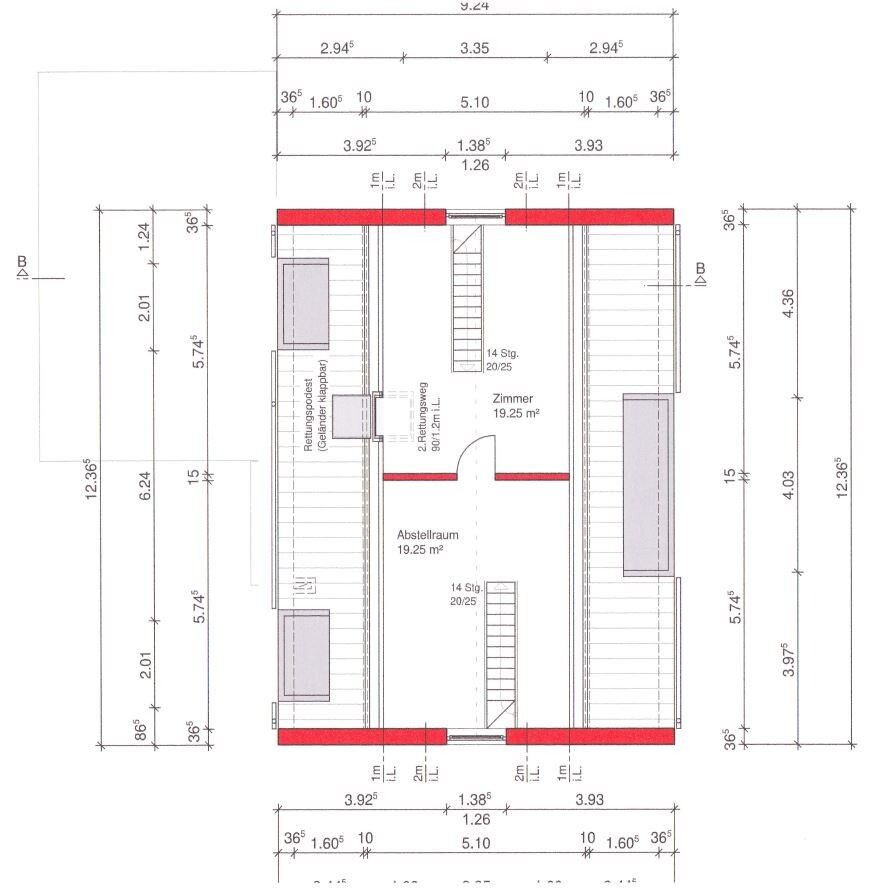
Are we making a fundamental (calculation) error here, or is the system much too small given the roof size?
It would be great if you could share your assessment.
As an additional optional question, the system is proposed with IBC modules and an SMA inverter for a total net price of about 11,500 € (approx. 11.5K euros).
Are these components any good, and is that a reasonable price in NRW?
Best regards,
Tarnari
We have received a quote for a photovoltaic system on the roof of our single-family house planned for next year.
Our plan is to fully cover the south-facing roof.
The house measures approximately 9 x 12 m (30 x 40 feet) with the roof ridge running along the longer side, featuring a gable roof with a 45-degree pitch. There will be no roof overhang and one dormer.
You can find a floor plan of the attic with the basic dimensions attached. The photovoltaic system will be installed on the roof shown in the floor plan with the single dormer, not on the side with the two dormers.
What surprises us about the quote is that the supplier calculates a photovoltaic area of 45.8 sqm (493 sq ft), or 28 modules (just to be clear, photovoltaic area, not roof area), which results in a system size of 8.8 kWp according to the offer.
I won’t say what I calculated for the roof area myself (I’m really bad at math, but there are online calculators for that), but it seems to us that the system could be much larger based on the roof size. The original goal was to fully utilize at least 10 kWp or more. Does the dormer really take up that much space?
Additionally, our architect mentioned that there may be regulations regarding minimum distances to the roof edge and the dormer or something similar — is that possible?
Are we making a fundamental (calculation) error here, or is the system much too small given the roof size?
It would be great if you could share your assessment.
As an additional optional question, the system is proposed with IBC modules and an SMA inverter for a total net price of about 11,500 € (approx. 11.5K euros).
Are these components any good, and is that a reasonable price in NRW?
Best regards,
Tarnari
You’ll find better answers to this question in the photovoltaic forum (just google it).
A brief try: the edge clearance depends on your wind load zone. Here, if I remember correctly, we are in Zone 1 with only about 10cm (4 inches).
For a system of that size, the cost should be around 1200 euros per kWp before tax. Your quote isn’t completely off, but it can probably be cheaper—especially if, for example, scaffolding from the house construction can be used.
Which IBC modules are they exactly? How many heat pumps? Are the modules black? SMA makes reliable inverters.
At a 45-degree roof pitch and a south orientation, soft limiting to 70% is recommended. This can be done much more affordably with equally good inverters from Fronius, because you can connect less expensive meters.
Best regards,
Michael
A brief try: the edge clearance depends on your wind load zone. Here, if I remember correctly, we are in Zone 1 with only about 10cm (4 inches).
For a system of that size, the cost should be around 1200 euros per kWp before tax. Your quote isn’t completely off, but it can probably be cheaper—especially if, for example, scaffolding from the house construction can be used.
Which IBC modules are they exactly? How many heat pumps? Are the modules black? SMA makes reliable inverters.
At a 45-degree roof pitch and a south orientation, soft limiting to 70% is recommended. This can be done much more affordably with equally good inverters from Fronius, because you can connect less expensive meters.
Best regards,
Michael
B
boxandroof8 Nov 2019 00:25Tarnari schrieb:
Are we facing a complete calculation error, or is the system way too small compared to the roof? To add to the good previous post: no, you are not mistaken. Go up to 10 kWp, or if you can go higher, fully load above 13 kWp. Lay the modules out on paper on your own roof and then order exactly that.
I also don’t understand why many solar installers don’t fill the entire roof and try to sell more. It was the same for us, and I’m glad for every extra module we now have.
N
nordanney8 Nov 2019 07:20boxandroof schrieb:
I also don’t understand why many solar installers don’t fully cover the roof and sell more. It was the same for us, and I’m glad about every additional module we now have.This partly has to do with acceptable string lengths and the inverters.
H
hampshire9 Nov 2019 09:20The standard modules are connected in series. A dormer casts a shadow. Shadows on a series connection reduce the overall output. Ask the photovoltaic installer about the layout and why they recommend and calculate it this way.
If someone simply fills the roof with series-connected panels and promises full power despite shading, they may have a better kW peak/€ ratio on paper but deliver a less efficient system in practice.
Sometimes greed outweighs judgment, and that’s how these guys get their contracts.
Additionally, for systems over 10 kW peak, you pay an energy surcharge on your production. This increased significantly in 2020.
Tip: Size your system generously for your own consumption, use a hybrid inverter, and store excess energy reasonably in a battery and hot water cylinder.
If you don’t want to spoil the appearance of your house, choose solar roof tiles. Although considerably more expensive, they increase the property value (a good investment). With a low-voltage system on the roof and parallel connection, you avoid shading issues, no electrician has to work on the roof, there is no added fire risk, and no high voltage runs above the living areas. These are all disadvantages of standard photovoltaic panels that no one talks about and everyone accepts because no one questions them anymore.
If someone simply fills the roof with series-connected panels and promises full power despite shading, they may have a better kW peak/€ ratio on paper but deliver a less efficient system in practice.
Sometimes greed outweighs judgment, and that’s how these guys get their contracts.
Knöpfchen schrieb:
If the system is larger than 9.9 kW peak, a direct meter from the utility is generally required.
This means the meter cabinet needs an additional measuring slot.
Additionally, for systems over 10 kW peak, you pay an energy surcharge on your production. This increased significantly in 2020.
Tip: Size your system generously for your own consumption, use a hybrid inverter, and store excess energy reasonably in a battery and hot water cylinder.
If you don’t want to spoil the appearance of your house, choose solar roof tiles. Although considerably more expensive, they increase the property value (a good investment). With a low-voltage system on the roof and parallel connection, you avoid shading issues, no electrician has to work on the roof, there is no added fire risk, and no high voltage runs above the living areas. These are all disadvantages of standard photovoltaic panels that no one talks about and everyone accepts because no one questions them anymore.
Similar topics