
F
fahri190229 May 2024 11:36Hello everyone,
We are currently looking at a plot of land and still have some concerns regarding the existing slope on the site. It concerns plots No. 5 and 6 – we would take plot 5 entirely and about up to the turning circle on plot 6. So, we can still combine parts of these plots. In total, that would be around 1100 square meters (11,840 square feet). Behind the plot, at a lower level, there is the RRB on the right, and oaks are planned to be planted there. The elevations are also shown here.
Looking at the heights, I currently have quite a few worries and am not sure if this is really the right plot for our building project.
The plan is for approximately 200 square meters (2,150 square feet) of living space in a staggered storey design, with a double garage next to it. We will need to compensate for about 1.5 meters (5 feet) of height difference along the length of the building.
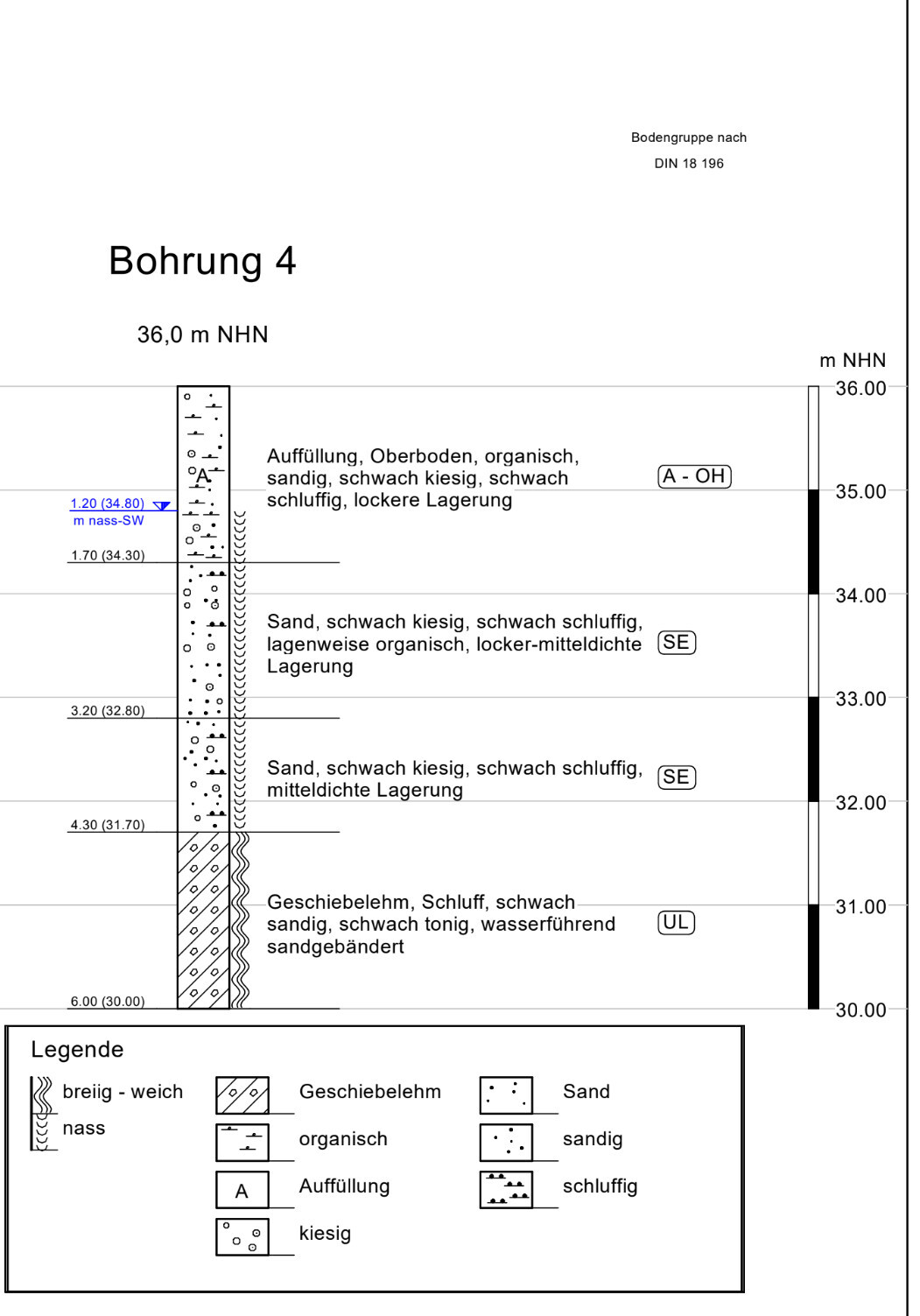
The groundwater level is at about -1.2 meters (-4 feet). The entire lower area behind the plot was underwater for quite some time during this past winter, in which there was significant rainfall here in Schleswig-Holstein. Whether the water reached up to the plot itself, I cannot say for sure as I was not on site at the time.
From my perspective, I see three immediate issues:
1) Water coming "downhill" from above, i.e., from plots 3 and 4, which are also at least about 2 meters (6.5 feet) higher than us. A friend of mine says that a splash guard in the form of a small wall at the property boundary would be sufficient – a 40 to 50 cm (16 to 20 inch) high small wall would redirect storm runoff during extreme heavy rain events around the plot and house. Do you think this would be enough, or is that too naive?
2) In the same town this year, there was a case where a house without a basement apparently had some interior rooms become damp due to the high groundwater, because the foundation was sitting in the groundwater and water was drawn up through the floor slab into the house. Until now, I only knew of this kind of issue with basements. The architect mentioned drainage that could divert the water to lower areas, but my specific question here is: what if the lower area can no longer absorb any more water? Wouldn’t the drainage then be ineffective? Alternatively, the foundations or the slab could be constructed using waterproof concrete (WU concrete), but that would considerably increase costs.
I’m an amateur, so sorry for the question – how would you approach these height and location issues?
And finally:
3) Is it possible that, with increasing rainfall amounts, parts of the plot could remain permanently flooded? I have pictures in my mind of flooding along rivers where whole meadows get submerged and stay underwater for weeks. That, of course, would not be desirable. Logically, I think the entire lower area is quite large and lies about 2 meters (6.5 feet) below our plot – there should be enough space there, and if those 2 meters were completely underwater, that would mean billions of liters of water.
A soil survey specifically for the plot is still planned, but a report from the road construction company has already been done, which I will also attach here. According to the architect, the soil condition does not appear to be very problematic.
How would you handle the location of a plot like this? Do you see any further problems that I might have overlooked?
Am I being too cautious? I have a basement that was waterproofed with a "black tank" (a type of waterproofing membrane) in 1998. It has never really caused serious problems, but it basically sits in groundwater, and I have to pump water out of a sump all day, because back then no one told us about "white tanks" (concrete waterproofing). Those are mistakes you simply can’t fix later, and I want to avoid something similar with what will likely be the last house I ever build.
Looking forward to your suggestions, assessments, and opinions.
Best regards
P.S.: I know that compared to other federal states this is probably not an extreme slope, but rather a plot with a relatively steep incline. However, considering climate change, I am already giving it quite a lot of thought today.
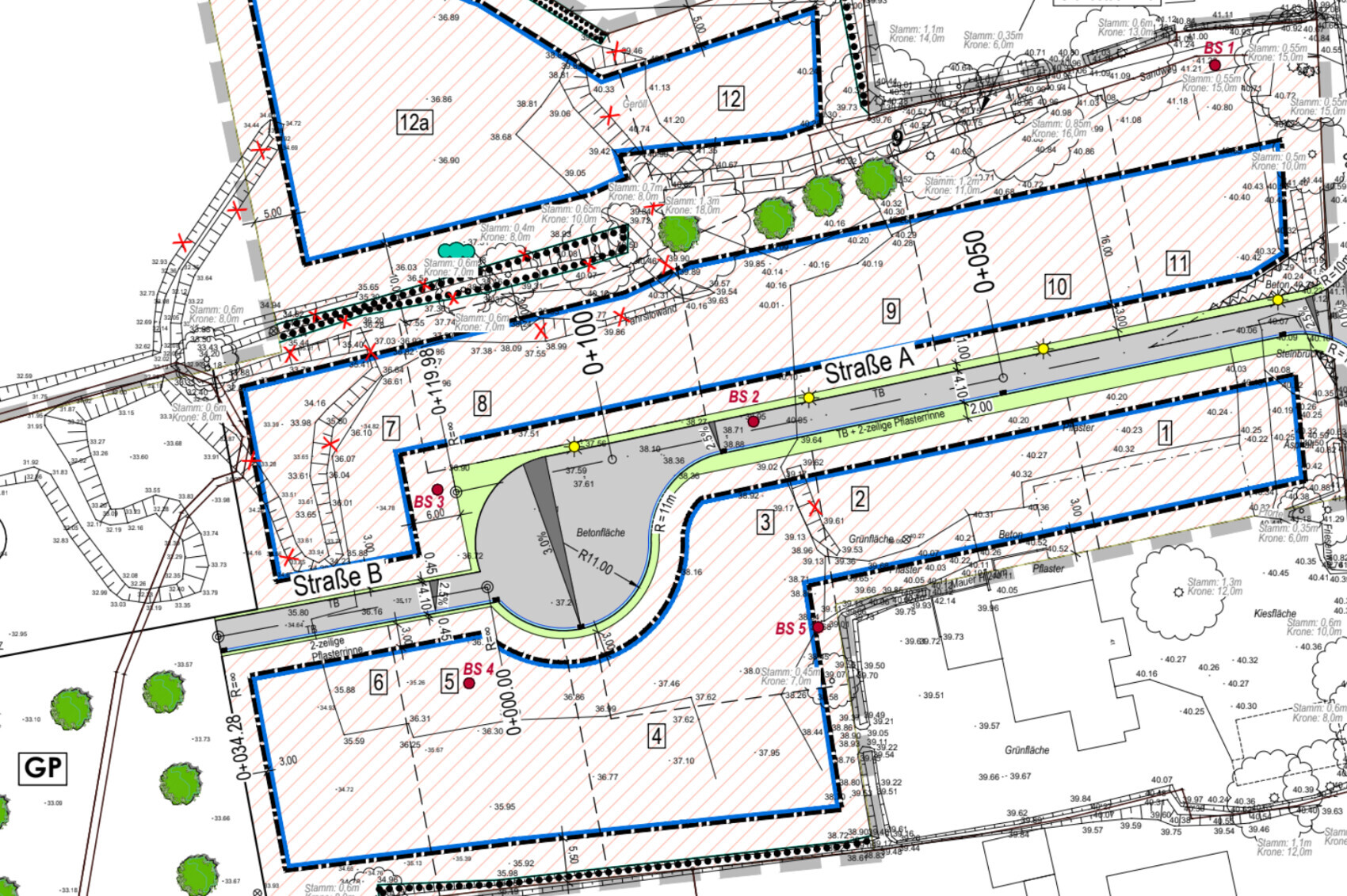
We are currently looking at a plot of land and still have some concerns regarding the existing slope on the site. It concerns plots No. 5 and 6 – we would take plot 5 entirely and about up to the turning circle on plot 6. So, we can still combine parts of these plots. In total, that would be around 1100 square meters (11,840 square feet). Behind the plot, at a lower level, there is the RRB on the right, and oaks are planned to be planted there. The elevations are also shown here.
Looking at the heights, I currently have quite a few worries and am not sure if this is really the right plot for our building project.
The plan is for approximately 200 square meters (2,150 square feet) of living space in a staggered storey design, with a double garage next to it. We will need to compensate for about 1.5 meters (5 feet) of height difference along the length of the building.
The groundwater level is at about -1.2 meters (-4 feet). The entire lower area behind the plot was underwater for quite some time during this past winter, in which there was significant rainfall here in Schleswig-Holstein. Whether the water reached up to the plot itself, I cannot say for sure as I was not on site at the time.
From my perspective, I see three immediate issues:
1) Water coming "downhill" from above, i.e., from plots 3 and 4, which are also at least about 2 meters (6.5 feet) higher than us. A friend of mine says that a splash guard in the form of a small wall at the property boundary would be sufficient – a 40 to 50 cm (16 to 20 inch) high small wall would redirect storm runoff during extreme heavy rain events around the plot and house. Do you think this would be enough, or is that too naive?
2) In the same town this year, there was a case where a house without a basement apparently had some interior rooms become damp due to the high groundwater, because the foundation was sitting in the groundwater and water was drawn up through the floor slab into the house. Until now, I only knew of this kind of issue with basements. The architect mentioned drainage that could divert the water to lower areas, but my specific question here is: what if the lower area can no longer absorb any more water? Wouldn’t the drainage then be ineffective? Alternatively, the foundations or the slab could be constructed using waterproof concrete (WU concrete), but that would considerably increase costs.
I’m an amateur, so sorry for the question – how would you approach these height and location issues?
And finally:
3) Is it possible that, with increasing rainfall amounts, parts of the plot could remain permanently flooded? I have pictures in my mind of flooding along rivers where whole meadows get submerged and stay underwater for weeks. That, of course, would not be desirable. Logically, I think the entire lower area is quite large and lies about 2 meters (6.5 feet) below our plot – there should be enough space there, and if those 2 meters were completely underwater, that would mean billions of liters of water.
A soil survey specifically for the plot is still planned, but a report from the road construction company has already been done, which I will also attach here. According to the architect, the soil condition does not appear to be very problematic.
How would you handle the location of a plot like this? Do you see any further problems that I might have overlooked?
Am I being too cautious? I have a basement that was waterproofed with a "black tank" (a type of waterproofing membrane) in 1998. It has never really caused serious problems, but it basically sits in groundwater, and I have to pump water out of a sump all day, because back then no one told us about "white tanks" (concrete waterproofing). Those are mistakes you simply can’t fix later, and I want to avoid something similar with what will likely be the last house I ever build.
Looking forward to your suggestions, assessments, and opinions.
Best regards
P.S.: I know that compared to other federal states this is probably not an extreme slope, but rather a plot with a relatively steep incline. However, considering climate change, I am already giving it quite a lot of thought today.
M
MachsSelbst29 May 2024 13:17You probably mean that you would choose 6 and extend the 5 up to the height of the turning radius...
What actually happens during heavy rain, when the groundwater level after a very wet year in January is concerned, cannot be determined just from the raw elevation values. This might be the case at borehole 4, but 5 meters (16 feet) away it could be completely different.
That’s why water can accumulate randomly in one spot, while flowing away well in another.
If drilling was done in summer, you might have totally different groundwater levels than in spring or autumn.
After the very wet last year, the groundwater at our site was just below the top of the slab at the beginning of January. Now in May, it is about one meter (3 feet) lower. We still have a drainage pipe from the construction stuck in the terrace where we can observe this well.
What you describe, with the field behind the property being under water for a long time, definitely suggests that the soil in the area generally has poor infiltration.
And it will definitely not get better if 30 to 40% of the area is sealed now with roads, slabs, paths, etc.
If you can avoid building a basement, then do so.
What actually happens during heavy rain, when the groundwater level after a very wet year in January is concerned, cannot be determined just from the raw elevation values. This might be the case at borehole 4, but 5 meters (16 feet) away it could be completely different.
That’s why water can accumulate randomly in one spot, while flowing away well in another.
If drilling was done in summer, you might have totally different groundwater levels than in spring or autumn.
After the very wet last year, the groundwater at our site was just below the top of the slab at the beginning of January. Now in May, it is about one meter (3 feet) lower. We still have a drainage pipe from the construction stuck in the terrace where we can observe this well.
What you describe, with the field behind the property being under water for a long time, definitely suggests that the soil in the area generally has poor infiltration.
And it will definitely not get better if 30 to 40% of the area is sealed now with roads, slabs, paths, etc.
If you can avoid building a basement, then do so.
F
fahri190229 May 2024 15:57Hello,
first of all, thank you for your feedback.
I am a bit confused, but that is probably because I didn’t phrase it correctly.
I am not interested in building a basement, and that was not the question. If I purchase the plot, I am more concerned with assessing the risks related to the hillside location for the entire house without a basement, specifically regarding the amount of water coming from “above” (sky + street + higher neighboring properties). This is increasing over time, and I don’t see a proper place at the lower end where the water could go, especially if, like this year, it rains for several weeks straight.
I actually visited the site after a cloudburst, and naturally there is water on the paddock (since there is no road or access yet), which is not surprising. But the lower left corner of “our” property is completely flooded. Now – after a cloudburst – this area would be the garden zone, meaning ornamental lawn, etc. Of course, there is no sewer system built yet. But generally, the amount of rain hitting the lawn would probably increase because of the additional runoff from the sealed surfaces, right? If the water can’t “infiltrate” there now, then it won’t be able to do so after the sewer system and so forth are installed. That wouldn’t affect it, or am I mistaken?
Best regards
first of all, thank you for your feedback.
I am a bit confused, but that is probably because I didn’t phrase it correctly.
I am not interested in building a basement, and that was not the question. If I purchase the plot, I am more concerned with assessing the risks related to the hillside location for the entire house without a basement, specifically regarding the amount of water coming from “above” (sky + street + higher neighboring properties). This is increasing over time, and I don’t see a proper place at the lower end where the water could go, especially if, like this year, it rains for several weeks straight.
I actually visited the site after a cloudburst, and naturally there is water on the paddock (since there is no road or access yet), which is not surprising. But the lower left corner of “our” property is completely flooded. Now – after a cloudburst – this area would be the garden zone, meaning ornamental lawn, etc. Of course, there is no sewer system built yet. But generally, the amount of rain hitting the lawn would probably increase because of the additional runoff from the sealed surfaces, right? If the water can’t “infiltrate” there now, then it won’t be able to do so after the sewer system and so forth are installed. That wouldn’t affect it, or am I mistaken?
Best regards
Hello,
To reduce surface water, it will definitely be crucial how large the sewer system / drains are planned and how much capacity the connection to the main lines will have.
The roundabout appears to be designed as a sort of "collection point," and the paved channels are meant to assist in transporting the water.
Are there any regulations regarding rainwater (infiltration or discharge)?
The 50–60 cm (20–24 inches) wall would also need to be compatible with the garage; otherwise, the water will simply find its way.
It is also difficult to predict how much the "field basin" will fill up when the sealed surfaces / directed discharge across the road increase.
However, the plan already looks as if this field is intended to be the designated "flood area." Plot 6 would then essentially be part of it.
It may also work differently, though, and the expansion of the sewer system at the left end of "Street B" (drain) could ease the usual flooding situation of the field since it can discharge into the sewer there. In that case, your part of the property might no longer be underwater, unless there are really heavy, prolonged rains that generally overload the sewer system.
The best option would be to discuss these concerns directly with the utility company responsible for infrastructure development, if possible.
To reduce surface water, it will definitely be crucial how large the sewer system / drains are planned and how much capacity the connection to the main lines will have.
The roundabout appears to be designed as a sort of "collection point," and the paved channels are meant to assist in transporting the water.
Are there any regulations regarding rainwater (infiltration or discharge)?
The 50–60 cm (20–24 inches) wall would also need to be compatible with the garage; otherwise, the water will simply find its way.
It is also difficult to predict how much the "field basin" will fill up when the sealed surfaces / directed discharge across the road increase.
However, the plan already looks as if this field is intended to be the designated "flood area." Plot 6 would then essentially be part of it.
It may also work differently, though, and the expansion of the sewer system at the left end of "Street B" (drain) could ease the usual flooding situation of the field since it can discharge into the sewer there. In that case, your part of the property might no longer be underwater, unless there are really heavy, prolonged rains that generally overload the sewer system.
The best option would be to discuss these concerns directly with the utility company responsible for infrastructure development, if possible.
M
MachsSelbst29 May 2024 21:06From my own experience in a residential area with poor infiltration, I can tell you that the sewer system does not help much. It only drains the streets, thus the paved surfaces. An exception would be if you are allowed to discharge your rainwater into it, but that usually isn’t exactly cheap either.
Infiltration problems tend to get worse, not better, due to the sealing and compaction of the soil, which is common in residential developments.
Infiltration problems tend to get worse, not better, due to the sealing and compaction of the soil, which is common in residential developments.
F
fahri190229 May 2024 22:35Thanks for the feedback, I suspected as much and my gut feeling was right.
We will consider how to proceed from here.
Your assessments are definitely helpful to us.
We will consider how to proceed from here.
Your assessments are definitely helpful to us.
Similar topics