
Hello,
we will start building our "dream house" at the end of the year and until a few days ago, we were absolutely sure: this is just perfect.
But suddenly, we are having serious doubts about the kitchen and living area. We are very satisfied with the size of all the other rooms, only here we are feeling extremely uncertain.
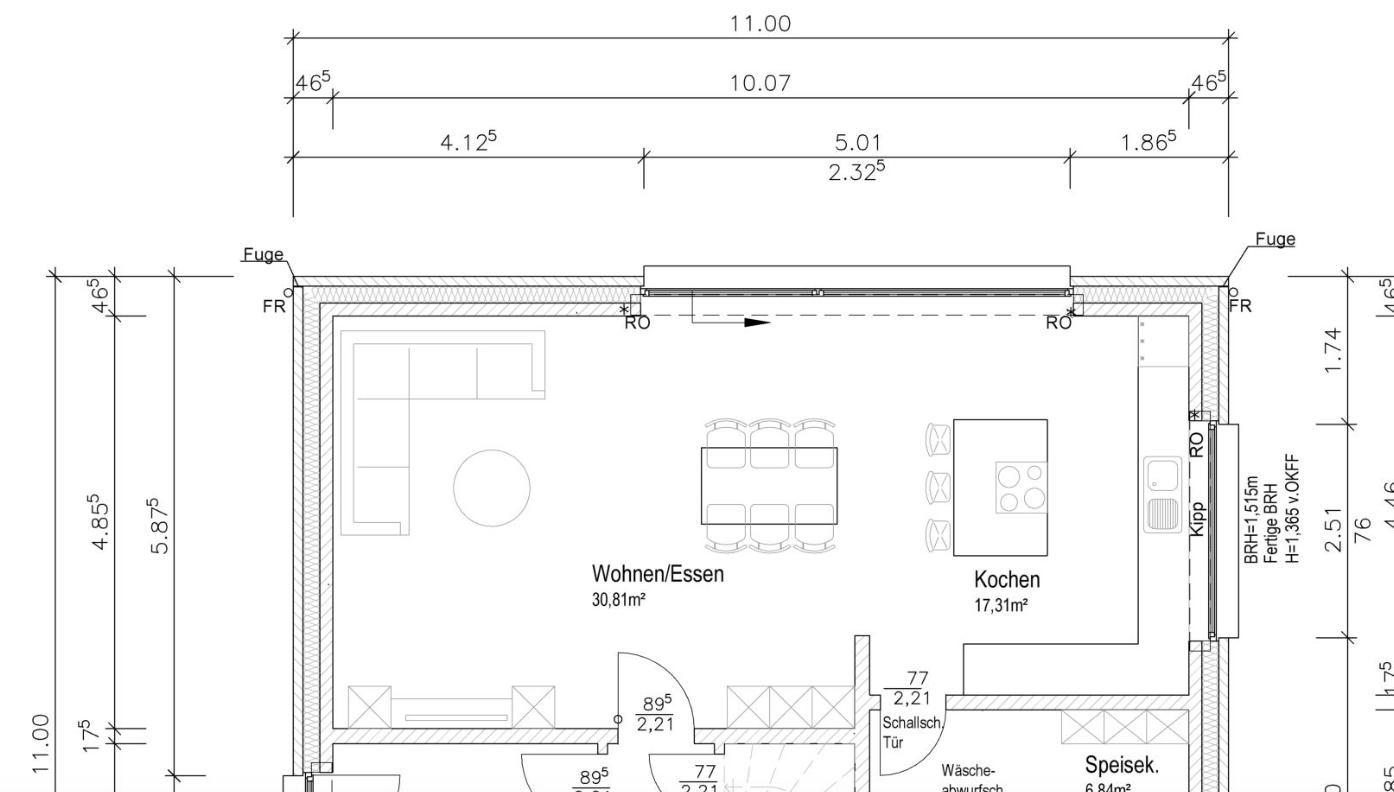
Attached is a screenshot from the building plan. On the right is the kitchen with an island, in the middle the dining table, and to the left the couch and TV.
The kitchen is about 17 m² (183 sq ft), and the living and dining area is 30.81 m² (332 sq ft).
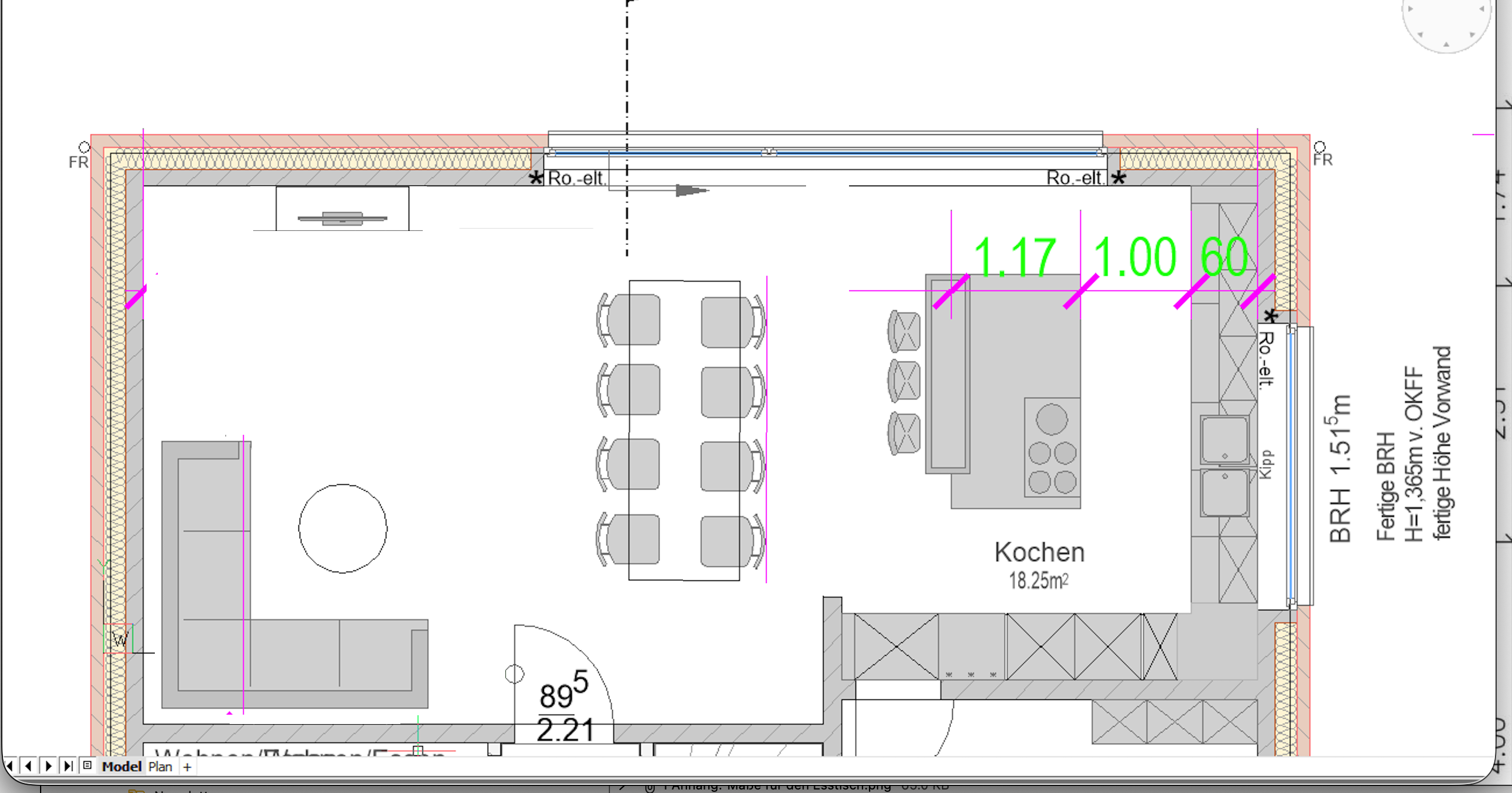
We have now considered swapping the position of the couch and TV, and placing the table perpendicular to the window, see the second screenshot attached.
Before we thought, "Wow, what a big house, yay!" but now it feels more like, "Phew, it’s so small and cramped..."
Another issue is that the purchase contract for the house has already been signed and the documents have been submitted to the building authority (building permit / planning permission).
In other words, making changes is now difficult (especially since we are already at the limit of our budget)...
It is a city villa, with a 5-meter (16 ft) tall floor-to-ceiling window by the kitchen/dining area, and a ceiling height of only 2.55 m (8 ft 4 in).
What is your opinion? Are we just making ourselves unnecessarily anxious?
And yes, I know: these are luxury problems we’re dealing with. But in the end, it’s meant to be "for the rest of our lives"...
Looking forward to your feedback!
we will start building our "dream house" at the end of the year and until a few days ago, we were absolutely sure: this is just perfect.
But suddenly, we are having serious doubts about the kitchen and living area. We are very satisfied with the size of all the other rooms, only here we are feeling extremely uncertain.
Attached is a screenshot from the building plan. On the right is the kitchen with an island, in the middle the dining table, and to the left the couch and TV.
The kitchen is about 17 m² (183 sq ft), and the living and dining area is 30.81 m² (332 sq ft).
We have now considered swapping the position of the couch and TV, and placing the table perpendicular to the window, see the second screenshot attached.
Before we thought, "Wow, what a big house, yay!" but now it feels more like, "Phew, it’s so small and cramped..."
Another issue is that the purchase contract for the house has already been signed and the documents have been submitted to the building authority (building permit / planning permission).
In other words, making changes is now difficult (especially since we are already at the limit of our budget)...
It is a city villa, with a 5-meter (16 ft) tall floor-to-ceiling window by the kitchen/dining area, and a ceiling height of only 2.55 m (8 ft 4 in).
What is your opinion? Are we just making ourselves unnecessarily anxious?
And yes, I know: these are luxury problems we’re dealing with. But in the end, it’s meant to be "for the rest of our lives"...
Looking forward to your feedback!
N
nordanney24 Mar 2026 22:44Neubau27 schrieb:
Currently, we have a basement where we store various items like food, drinks, and appliances that are rarely used, such as a waffle iron and similar items. That option is no longer available. Hence, the pantry as a “replacement for storage space.” I’m not sure how much that actually is—but if you need such a large area plus a 7m (23 ft) kitchen counter for that, you must have a huge amount of utensils and food/beverages stocked.
Seriously though, how much food do you store? Do you shop so infrequently that you only go every two months? If not, hoarding shouldn’t be necessary.
I’m not familiar with the rest of your house or the design, but this seems like the typical issue with a modern “urban villa” with a shed or mono-pitched roof, where you sacrifice attic storage space while keeping the overall construction costs similar, and instead build pantries. I’m currently living in my third home, some with basements, some without. In my opinion, a pantry is a waste of space with well-planned housing (unless you simply have the budget to not worry about square meters).
Neubau27 schrieb:
constructive answers only!!! Yes… too bad it’s not you. It makes many things difficult and time-consuming.
Neubau27 schrieb:
The fact that there’s no window to the “left” of the TV area is intentional and related to the plot. Isn’t everything intentional? Intentions are often neither logical, practical, nor well thought out.
Here, it’s also intentional that only the side entrance is actually used, stumbling over the heat pump, and placing a closet in the second parallel hallway?!
The hallway has a bottleneck towards the open living area, so the main room becomes darker and less inviting, and unfortunately there is no visual axis.
I would question the intention of a dark living room. The stove and sink should be offset, and 65cm (25.6 inches) is only enough seating space with a stop.
Structurally, the large window is a major challenge. This could cause problems later.
The door and the window in the office are poorly positioned. Is this also intentional, like a tiny hand basin in a shower bathroom?
G
Gerddieter24 Mar 2026 23:18Hey, your utility room is huge—I'd easily move the kitchen-side wall in by about 30cm (12 inches). That way, you'll have enough space next to the island...
And that odd wall projection sticking into the kitchen (next to the utility room door) I would keep no deeper than the cabinet depth—around 60 to 65cm (24 to 26 inches). It looks awkward currently. Although it's not really suitable for a built-in cabinet anyway since something is missing on the other side of the cabinet...
GD
And that odd wall projection sticking into the kitchen (next to the utility room door) I would keep no deeper than the cabinet depth—around 60 to 65cm (24 to 26 inches). It looks awkward currently. Although it's not really suitable for a built-in cabinet anyway since something is missing on the other side of the cabinet...
GD
G
Gerddieter24 Mar 2026 23:23Oh, and I wouldn’t make any major, building permit–relevant, and costly changes at this point—the ground floor looks quite nice.
You can still optimize some interior walls and move windows slightly during the construction planning phase, which should basically be free of charge...
Gd
You can still optimize some interior walls and move windows slightly during the construction planning phase, which should basically be free of charge...
Gd
M
motorradsilke25 Mar 2026 06:56nordanney schrieb:
I'll be a bit provocative. Why does an average household need a pantry? It seems more like something from upscale living or large estates than really necessary.
For practical reasons, I wouldn’t think of storing stuff in a pantry (20 kg (44 lbs) of flour, 300 canned goods, etc.) – the essentials fit into a regular kitchen. It’s like many things—subjective. We have a small pantry, and we love it. It’s just much more convenient for storing supplies than closed cabinets. We only have open shelves in there.
Because of it, our kitchen could be smaller.
We also buy deals in bulk, and sometimes I receive larger quantities through food sharing.

HannesL schrieb:
If budget is a concern, one could consider saving costs by using precast panels with internal insulation as external walls and instead opt for a fully insulated 36.5 cm (14 inches) hollow brick wall. But hardly from the same supplier. For example, Rötzer offers wall panels made of bricks, which I consider "not a good idea" due to mortar stress alone.Papierturm schrieb:
From my own experience: most building authorities do not mind if interior walls are shifted. Also, changes to facades are possible as long as the external dimensions remain unchanged, for example minor alterations to window sizes. Not entirely: changes to interior walls also affect the heating demand calculation, and distances between windows and the outer edges of the building can be important for fire safety.Papierturm schrieb:
My wife would have preferred higher ceiling heights. Originally, we had planned at least 255 cm (100 inches). Since ceiling-mounted lamps are less common nowadays, rooms could actually be designed lower. Furthermore, windows taller than 240 cm (94 inches) often increase costs, and higher lintels tend to make rooms darker.https://www.instagram.com/11antgmxde/
https://www.linkedin.com/company/bauen-jetzt/
Similar topics