
ᐅ Space for storing excavated material? Without official approval or building permit/planning permission?
Created on: 18 Apr 2025 13:39
G
GeraldGHello everyone,
we are planning a house approximately 11.5m x 9m (38 ft x 30 ft) with a basement. The plot itself is very flat, so we estimate about 310 m³ (11,000 ft³) of excavation based on 11.5m x 9m x 3m (38 ft x 30 ft x 10 ft).
Our soil disposal site charges 28€ per ton, which adds up quickly. However, there is a larger project nearby that requires about 10,000 m³ (350,000 ft³) of soil. I could deliver the excavation there for free. The project won’t start for another 1-2 years, so I would like to temporarily store the soil at the neighbor’s. The neighboring plot is also a building lot but was developed in the 1980s and has not been built on yet, and the current owners do not plan to build there soon. Storing it at the neighbor’s would allow me to start the garden right after building the house without waiting for the soil to be removed.
However, I find it difficult to imagine how much space is needed. I still need to ask the neighbors but wanted to know approximately how large the area occupied would be. Could someone tell me if the yellow marked area is enough to store the soil from the red marked area? Is there anything I should consider? I heard something about an “immission control permit” for quantities above 100 tons. But I understand that such a permit is not required if the excavation is stored directly adjacent to the site. Does this also apply to the neighbor’s property or only to your own?
Thank you very much!
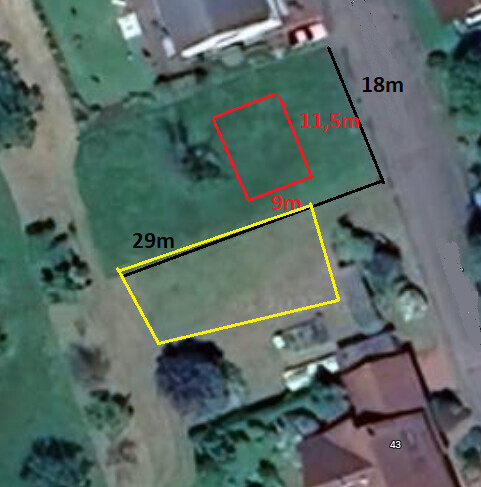
we are planning a house approximately 11.5m x 9m (38 ft x 30 ft) with a basement. The plot itself is very flat, so we estimate about 310 m³ (11,000 ft³) of excavation based on 11.5m x 9m x 3m (38 ft x 30 ft x 10 ft).
Our soil disposal site charges 28€ per ton, which adds up quickly. However, there is a larger project nearby that requires about 10,000 m³ (350,000 ft³) of soil. I could deliver the excavation there for free. The project won’t start for another 1-2 years, so I would like to temporarily store the soil at the neighbor’s. The neighboring plot is also a building lot but was developed in the 1980s and has not been built on yet, and the current owners do not plan to build there soon. Storing it at the neighbor’s would allow me to start the garden right after building the house without waiting for the soil to be removed.
However, I find it difficult to imagine how much space is needed. I still need to ask the neighbors but wanted to know approximately how large the area occupied would be. Could someone tell me if the yellow marked area is enough to store the soil from the red marked area? Is there anything I should consider? I heard something about an “immission control permit” for quantities above 100 tons. But I understand that such a permit is not required if the excavation is stored directly adjacent to the site. Does this also apply to the neighbor’s property or only to your own?
Thank you very much!

M
MachsSelbst18 Apr 2025 18:08If you build a basement measuring 11.5 x 9 m (38 x 30 feet), you can easily expect the excavation to be around 15 x 13 m (49 x 43 feet). Not all of the excess material will be backfilled due to drainage and other requirements.
That will be about 500 m³ (650 cubic yards).
Your neighbor will probably laugh briefly and then refuse. How is he supposed to know if you will even have the money to haul all that away in two years? After all, you’ll likely be the one paying for the trucks to the construction site.
And what are they supposed to do with 10,000 m³ (13,000 cubic yards), most of which probably won’t be suitable for the foundation anyway? What if someone nearby steps in and tells your driver, “Sorry boss, we don’t need any more…”?
And lastly... have you heard of Intel? They also planned a big construction project, but a few months before the scheduled start, it was put on hold, probably indefinitely.
PS:
And as with everything in life, no one cares until someone gets pissed off at you.
That will be about 500 m³ (650 cubic yards).
Your neighbor will probably laugh briefly and then refuse. How is he supposed to know if you will even have the money to haul all that away in two years? After all, you’ll likely be the one paying for the trucks to the construction site.
And what are they supposed to do with 10,000 m³ (13,000 cubic yards), most of which probably won’t be suitable for the foundation anyway? What if someone nearby steps in and tells your driver, “Sorry boss, we don’t need any more…”?
And lastly... have you heard of Intel? They also planned a big construction project, but a few months before the scheduled start, it was put on hold, probably indefinitely.
PS:
And as with everything in life, no one cares until someone gets pissed off at you.

Purely in terms of volume, you should roughly estimate around 300–500 m³ (cubic meters), depending on the depth of the basement and the construction method. If you want to pile the excavated soil 2 m (6.5 ft) high, you will need an area of about 150–250 m² (1,600–2,700 sq ft) – for example, a space of 15 × 10 m (50 × 33 ft) or more, depending on compaction and the type of material.
Important point: Such soil heaps are considered "waste storage" depending on their quantity and duration – and above 100 t (tons) (which for clay soil corresponds to about 60 m³ (2,100 ft³)), you are theoretically subject to notification or even permit requirements. The rule about being "directly adjacent" only applies to your own building plot, not to a neighbor’s field.
Conclusion: Yes, technically it is possible – but you need a clear, written agreement with your neighbor and should also check with your local municipality or county office. A quick phone call is enough to avoid trouble later. Otherwise, it can become very costly if someone files a complaint.
And to be honest: In practice, this rarely works smoothly over several years.
Important point: Such soil heaps are considered "waste storage" depending on their quantity and duration – and above 100 t (tons) (which for clay soil corresponds to about 60 m³ (2,100 ft³)), you are theoretically subject to notification or even permit requirements. The rule about being "directly adjacent" only applies to your own building plot, not to a neighbor’s field.
Conclusion: Yes, technically it is possible – but you need a clear, written agreement with your neighbor and should also check with your local municipality or county office. A quick phone call is enough to avoid trouble later. Otherwise, it can become very costly if someone files a complaint.
And to be honest: In practice, this rarely works smoothly over several years.
GeraldG schrieb:
so that you can probably expect around 11.5m x 9m x 3m = 310 m³ (11,000 ft³) of excavation volume. I calculate more than 500 cubic meters (18,000 cubic feet) of native soil as excavation volume (basement excavation has to be larger than the basement itself, so you usually add about 1.5 to 2 meters (5 to 6.5 feet) extra on each side).
Native soil volume in excavation is about three times as much in cubic meters because the soil is loosened.
That means at least 1,500, so nearly 2,000 cubic meters (53,000 to 70,000 cubic feet).
GeraldG schrieb:
But nearby there is a larger project planned, which requires about 10,000 m³ (350,000 ft³) of soil. GeraldG schrieb:
I could deliver the excavated soil there free of charge. That's what you say. But who pays for the transport of excavated soil that contains weeds? It mostly works only in theory. Ultimately, you have nothing to lose by trying to dispose of the soil now or in two years. It's worth a shot. However, I believe the excavation company can handle it more efficiently and cost-effectively.
You can calculate yourself how often a vehicle must travel to move around 1,500 to 2,000 cubic meters (53,000 to 70,000 cubic feet) of soil (approximately 1.5 cubic meters (53 cubic feet) of soil weighs about one metric ton). Also consider how long it takes to load a truck. Keep in mind soil is not compacted in perfect cubic shapes.
We actually gave away our soil through classified ads. On one Saturday, only a small fraction of the material stored on our property (due to slab construction) was removed. The recipient gave up after about 10 trips, and we had to find an alternative disposal method.
M
motorradsilke19 Apr 2025 12:51Depending on the soil type, an additional 20 to 30% is usually calculated when converting from in-situ soil to loosened soil.
Similar topics