
ᐅ Are there houses that even professional design software cannot accurately model?
Created on: 6 Apr 2018 23:36
T
Tobias Claren
Hello.
It seems that in every house planning software, whether free like "Sweet Home 3D" or paid like "Architect 3D," you always set only one level for the ceiling and floor.
With Architect 3D, this can be seen in a video on YouTube.
Can that really be the case? Does this happen so rarely?
Attached is an example of how something like this might look.
Of course, a 3D program like SketchUp could somehow represent that, but it is not specialized house planning software...
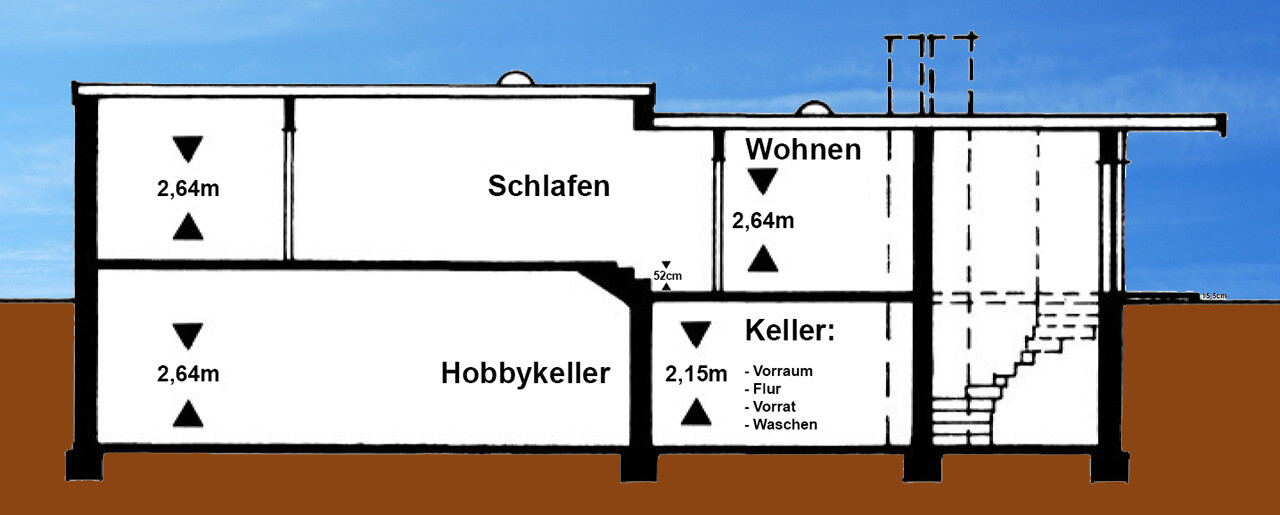
It seems that in every house planning software, whether free like "Sweet Home 3D" or paid like "Architect 3D," you always set only one level for the ceiling and floor.
With Architect 3D, this can be seen in a video on YouTube.
Can that really be the case? Does this happen so rarely?
Attached is an example of how something like this might look.
Of course, a 3D program like SketchUp could somehow represent that, but it is not specialized house planning software...
T
Tobias Claren7 Apr 2018 01:160_o.
"Mathematica" cost over 3000 euros around 2010, and there are various videos available. This software is definitely more specialized than "AutoCAD," which has many tutorials. AutoCAD costs at least 255 euros per month, over 2000 euros per year, and more than 6000 euros for three years.
AutoCAD can basically be "interesting" for many people, including private users.
This is regardless of whether they buy it or use unauthorized copies. Designing 3D objects is more appealing to the general public and more practical to use (3D printers, animation, etc.) than mathematics.
"Mathematica" cost over 3000 euros around 2010, and there are various videos available. This software is definitely more specialized than "AutoCAD," which has many tutorials. AutoCAD costs at least 255 euros per month, over 2000 euros per year, and more than 6000 euros for three years.
AutoCAD can basically be "interesting" for many people, including private users.
This is regardless of whether they buy it or use unauthorized copies. Designing 3D objects is more appealing to the general public and more practical to use (3D printers, animation, etc.) than mathematics.
And what speaks against Sketchup?
With it, implementing everything quite straightforwardly from your plans and sections, including true dimensioning, would be possible. There are also great tutorial videos available...
(In the end, you need to get comfortable with the tool; for a certain level of complexity, the more advanced software can quickly be worthwhile if you would otherwise rely on numerous workarounds.)
With it, implementing everything quite straightforwardly from your plans and sections, including true dimensioning, would be possible. There are also great tutorial videos available...
(In the end, you need to get comfortable with the tool; for a certain level of complexity, the more advanced software can quickly be worthwhile if you would otherwise rely on numerous workarounds.)
Tobias Claren schrieb:
0_o.
"Mathematica" cost over 3000 euros around 2010, and there are plenty of videos available. And that is surely even more specialized than "Autocad" Mathematica is widely used by science students (around 2005 it cost about 100 € for students), so of course there are videos available. It is probably similar for the standard software in architecture.
T
Tobias Claren7 Apr 2018 13:43There are also people who don’t care which version is used in a video. They even create videos using a pirated copy. As long as it isn’t visible in the video, the manufacturer can’t do anything about it. The video could also have been made with a licensed version, and it doesn’t have to show the creator’s name in their database. YouTube wouldn’t receive such information for cases like this, and the video could have been created by someone else.
The "standard software," or the smallest version and I think one or two versions above that, apparently don’t even support 3D. And there are plenty of architectural 3D videos that clearly use more than just the "standard" version.
The "standard software," or the smallest version and I think one or two versions above that, apparently don’t even support 3D. And there are plenty of architectural 3D videos that clearly use more than just the "standard" version.
Haus² schrieb:
And what speaks against SketchUp?
With it, you can implement everything quite straightforwardly based on your plans and sections, including true dimensioning. There are also great tutorial videos available...
(In the end, you need to be comfortable with the tool, but with increasing complexity, a more advanced program can quickly become worthwhile if you otherwise need many workarounds.)I am also a big fan of SketchUp, but inserting windows, doors, etc., can be quite tedious — although it offers complete freedom in design. More specialized software with parametric window, door, and stair models is definitely more convenient in that regard. Still, SketchUp is an equally capable tool and provides unexpected possibilities thanks to its flexibility.
Similar topics