
Hello,
we are building a detached house using solid construction with a well-known developer who has a very good reputation. The roof is in place, and the shell structure will be completed next week.
On Monday, the independent site inspector came for the first inspection and criticized the absence of drainage openings in the base area. The site manager responded that the masonry standard DIN EN 1996-2/NA no longer requires drainage joints.
What is your opinion on this? I am not interested in legal aspects but in the technical side. Our inspector considers the construction questionable in this regard and clearly stated this in his report. I forwarded the report to the developer; their response again referred only to compliance with the DIN standard (although the inspector questions the site manager’s interpretation of the standard, but I won’t go into details here). Such a response raises warning signs for me because I cannot assess whether the standard (as interpreted by the site manager) makes technical sense.
Since then, I have been very worried and have strong difficulties sleeping. Will a problem house be built if the standards are met? Of course, there is a warranty, but I now feel uneasy about the house. The excitement about our new home is gone. Retrofitting drainage joints by drilling is very delicate because the vapor barrier film should not be damaged.
Does anyone have technical expertise on this matter and can contribute some insights?
Thank you in advance.
P.S.: We have cavity walls with a facing brick, air cavities, insulation material, and aerated concrete blocks. The insulation naturally includes a vapor barrier film.
we are building a detached house using solid construction with a well-known developer who has a very good reputation. The roof is in place, and the shell structure will be completed next week.
On Monday, the independent site inspector came for the first inspection and criticized the absence of drainage openings in the base area. The site manager responded that the masonry standard DIN EN 1996-2/NA no longer requires drainage joints.
What is your opinion on this? I am not interested in legal aspects but in the technical side. Our inspector considers the construction questionable in this regard and clearly stated this in his report. I forwarded the report to the developer; their response again referred only to compliance with the DIN standard (although the inspector questions the site manager’s interpretation of the standard, but I won’t go into details here). Such a response raises warning signs for me because I cannot assess whether the standard (as interpreted by the site manager) makes technical sense.
Since then, I have been very worried and have strong difficulties sleeping. Will a problem house be built if the standards are met? Of course, there is a warranty, but I now feel uneasy about the house. The excitement about our new home is gone. Retrofitting drainage joints by drilling is very delicate because the vapor barrier film should not be damaged.
Does anyone have technical expertise on this matter and can contribute some insights?
Thank you in advance.
P.S.: We have cavity walls with a facing brick, air cavities, insulation material, and aerated concrete blocks. The insulation naturally includes a vapor barrier film.
D
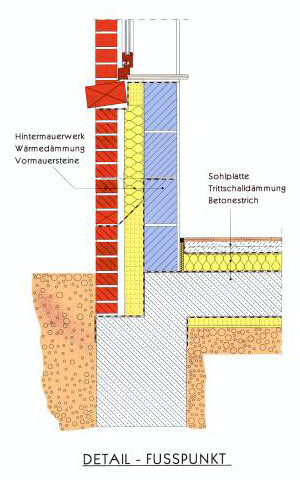
DragonyxXL7 Nov 2016 12:43Although it's not exactly the same topic, is it possible to backfill soil against a brick veneer as shown in the sketch? How would water drain on the inside surface of the bricks in that case? Would there be weep holes there that would be "blocked" by the backfill?
K
Knallkörper8 Nov 2016 16:08To my knowledge, the drainage openings at the bottom are never dispensable. The ventilation openings at the top, however, can be omitted when using cavity insulation.
Drainage openings are also necessary above the windows (...)
@DragonyxXL: The drainage slots are then "raised." Usually, a thick coating or a waterproof slurry is applied to the cladding bricks that are below ground level. I believe not every cladding brick is suitable for this.
Drainage openings are also necessary above the windows (...)
@DragonyxXL: The drainage slots are then "raised." Usually, a thick coating or a waterproof slurry is applied to the cladding bricks that are below ground level. I believe not every cladding brick is suitable for this.
B
Bauexperte8 Nov 2016 23:55Galaxie schrieb:
To clarify: I am not concerned with DIN standards or anything like that; the walls and the water that has penetrated do not care about any DIN standards. The question here is whether drainage is ensured or not. The competitor, represented by the red colleague, would not do or omit anything that might cause problems for him in the future.
Drainage is ensured... otherwise, the standard you mentioned would not have been adopted. Is it reasonable? What in house construction is really reasonable these days? Delivering a new building within 3 months – in my opinion – is not reasonable either; but who am I to judge.
Regards, Bauexperte
The solution!
I received a call from the technical manager of our developer. The fact that no weep holes are planned in the base area is intentional for the following reasons:
This completely convinced me, and I am now fully reassured.
I received a call from the technical manager of our developer. The fact that no weep holes are planned in the base area is intentional for the following reasons:
- Water leakage through open joints has never been observed
- The regulation requiring open joints was only introduced into the masonry standard in 1974. Before that, it was optional for over 70 years, and no damage cases were documented.
- Moisture measurements have shown that "open" walls are about 4% more humid than unventilated walls.
- The risk of moisture entering unchecked through weep holes is considered higher than the risk of water accumulating without weep holes.
This completely convinced me, and I am now fully reassured.
K
Knallkörper12 Nov 2016 21:11Hello.
Strange, I just noticed water running out of the drainage joints in our new build.
Strange, I just noticed water running out of the drainage joints in our new build.
Knallkörper schrieb:
Hello.
Strange, I just noticed water flowing out of the drainage joints in our new build.That is indeed strange. Could that have been during the construction phase?
Similar topics