
ᐅ Are cracks in the plaster to be expected with monolithic wall construction without external thermal insulation composite systems (ETICS) / external wall insulation?
Created on: 18 May 2021 19:56
S
Steffen_S
Hello everyone,
I am currently planning my first single-family home, a roughly 250m² (2,690 sq ft) bungalow for my family and me. By "planning," I mean that I am researching the available building materials, how houses are generally constructed, and so on.
Here is a rough 3D concept.
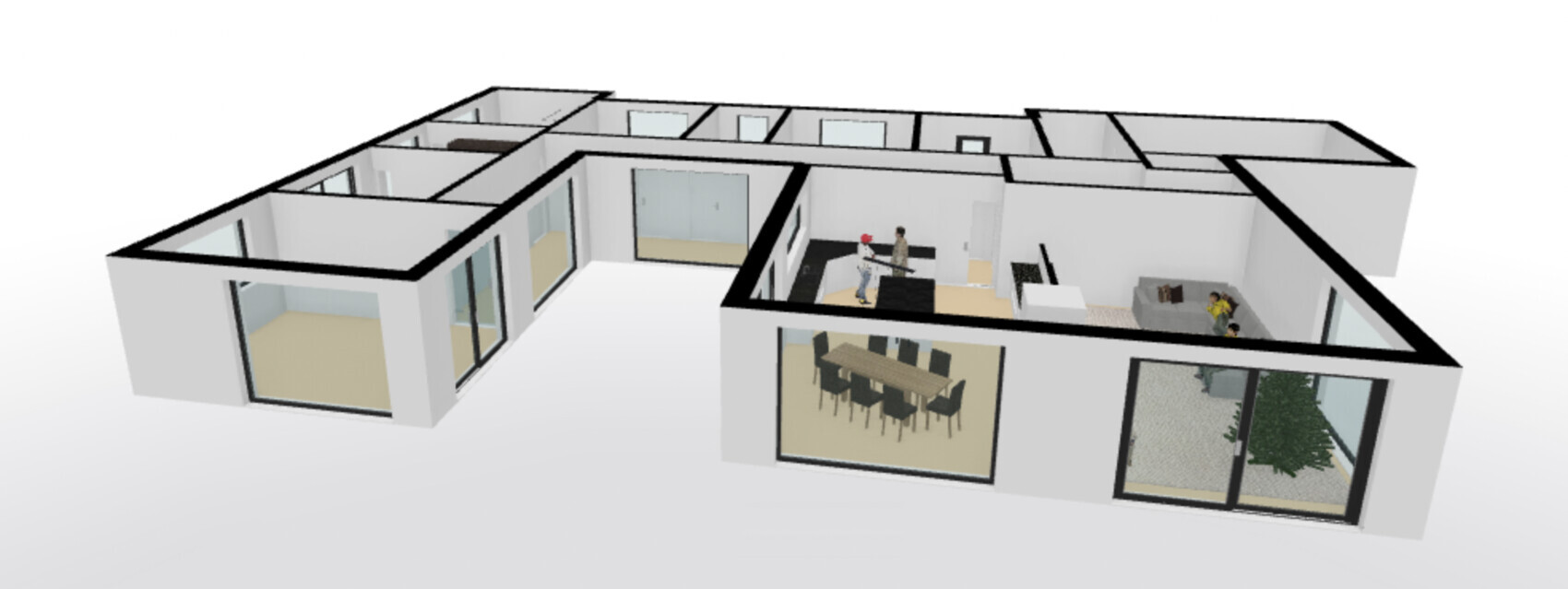
My father is somewhat of a veteran in this field and has built several family single-family homes himself, acting as a kind of site manager or planner. He is an engineer; I work in IT. I do a lot of research, while he tends to stick to the motto "trust in proven methods." So we often have differing opinions. That’s the background 🙂
I recently came across Ytong because I like the idea of a monolithic exterior wall without many layers or unnecessary complexity. I am interested in the 425mm (16.7 inches) wall thickness.
I would like to have external venetian blinds on all windows and sliding doors and have seen that their installation can be done like this, for example:
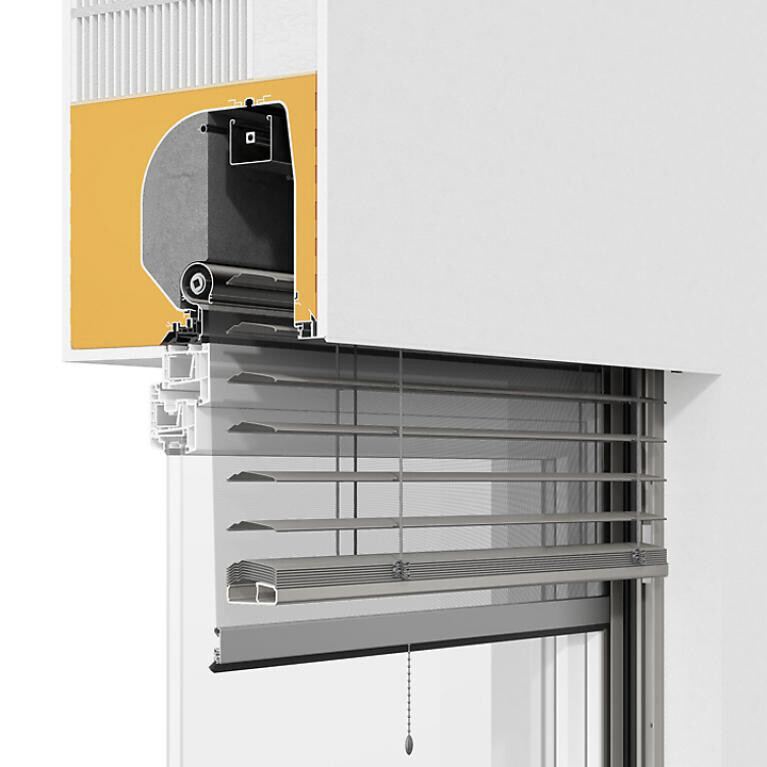
I assume there are finished, insulated boxes available for this purpose, like these here:

and that you can then plaster over the joints with reinforcing mesh without breaking the building material, resulting in a smooth and clean surface.
My father says, “For heaven’s sake... get 365mm (14.4 inches) Poroton T7 or Ytong if you prefer, and install a slim 60mm (2.4 inches) external thermal insulation composite system (ETICS) over the masonry and shutter boxes. Otherwise, you’ll get thermal bridges at the boxes and the plaster will crack there over the years.”
He also worries a lot about integrating the 3.5-meter (11.5 feet) wide windows and sliding doors with the venetian blinds, how to incorporate the boxes into the masonry and lintels, etc. I think: this can’t be rocket science nowadays? You see it everywhere, it shouldn’t be so difficult, right?
I would like to trust his experience—he certainly has plenty—but I also believe that building materials and techniques can evolve. Since you occasionally read about monolithic construction and venetian blinds or roller shutter boxes aren’t uncommon, I wonder if everyone just accepts plaster cracks or if this is perhaps no longer an issue today?
Thank you very much!
I am currently planning my first single-family home, a roughly 250m² (2,690 sq ft) bungalow for my family and me. By "planning," I mean that I am researching the available building materials, how houses are generally constructed, and so on.
Here is a rough 3D concept.
My father is somewhat of a veteran in this field and has built several family single-family homes himself, acting as a kind of site manager or planner. He is an engineer; I work in IT. I do a lot of research, while he tends to stick to the motto "trust in proven methods." So we often have differing opinions. That’s the background 🙂
I recently came across Ytong because I like the idea of a monolithic exterior wall without many layers or unnecessary complexity. I am interested in the 425mm (16.7 inches) wall thickness.
I would like to have external venetian blinds on all windows and sliding doors and have seen that their installation can be done like this, for example:
I assume there are finished, insulated boxes available for this purpose, like these here:
and that you can then plaster over the joints with reinforcing mesh without breaking the building material, resulting in a smooth and clean surface.
My father says, “For heaven’s sake... get 365mm (14.4 inches) Poroton T7 or Ytong if you prefer, and install a slim 60mm (2.4 inches) external thermal insulation composite system (ETICS) over the masonry and shutter boxes. Otherwise, you’ll get thermal bridges at the boxes and the plaster will crack there over the years.”
He also worries a lot about integrating the 3.5-meter (11.5 feet) wide windows and sliding doors with the venetian blinds, how to incorporate the boxes into the masonry and lintels, etc. I think: this can’t be rocket science nowadays? You see it everywhere, it shouldn’t be so difficult, right?
I would like to trust his experience—he certainly has plenty—but I also believe that building materials and techniques can evolve. Since you occasionally read about monolithic construction and venetian blinds or roller shutter boxes aren’t uncommon, I wonder if everyone just accepts plaster cracks or if this is perhaps no longer an issue today?
Thank you very much!
N
nordanney19 May 2021 07:01Steffen_S schrieb:
I honestly don’t understand why you can’t or won’t give me a clear answer to a specific question.Your specific question was, “I wonder if they then all accept plaster cracks, or if that just isn’t really an issue nowadays?” The answer is: yes, that’s not an issue.You didn’t ask about detailed construction drawings or anything like that. What’s your problem? Are you building yourself or having professionals do the work?
M
Martial.white19 May 2021 08:36To address the main question of the thread: I find the floor plan quite interesting. 😉
Jokes aside: I’m afraid you’ll only get inadequate answers to the specific question about the execution here in the forum. There are fewer tradespeople and construction experts around, and more homeowners, who mostly have only risky half-knowledge (I include myself here and would be glad to have even "partial" knowledge).
Jokes aside: I’m afraid you’ll only get inadequate answers to the specific question about the execution here in the forum. There are fewer tradespeople and construction experts around, and more homeowners, who mostly have only risky half-knowledge (I include myself here and would be glad to have even "partial" knowledge).
S
Steffen_S19 May 2021 10:03Thank you for doe
I want to understand as much as possible, so I’m researching and asking questions. Of course, contractors will do the building; I will help where I can.
If I knew beforehand that with monolithic walls combined with solid roller shutter boxes there might possibly be unavoidable plaster cracks, I would consider an ETICS (external thermal insulation composite system).
Maybe someone here in the forum has experience with this topic and can say something like "make sure reinforcing mesh is embedded in the plaster there!" or "definitely avoid this type of roller shutter box!" etc., etc. I can’t ask specifically about things I don’t even know yet.
But to be more specific: for the desire to build monolithic walls with Ytong, what exactly should be considered during planning and tendering? Is reinforcing mesh in the plaster sufficient as bridging between the wall and the roller shutter box to prevent plaster cracks? Does it possibly need to be “special” or have a particular layering? Can “any” plasterer do this, or should I make sure the company has specific experience with monolithic Ytong walls?
Is the whole effort and worry perhaps unnecessary because a slim ETICS might be negligible in terms of cost—what would we be talking about here, for example, with wood fiber insulation boards?
Or is this building method generally not recommended, and should I definitely consider ETICS?
These are all points you might read between the lines in the question rather than “What do you actually think of the floor plan?” ;-)
Many thanks
nordanney schrieb:
Your specific question was "I’m wondering whether they then just accept all the plaster cracks, or if that is generally no longer an issue nowadays?" The answer is: no, it’s not an issue.
You didn’t ask about detailed construction plans or similar. What exactly is your problem? Are you building yourself or are contractors doing the work?
I want to understand as much as possible, so I’m researching and asking questions. Of course, contractors will do the building; I will help where I can.
If I knew beforehand that with monolithic walls combined with solid roller shutter boxes there might possibly be unavoidable plaster cracks, I would consider an ETICS (external thermal insulation composite system).
Maybe someone here in the forum has experience with this topic and can say something like "make sure reinforcing mesh is embedded in the plaster there!" or "definitely avoid this type of roller shutter box!" etc., etc. I can’t ask specifically about things I don’t even know yet.
But to be more specific: for the desire to build monolithic walls with Ytong, what exactly should be considered during planning and tendering? Is reinforcing mesh in the plaster sufficient as bridging between the wall and the roller shutter box to prevent plaster cracks? Does it possibly need to be “special” or have a particular layering? Can “any” plasterer do this, or should I make sure the company has specific experience with monolithic Ytong walls?
Is the whole effort and worry perhaps unnecessary because a slim ETICS might be negligible in terms of cost—what would we be talking about here, for example, with wood fiber insulation boards?
Or is this building method generally not recommended, and should I definitely consider ETICS?
These are all points you might read between the lines in the question rather than “What do you actually think of the floor plan?” ;-)
Many thanks
S
Steffen_S19 May 2021 10:04Martial.white schrieb:
To address the main question of the thread for a change: I find the floor plan quite interesting. 😉
Jokes aside: I’m afraid you will only get limited answers regarding the specific execution details here in the forum. There are fewer tradespeople and construction experts, and more homeowners who mostly have only risky half-knowledge (I include myself here and would be happy to have at least “half” the knowledge). Thank you. I have already browsed around here a bit, and occasionally the explanations are very detailed or well presented. That it is not the case in my thread on this topic is probably due to the way the question was asked.
I myself also have only very limited and risky half-knowledge in a few areas and would like to improve on that.
N
nordanney19 May 2021 10:51Steffen_S schrieb:
Is reinforcement mesh in the render sufficient as a bridge between the wall and the roller shutter box to prevent cracks in the render? Yes.
Steffen_S schrieb:
Does this mesh need to be "special" or have a specific layer setup? As far as I know, there are no special requirements.
Steffen_S schrieb:
Can any plasterer do this, or should I specifically make sure the company has experience with monolithic Ytong walls? Any plasterer should be able to do it, since you are asking for a standard application.
Steffen_S schrieb:
Is all this effort maybe not worth it because a slim ETICS (external thermal insulation composite system) might be negligible in cost—what would we be talking about here, for example, with wood fiber insulation boards? A slim ETICS for the whole house? The cost is almost the same as a thicker ETICS (material only accounts for a small part of the total cost, and the additional cost for thicker insulation material is low). Since you want to build monolithically (which is perfectly normal practice, just like ETICS), I wouldn’t change your whole approach because of such a minor detail. Mixing a supposedly monolithic Ytong wall with a pseudo-ETICS is the worst and also the most expensive option.
Steffen_S schrieb:
Or is this construction method generally not recommended and should I definitely consider using an ETICS? Both methods are common today and it mostly comes down to personal preference. Some want to avoid "plastic" on their facade (even though there are many ETICS variants), others prefer monolithic walls, and a third group favors cavity wall construction with attractive facing brickwork. Inside the house, there is no difference; only the cost varies.
 bauenmk202019 May 2021 11:08
You get cracks in the plaster due to incorrect application or different thermal expansion coefficients of the materials. Make sure your wall structure is fairly uniform so that it doesn’t expand unevenly under direct sunlight.
This all relates to building physics. An important aspect during construction is always the “joints,” meaning how component A connects to component B and how these are executed. Besides temperature, factors such as rain or moisture can also affect the plaster. For example, drip edges should have enough distance from the facade. Don’t skimp on the roof overhang.
At the base of the wall, you will likely experience mechanical stress. Here, too, perimeter insulation is applied in monolithic construction. The plaster tends to form vertical cracks at the joints between insulation panels.
PS:
If using Poroton bricks, have them laid with a mortar bed and not dipped into mortar. For filled bricks, the latter probably wouldn’t work, but if you’re not using filled ones, you’ll thank me later 🙂
This all relates to building physics. An important aspect during construction is always the “joints,” meaning how component A connects to component B and how these are executed. Besides temperature, factors such as rain or moisture can also affect the plaster. For example, drip edges should have enough distance from the facade. Don’t skimp on the roof overhang.
At the base of the wall, you will likely experience mechanical stress. Here, too, perimeter insulation is applied in monolithic construction. The plaster tends to form vertical cracks at the joints between insulation panels.
PS:
If using Poroton bricks, have them laid with a mortar bed and not dipped into mortar. For filled bricks, the latter probably wouldn’t work, but if you’re not using filled ones, you’ll thank me later 🙂
Similar topics