
ᐅ Architectural floor plan for a 240 m² single-family home in Bauhaus style
Created on: 15 Dec 2016 18:16
K
Kostiksch
Hello everyone,
My name is Konstantin, and we will be building a house for ourselves and our children (currently 1, increasing to 3 in the next few years) in early 2017.
I have been following this forum for a while and am always grateful for your tips on all aspects of house construction. I have already been able to use many ideas for our project. Thank you all!
Attached is our floor plan (created with a friend who is an architect).
This floor plan has been optimized several times and we are quite happy with it.
Since this is a major investment that should be well planned and prepared, we would like to hear your opinions on the floor plan to avoid possible mistakes or to incorporate new ideas.
We look forward to your feedback.
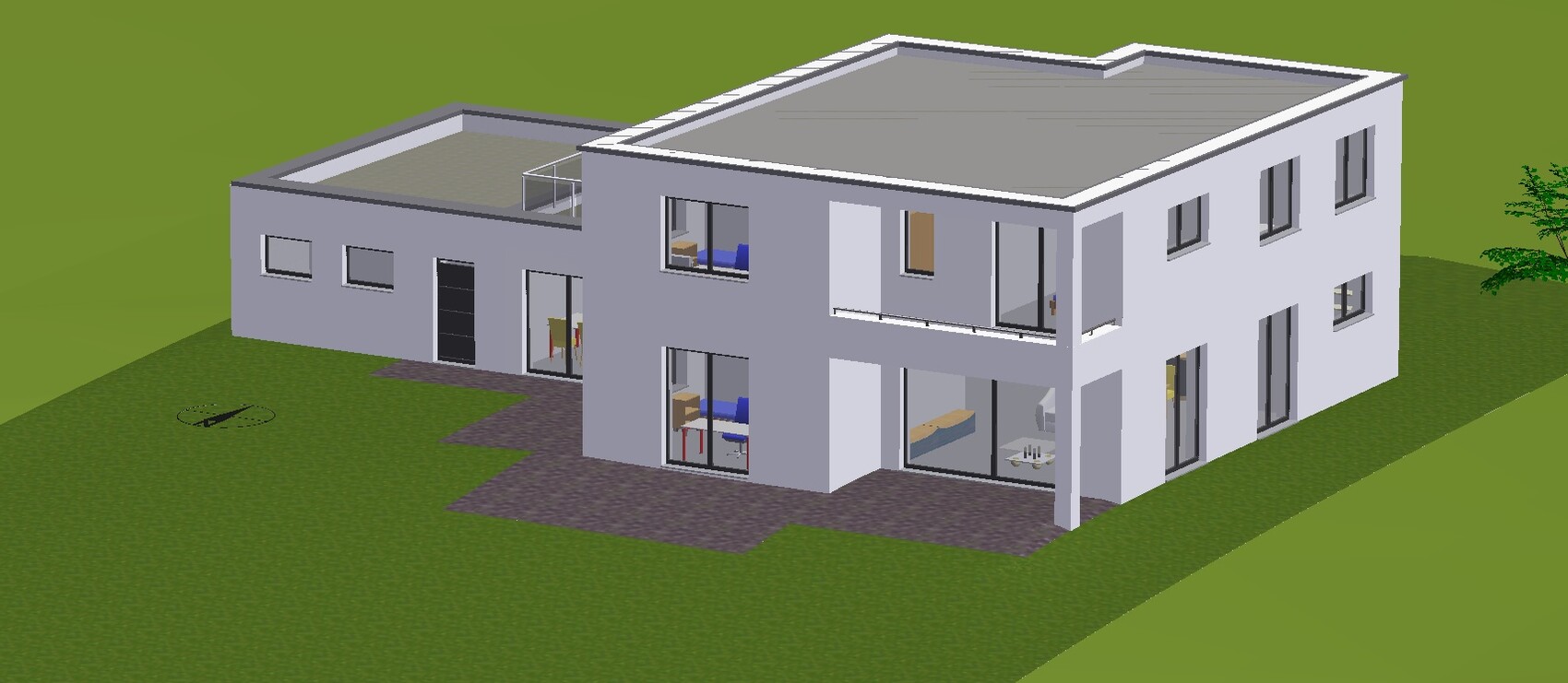
I have included images of the ground floor, upper floor, 3D house model, and the plot.
Development Plan / Restrictions
Plot size: 1,008m2 (see plot plan No. 412)
Slope: YES, south-facing slope 10%
Floor area ratio (FAR): 0.4
Site coverage ratio (building density): 0.4
Building envelope, building line, and boundary
Edge setback: 3 meters (10 feet) from the street, 1 meter (3 feet) from the neighbor (west side)
Number of floors: 1 full floor + 1 recessed upper floor
Roof type: flat roof
Client Requirements
Style: Bauhaus
Roof: flat roof
Basement: no
Number of floors: 2
Number of people, age: currently 3, increasing to 5 within 5 years
Office: home office + meeting room
Guest stays per year: at least 1–2 times per month
Open or closed architecture: open
Conservative or modern construction: modern
Open kitchen, cooking island: open kitchen
Number of dining seats: at least 8
Fireplace: no
Balcony, roof terrace: yes/yes
Garage, carport: garage
Vegetable garden, greenhouse: no
Additional features: KNX wiring, ground-source heat pump, controlled mechanical ventilation, water softener, KFW55 (energy standard)
House Design
Designed by: architect
Estimated cost according to architect/planner: around 500,000 euros plus land
Preferred heating technology: heat pump
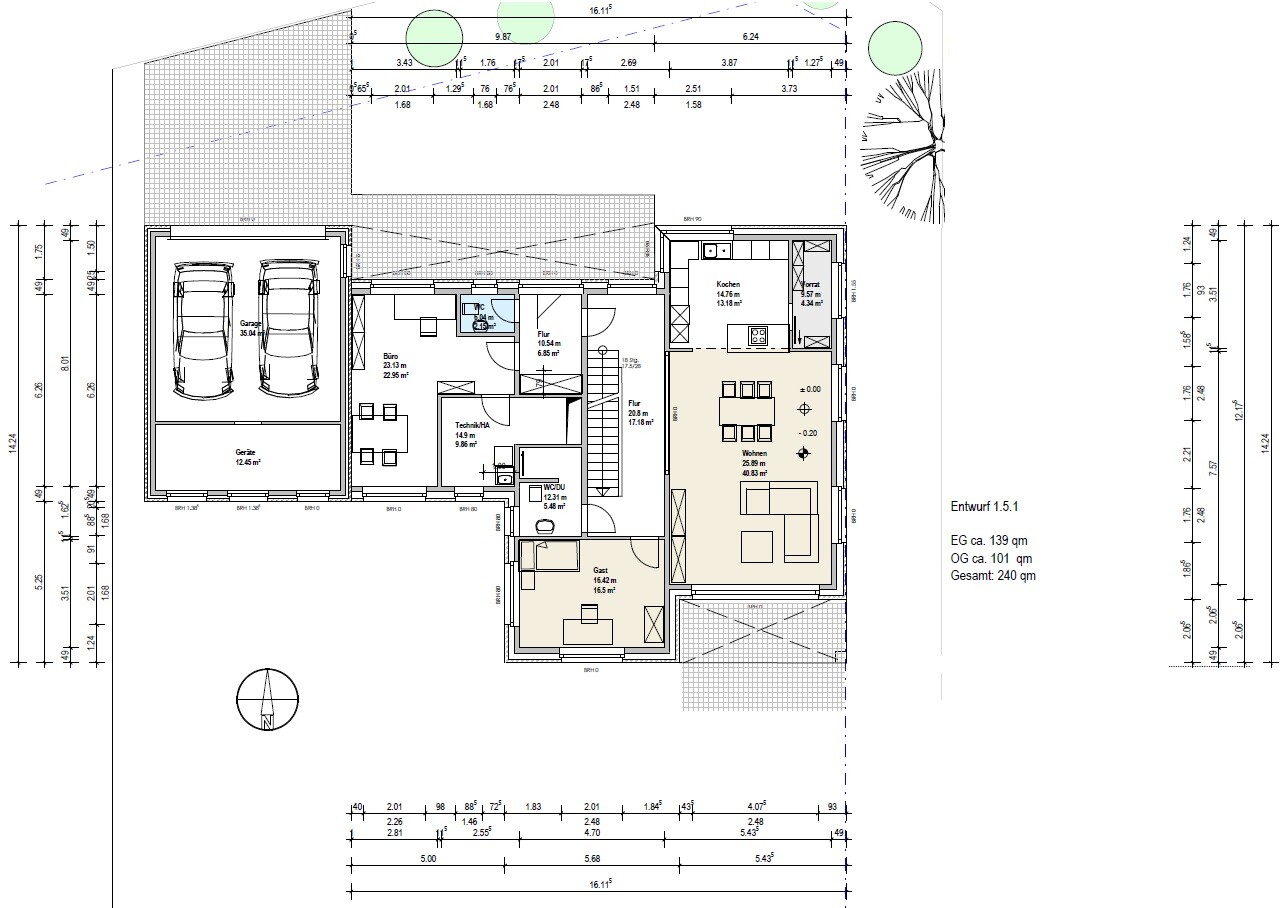
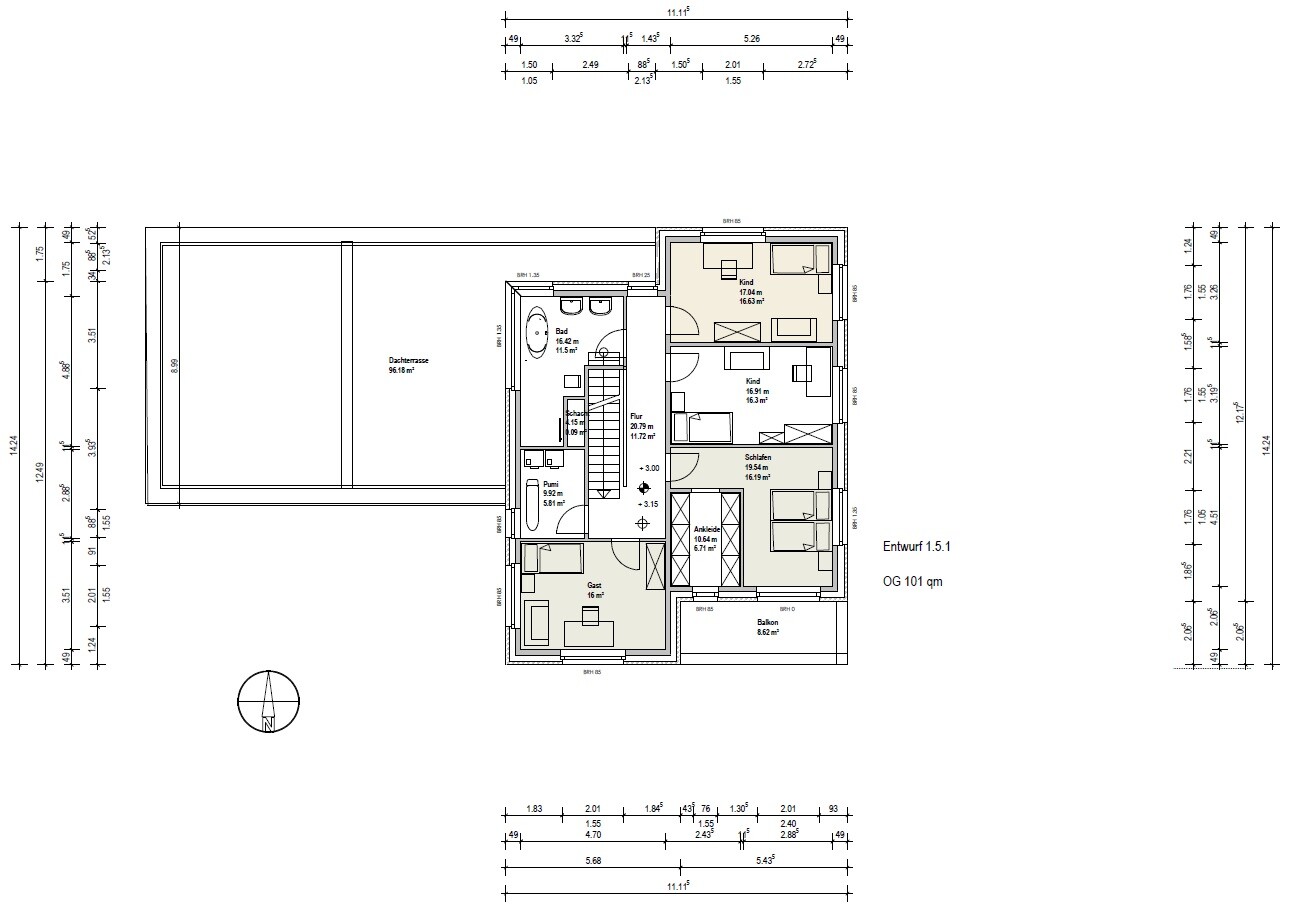
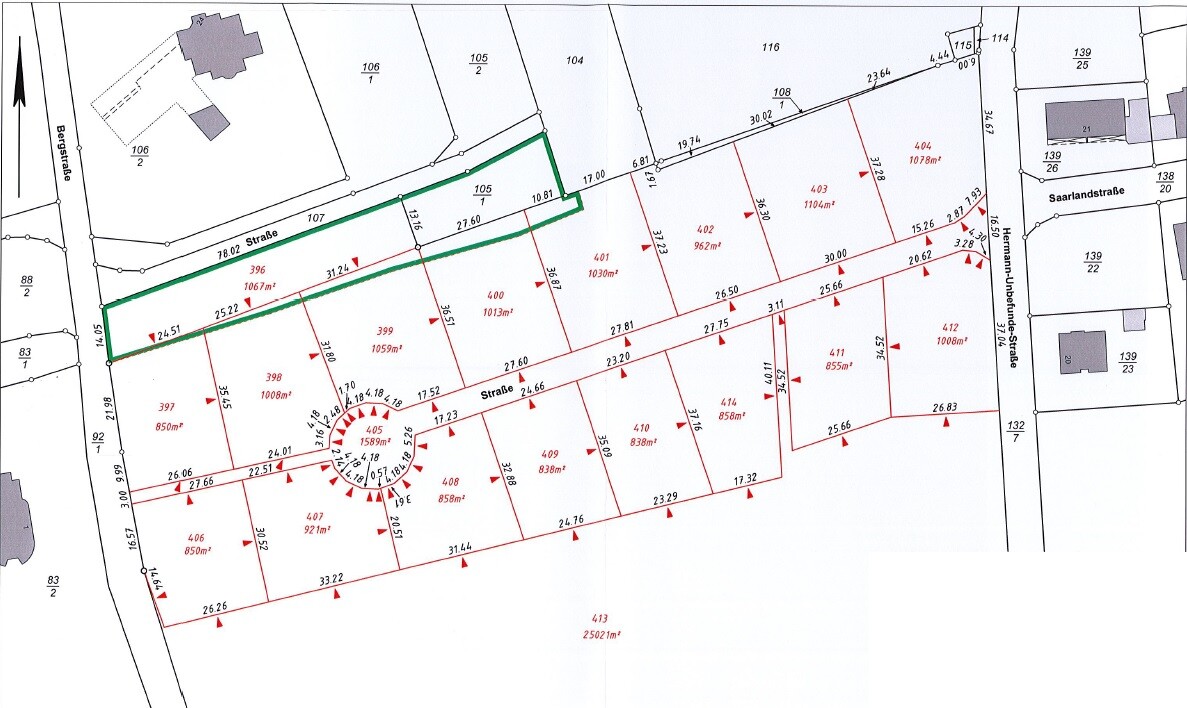
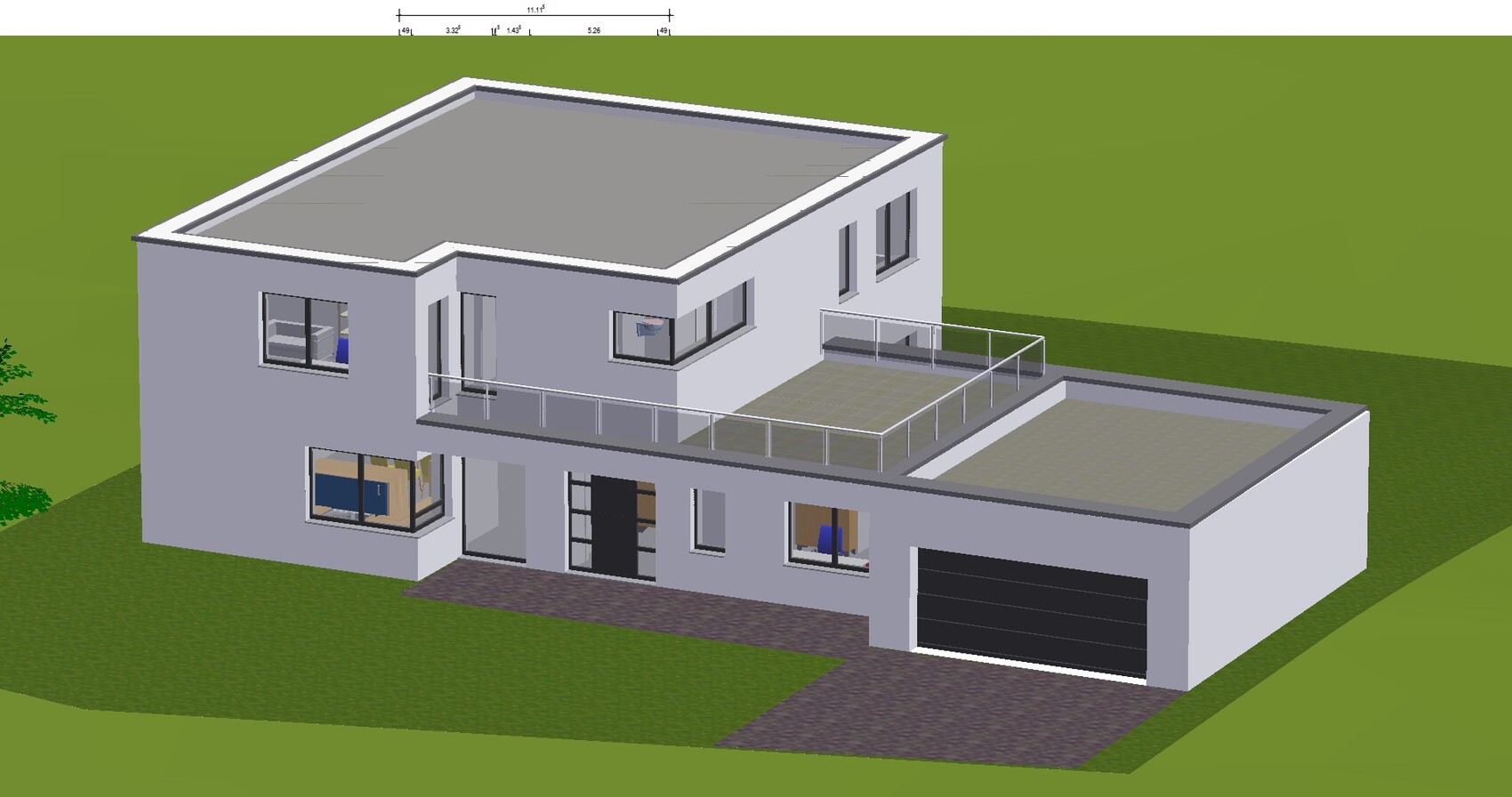
My name is Konstantin, and we will be building a house for ourselves and our children (currently 1, increasing to 3 in the next few years) in early 2017.
I have been following this forum for a while and am always grateful for your tips on all aspects of house construction. I have already been able to use many ideas for our project. Thank you all!
Attached is our floor plan (created with a friend who is an architect).
This floor plan has been optimized several times and we are quite happy with it.
Since this is a major investment that should be well planned and prepared, we would like to hear your opinions on the floor plan to avoid possible mistakes or to incorporate new ideas.
We look forward to your feedback.
I have included images of the ground floor, upper floor, 3D house model, and the plot.
Development Plan / Restrictions
Plot size: 1,008m2 (see plot plan No. 412)
Slope: YES, south-facing slope 10%
Floor area ratio (FAR): 0.4
Site coverage ratio (building density): 0.4
Building envelope, building line, and boundary
Edge setback: 3 meters (10 feet) from the street, 1 meter (3 feet) from the neighbor (west side)
Number of floors: 1 full floor + 1 recessed upper floor
Roof type: flat roof
Client Requirements
Style: Bauhaus
Roof: flat roof
Basement: no
Number of floors: 2
Number of people, age: currently 3, increasing to 5 within 5 years
Office: home office + meeting room
Guest stays per year: at least 1–2 times per month
Open or closed architecture: open
Conservative or modern construction: modern
Open kitchen, cooking island: open kitchen
Number of dining seats: at least 8
Fireplace: no
Balcony, roof terrace: yes/yes
Garage, carport: garage
Vegetable garden, greenhouse: no
Additional features: KNX wiring, ground-source heat pump, controlled mechanical ventilation, water softener, KFW55 (energy standard)
House Design
Designed by: architect
Estimated cost according to architect/planner: around 500,000 euros plus land
Preferred heating technology: heat pump
K
Kostiksch16 Dec 2016 16:58ivenh0 schrieb:
I don’t want to be mean, but your architect friend seems to have simply taken this floor plan, mirrored it on the ground floor, and slightly modified it on the upper floor.
Google: "Kern-Haus Ixeo"andimann schrieb:
Hi,
Indeed, this could lead to copyright issues!
If your architect is not by chance from Kern-Haus, you will need to stay away from this floor plan. It wouldn’t be their property!
Best regards,
AndreasNothing was copied here... if anything, it was only inspired by it, but almost everything was changed (proportions, rooms, facade, windows, etc.)
Kostiksch schrieb:
This floor plan has already been optimized several times and we quite like it now.From the core planner
Kostiksch schrieb:
Nothing was copied here ... if anything, it was only used as a reference but almost everything was changed in some way (proportions, rooms, facade, windows, etc.)Don’t try to fool us – we do have eyes ... just changing a few windows isn’t enough.
......................................
I have deliberately held back with my comment, which unfortunately is negative. Fortunately, @andimann expressed my thoughts ahead of me – I fully agree with him.
The exterior view, especially the east and south sides, looks very bulky – it has none of the elegance of a modern Bauhaus style.
The small covered terrace and the upper balcony give the impression of a two-family house. The wide house/property is really being squeezed onto a long, narrow plot.
It does not fit the plot. Even if the neighbor is building equally tight, it simply is not attractive or appropriate!
I wonder why the main terrace and living areas are oriented towards the street when the rest of the property offers many other possibilities, including for construction and privacy screening. The only regulated setback of 3 meters (about 10 feet) was just barely maintained (more on that later). As a result, the living room will only look out onto the street or a hedge, which itself already takes up about a meter (3 feet) in width. There’s no real view of the garden!
Also, the access from the kitchen to the dining terrace (covered terrace) is way too long and passes through the lounge area. You’d need a butler with a walkie-talkie to bring the salad to the grill.
The use of the garden is also limited by the office extension, which apparently is used or visited by people outside the family. The guest room on the ground floor greatly reduces the garden view from the living area. With 500 square meters (about 5,400 square feet) of garden, that’s a big loss.
Which brings me to the rooftop terrace/balcony, which I also question: what is the purpose of a rooftop terrace that has almost no connection to the upper floor living areas except for a narrow balcony door from the hallway? If there was at least a sauna in the bathroom upstairs with access to the terrace to cool off or relax outdoors after a sauna session, that would make sense – but as it is, the rooftop terrace seems to be added just for the sake of having one. For kids it is also much too dangerous because it cannot be supervised from the garden. The routes to this balcony/rooftop terrace are too long and inconvenient even for hanging laundry. For relaxing or sitting—who wants to be cut off from the house all the way up there? What is the garden for then?
Regarding set back distances from the house to the property line: As a layperson, I question whether a two-story building can actually comply with a 3 meter (about 10 feet) setback to the property boundary. Shouldn’t this be larger, increasing with building height?
Inside the house:
I am wondering if it is really as awkward as it seems. Yes, when you enter, as a guest you somehow don’t quite know where to go.
I like the placement of the guest WC and that these rooms are not directly at the entrance, but they occupy space that might otherwise be part of the open living space (kitchen/dining/living).
The staircase is beautiful—but only suitable if you don’t have children. I wouldn’t want my child on it until at least age 10.
The open space is acceptable; the living area isn’t huge but reasonably sized and down-to-earth.
To reduce the bulkiness of the house and comply with the setback on the right side, I would move the upper part of the building to the left, so the bedrooms are more in the southwest and a single-story flat-roofed structure above the living area on the right side.
But honestly, I would choose a different house (or have one designed) where the kitchen, dining, and living areas face the garden, and the terrace is protected in the southwest.
Edit: With three children, I see the coat storage preferably under the stairs, even if parents don’t like it. The children will do it anyway, and eventually themselves, when they just need to take off a jacket briefly before heading out again. So the dining area won’t have a nice view into the hallway and could feel uncomfortable.

K
Kostiksch16 Dec 2016 17:37ypg schrieb:
No need to fool us – we do have eyes ...changing just a few windows isn’t enough.If you had read my statement carefully, you wouldn’t need to say that!
ypg schrieb:
Regarding the setback distances from the house to the property boundary: as a layperson, I question whether a two-story house can meet a 3-meter (10-foot) setback from the property line. Shouldn’t it be more, the higher the building, the more distance required?That’s fine!
Although I don’t fully agree with some points in your comment, I still want to thank you very much for your detailed feedback. That’s the first input that really adds value.
On some points, I agree with you.
The guest room on the ground floor is a guest room only when visitors stay; otherwise, it serves as a play and craft room. From our perspective, the entire south side on the ground floor is very well utilized.
On the upper floor, it’s difficult to position all bedrooms/kids’ rooms facing south; otherwise, the house would have to be very long and narrow, and the staircase wouldn’t fit.
I would gladly implement your ideas, but we have to consider certain building regulations, office use, number of rooms, and so on.
Kostiksch schrieb:
The guest room on the ground floor is only used as a guest room when visitors come; otherwise, it serves as a playroom and craft room, so from our perspective the entire south side of the ground floor is utilized very well.You will be lowering the blinds anyway when working and playing.
Kostiksch schrieb:
On the upper floor, it is difficult to place all bedrooms/children’s rooms facing the south side; otherwise, the house would have to be a long narrow building, and the staircase would not fit.Southwest!
Kostiksch schrieb:
I would love to implement your ideas, but we have to take certain building regulations, office use, number of rooms, etc., into account.We are well aware of that here in a building forum.
Still, one does not exclude the other, because the regulations don’t say: Build a block with living spaces facing east, away from your property.
The core house is not the only one of its kind – nor is it the only one that does not fit this plot. But if you hire a proper architect, they will optimize it and you will have a house that fits!
Of course, if you insist that it can only be done one way and not otherwise: you will have to live in it – not us.
Edit: Just try countering the residential complex with a diagonal.
I also don’t recognize any Bauhaus style here.
The staircase and the idea of accommodating three children there seem to come from a completely different context.
The large workspace suggests that colleagues or clients will be present on-site. Otherwise, the financial effort for this area is hard to justify. However, if clients do visit, there is no practical access. The current entrance to the house is minimal—a tiny hallway. It’s hardly representative. This fulfills the requirement to separate work from living, but nothing more.
I find it hard to believe this is the work of architects.
The staircase and the idea of accommodating three children there seem to come from a completely different context.
The large workspace suggests that colleagues or clients will be present on-site. Otherwise, the financial effort for this area is hard to justify. However, if clients do visit, there is no practical access. The current entrance to the house is minimal—a tiny hallway. It’s hardly representative. This fulfills the requirement to separate work from living, but nothing more.
I find it hard to believe this is the work of architects.
Similar topics