
Development Plan/Restrictions
Plot size: 1100sqm (1,1840 sq ft)
Slope: Yes (west to east)
Building coverage ratio / Floor area ratio: none
Building envelope, building line and boundary: none
Edge development: Theoretically possible, as neighboring plot belongs to parents
Number of parking spaces: 2 per housing unit (relevant if split into two apartments)
Number of floors: none
Roof type: only gable roof & hip roof (also for garage!)
Architectural style: none
Orientation: none
Maximum heights/restrictions: none
Other requirements: roof overhang of at least 50cm (20 inches)
Homeowners’ Requirements
Style, roof shape, building type: hip roof urban villa
Basement, floors: yes, 2 full floors
Number of people, ages: 36, 35, 4, 0
Space requirements on ground floor, upper floor:
Office: family use or home office? Home office once a week
Guest overnight stays per year: 1-2
Open or closed architecture: semi-open
Conservative or modern style: rather modern
Open kitchen, cooking island: yes, yes
Number of dining seats: 4-8
Fireplace: not necessary, also can’t find a suitable place
Music / stereo wall: TV wall yes
Balcony, roof terrace: balcony (only due to possible split into two apartments)
Garage, carport: double garage
Utility garden, greenhouse
Additional wishes/special features/daily routine, also reasons why this or that should or shouldn’t be: bay window with balcony, even if it gets expensive…
House Design
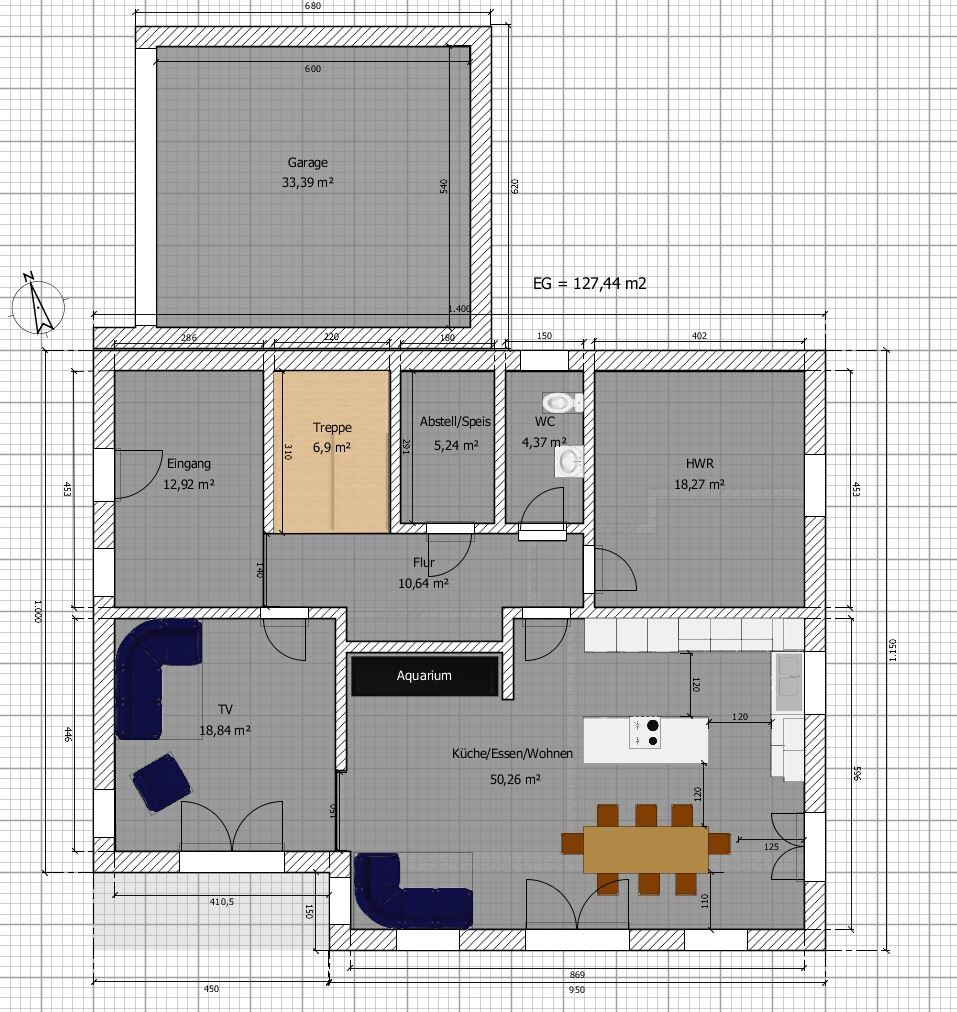
Who designed it: do-it-yourself with SweetHome3D
What do you like most? Why? Everything. I think I spent so long working on the floor plan that I’m in love with it and probably totally “blind” to its flaws.
What do you dislike? Why?
Price estimate according to architect/planner:
Personal price limit for the house, including equipment: 750,000€
Preferred heating system: gas
If you had to give up, which details/extensions
- could you do without: somehow nothing
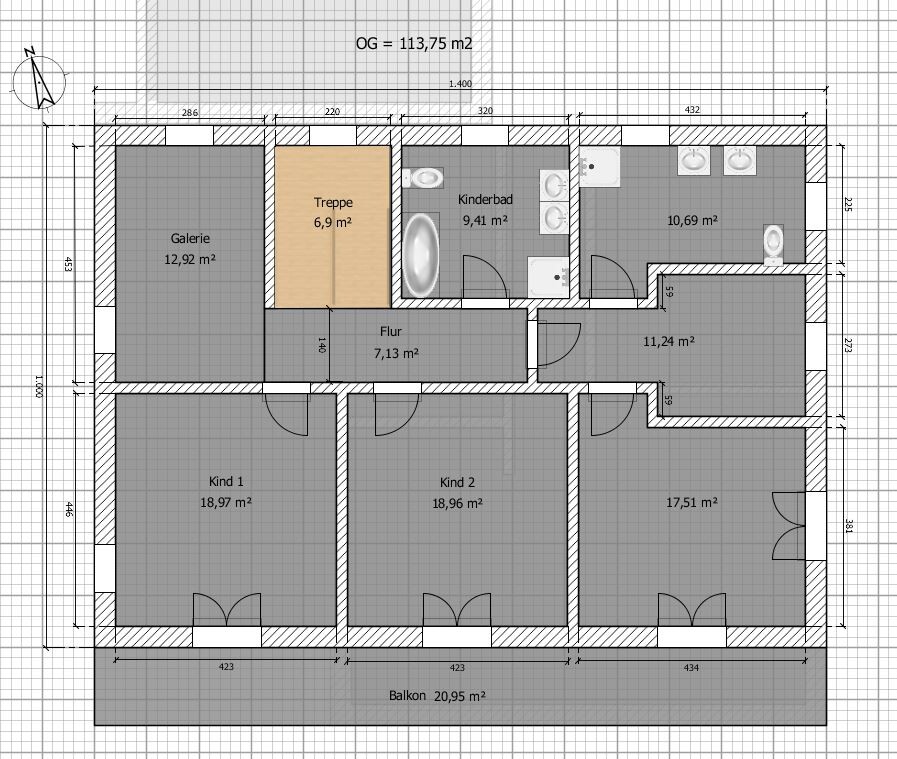
- could you not do without: large entrance/wardrobe; large children’s rooms; master bedroom facing east (I want to watch the sunrise); large aquarium as a highlight in the living area; platform staircase; children’s bathroom; and my wife absolutely wants a gallery.
Why did the design turn out as it is now?
I looked at almost every floor plan from all prefabricated house manufacturers and, annoyed by the “cookie-cutter” designs (keyword: living room/kitchen/dining all in one long corridor and stairs always immediately by the dirty entrance), I started working out my own floor plan. Many thanks to this forum because I have learned a lot from the floor plan discussions here! I even dealt with Feng Shui for the layout.
What do you think makes it particularly good or bad?
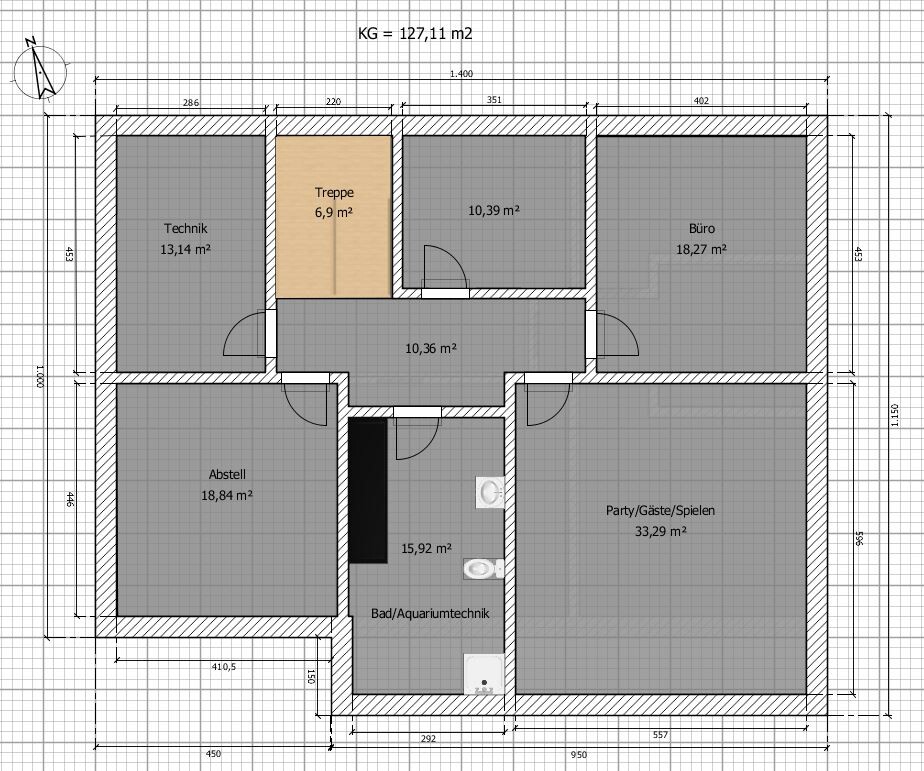
The rooms are ideally oriented to the sun: living spaces face south, unoccupied rooms face north. In addition, the slight slope (to the east) allows for nice walk-out basement rooms. The layout can also be easily split into two apartments, making it flexible for a barrier-free future. Technical aspects and piping were also considered: the utility room is on the street side and pipes/water lines don’t run erratically but are kept close together.
The only downside I see is that the kitchen is “far” from the entrance. However, I don’t find this very problematic and only mention it because it would probably be a common criticism.
What is the most important/basic question about the floor plan summarized in 130 characters?
I’m grateful for suggestions or optimizations of any kind! Especially tips for the master bathroom. I’m not 100% satisfied yet.
Good luck
Alro
Plot size: 1100sqm (1,1840 sq ft)
Slope: Yes (west to east)
Building coverage ratio / Floor area ratio: none
Building envelope, building line and boundary: none
Edge development: Theoretically possible, as neighboring plot belongs to parents
Number of parking spaces: 2 per housing unit (relevant if split into two apartments)
Number of floors: none
Roof type: only gable roof & hip roof (also for garage!)
Architectural style: none
Orientation: none
Maximum heights/restrictions: none
Other requirements: roof overhang of at least 50cm (20 inches)
Homeowners’ Requirements
Style, roof shape, building type: hip roof urban villa
Basement, floors: yes, 2 full floors
Number of people, ages: 36, 35, 4, 0
Space requirements on ground floor, upper floor:
Office: family use or home office? Home office once a week
Guest overnight stays per year: 1-2
Open or closed architecture: semi-open
Conservative or modern style: rather modern
Open kitchen, cooking island: yes, yes
Number of dining seats: 4-8
Fireplace: not necessary, also can’t find a suitable place
Music / stereo wall: TV wall yes
Balcony, roof terrace: balcony (only due to possible split into two apartments)
Garage, carport: double garage
Utility garden, greenhouse
Additional wishes/special features/daily routine, also reasons why this or that should or shouldn’t be: bay window with balcony, even if it gets expensive…
House Design
Who designed it: do-it-yourself with SweetHome3D
What do you like most? Why? Everything. I think I spent so long working on the floor plan that I’m in love with it and probably totally “blind” to its flaws.
What do you dislike? Why?
Price estimate according to architect/planner:
Personal price limit for the house, including equipment: 750,000€
Preferred heating system: gas
If you had to give up, which details/extensions
- could you do without: somehow nothing
- could you not do without: large entrance/wardrobe; large children’s rooms; master bedroom facing east (I want to watch the sunrise); large aquarium as a highlight in the living area; platform staircase; children’s bathroom; and my wife absolutely wants a gallery.
Why did the design turn out as it is now?
I looked at almost every floor plan from all prefabricated house manufacturers and, annoyed by the “cookie-cutter” designs (keyword: living room/kitchen/dining all in one long corridor and stairs always immediately by the dirty entrance), I started working out my own floor plan. Many thanks to this forum because I have learned a lot from the floor plan discussions here! I even dealt with Feng Shui for the layout.
What do you think makes it particularly good or bad?
The rooms are ideally oriented to the sun: living spaces face south, unoccupied rooms face north. In addition, the slight slope (to the east) allows for nice walk-out basement rooms. The layout can also be easily split into two apartments, making it flexible for a barrier-free future. Technical aspects and piping were also considered: the utility room is on the street side and pipes/water lines don’t run erratically but are kept close together.
The only downside I see is that the kitchen is “far” from the entrance. However, I don’t find this very problematic and only mention it because it would probably be a common criticism.
What is the most important/basic question about the floor plan summarized in 130 characters?
I’m grateful for suggestions or optimizations of any kind! Especially tips for the master bathroom. I’m not 100% satisfied yet.
Good luck
Alro
T
Traumhaus20207 Mar 2019 11:41kaho674 schrieb:
Sorry, Alro, for cluttering up the thread here. On the contrary! I find reports like those from @perth about foreign building and living styles very interesting.
Clearly, here in Germany we build much more solidly and with higher quality (and therefore more expensively) than, for example, in the USA or Australia. BUT does it always have to be so boring/ugly? I have the feeling that the only design highlight for German home builders is the gray windows. The rest is white and plain...
It doesn’t always have to be 10 gables and bay windows, but a bit of wooden cladding here, some stone or brickwork there, and 2-3 coordinated wall colors don’t cost a fortune...
Every little bit helps. You have a good budget, so something can be done. With 150 sqm (1,615 sq ft), it’s really tight, and there’s no room to cut corners. At 200 sqm (2,153 sq ft) or more, you can easily save 5 sqm (54 sq ft) and use that to upgrade the facade.
You definitely wanted an urban villa,
so get rid of that.
I’m curious to see what you choose and what can be implemented.
Actually, I only know of one really dull housing estate.
You definitely wanted an urban villa,
so get rid of that.
I’m curious to see what you choose and what can be implemented.
Actually, I only know of one really dull housing estate.

Where does everyone live, by the way? I don’t really get the impression that all the houses look the same when I drive through new developments. Sure, white dominates as the facade color, but that’s better than some other extremes… In my town, and right at one of the most central intersections, someone painted their townhouse in After Eight green… I would definitely have preferred white there. But basically, it’s a matter of taste. Personally, I like these “townhouses” less and less (especially when they’re more like “little villas”), but I don’t see a uniform look. Different roof pitches are used, as well as roof styles (provided the development plan/planning permission allows it). I’m also seeing more and more wood on facades or creative window designs (for example, two “connected” windows, either by material or color—I’m not sure what the technical term is). Of course, the building shapes are becoming more compact and cubic. But that’s due to construction costs and energy-saving regulations.
I find the way houses are built here (and I’m referring to the region I come from) much more appealing than in some other countries. I also like watching my wife follow Chip and Joanna occasionally when they’re remodeling, and some of it really is quite nice—but neither is it feasible here nor would I honestly want to live in it.
And to put it the other way around… when I soon see the building plans of our future neighbors, I hope more for a minimalist white cube than for an After Eight green Tuscan-style townhouse with Gothic influences and a Swedish log cabin garage…
I find the way houses are built here (and I’m referring to the region I come from) much more appealing than in some other countries. I also like watching my wife follow Chip and Joanna occasionally when they’re remodeling, and some of it really is quite nice—but neither is it feasible here nor would I honestly want to live in it.
And to put it the other way around… when I soon see the building plans of our future neighbors, I hope more for a minimalist white cube than for an After Eight green Tuscan-style townhouse with Gothic influences and a Swedish log cabin garage…

Traumhaus2020 schrieb:
It doesn't always have to be 10 gables and bay windows, but a bit of wood paneling here, some stone or brick cladding there, and 2-3 coordinated wall colors don’t cost a fortune… Exactly that "a bit" is the problem. It’s not always a full ten gables, but often the total of the quotes from their favorite Pinterest dream houses is just too much.
https://www.instagram.com/11antgmxde/
https://www.linkedin.com/company/bauen-jetzt/
I completely agree with Traumhaus. For example, in our case, the street-facing side is designed to be much more attractive and not all four exterior walls are painted the same color.
Of course, not all houses are the same in Germany, but almost every second thread here features a gable roof, and the "urban villas" look very similar except for the windows—square, with upper and lower floors of the same size.
There was once a thread where someone posted a link to an urban development somewhere in Germany, where these so-called villas were indeed lined up side by side and back to back.
When I still lived in Germany, the term "urban villas," as it is understood today, did not exist, and they certainly are not villas in my understanding of the term.
For example, in our homes, the upper and lower floors are generally not the same size, with the lower floor usually larger, and the kitchen always adjacent to the terrace. In my opinion, this allows for more freedom in interior design.
Often, I see on this forum that someone has a large plot of land, over 1000 square meters (about 10760 square feet), yet they build a square or slightly rectangular two-story house at one end, which usually results in a square kitchen of about 3.20 x 3.20 meters (10.5 x 10.5 feet) that is difficult to furnish. Every second kitchen in new constructions has this shape, which simply results from the nearly square house layout. I always wonder if this is usually dictated by the building permit or planning permission.
As for Fixer Upper, these houses definitely have character, with great kitchens featuring Calacatta countertops, well-coordinated colors, and not just gray in all shades.
Of course, not all houses are the same in Germany, but almost every second thread here features a gable roof, and the "urban villas" look very similar except for the windows—square, with upper and lower floors of the same size.
There was once a thread where someone posted a link to an urban development somewhere in Germany, where these so-called villas were indeed lined up side by side and back to back.
When I still lived in Germany, the term "urban villas," as it is understood today, did not exist, and they certainly are not villas in my understanding of the term.
For example, in our homes, the upper and lower floors are generally not the same size, with the lower floor usually larger, and the kitchen always adjacent to the terrace. In my opinion, this allows for more freedom in interior design.
Often, I see on this forum that someone has a large plot of land, over 1000 square meters (about 10760 square feet), yet they build a square or slightly rectangular two-story house at one end, which usually results in a square kitchen of about 3.20 x 3.20 meters (10.5 x 10.5 feet) that is difficult to furnish. Every second kitchen in new constructions has this shape, which simply results from the nearly square house layout. I always wonder if this is usually dictated by the building permit or planning permission.
As for Fixer Upper, these houses definitely have character, with great kitchens featuring Calacatta countertops, well-coordinated colors, and not just gray in all shades.
perth schrieb:
Of course, not all houses are the same in Germany, but probably every second thread here features a gable roof, and the "urban villas" all look the same except for the windows—square, with upper and lower floors of the same size.So, really? Every second house has a gable roof? And the rest are all urban villas? I mean, that’s a subjective impression. For a while, everyone was criticizing cubic flat roofs, and so on.
perth schrieb:
There was a thread here where someone posted a link to a housing development somewhere in Germany, where these so-called villas actually stood in rows, side by side and back to back.“There was…” yes, exactly—but that doesn’t mean every new development looks like that…not every American is a redneck driving a pickup truck with a shotgun behind the seat.
perth schrieb:
I often see here in the forum that someone owns a large plot, >1000 m² (10,764 sq ft), yet they build a square or slightly rectangular two-story house at one end, resulting in a roughly square kitchen about 3.20 x 3.20 m (10.5 x 10.5 ft) that is hard to furnish. Every second kitchen in new builds has this shape simply because the house is almost square. I always wonder if this is mostly due to the building regulations.Yes, as already mentioned, building regulations often set restrictions such as site coverage ratio, floor area ratio, eave height, ridge height, etc. The rest is determined by energy efficiency standards and construction costs.
perth schrieb:
And regarding Fixer Upper, these houses definitely have character, great kitchens with Calacatta countertops, everything nicely coordinated in color, not just gray shades.That’s a matter of taste; for a holiday lodge, I’d mostly like that, but it’s not my style for everyday living. And again, the question is price…how much does Joanna pay per linear meter for Calacatta marble, and then compare that to what a high-quality stone costs in a kitchen studio here? Generally speaking…apart from the fact that these houses wouldn’t get approval from a structural engineer nor comply with energy-saving regulations, just ask in Germany what an L-shaped 300 m² (3,229 sq ft) bungalow with eight gables, shingles, and a covered veranda costs.
Similar topics