
ᐅ Analog room thermostat – can it be replaced with a digital thermostat?
Created on: 8 Nov 2025 15:50
F
fjwalterHello everyone,
I have a room in my house with underfloor heating controlled by a room thermostat.
From what I can tell, it is a Halmburger thermostat.
Model RT-76 1U

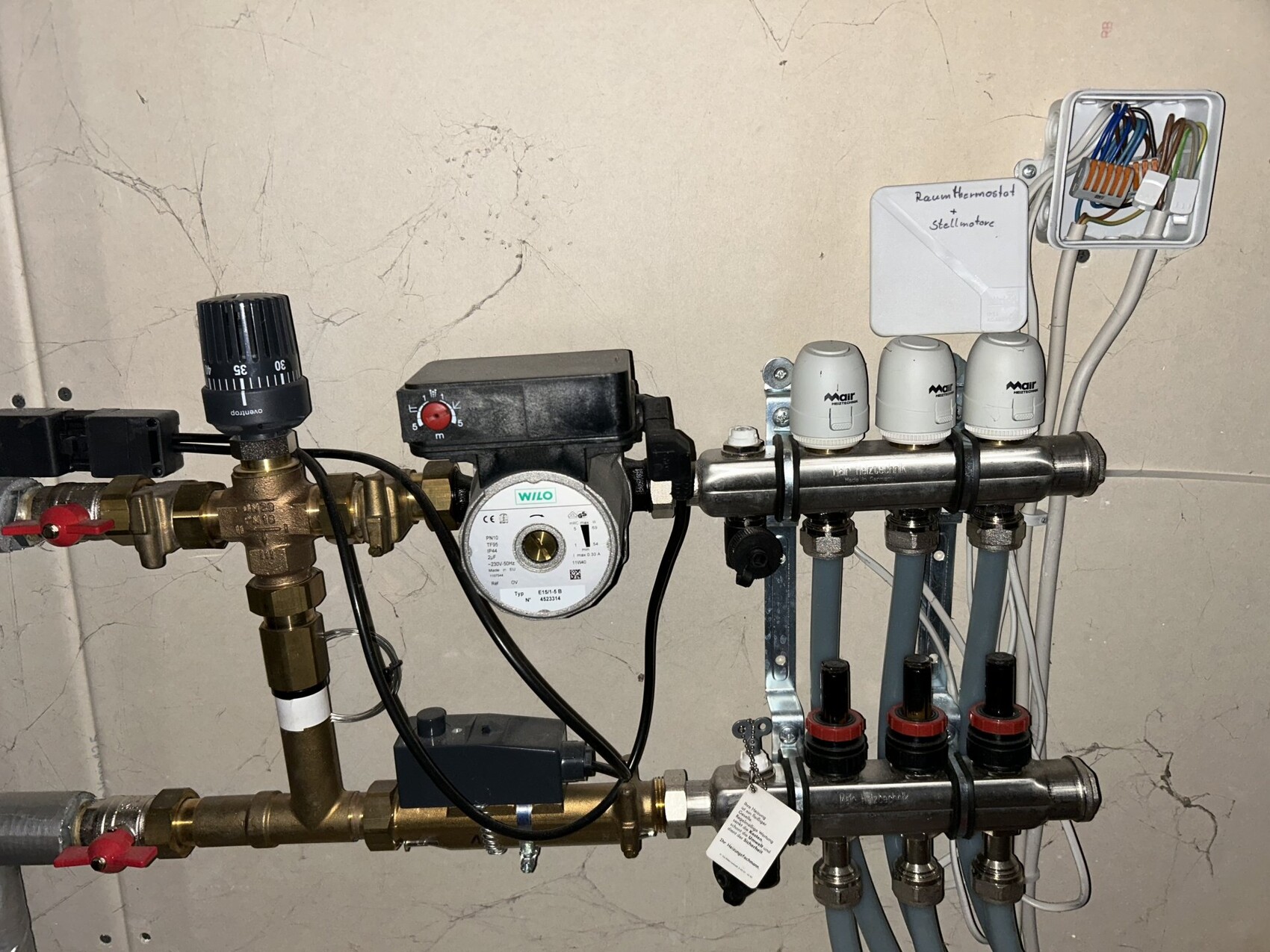
Here is the distribution:
I am not a specialist, but with some help, I have already found out the following:
The actuators in my existing system are electronically normally closed, which seems important for selecting a new device.
My requirements for a new thermostat:
After a brief online search, I think either Homematic IP or Bosch Smart Home could be suitable. Both can be used offline without mandatory cloud connection. My options are:
If you have any other recommendations, please feel free to share!
Now regarding installation:
Is the existing setup with the four wires compatible with both systems?
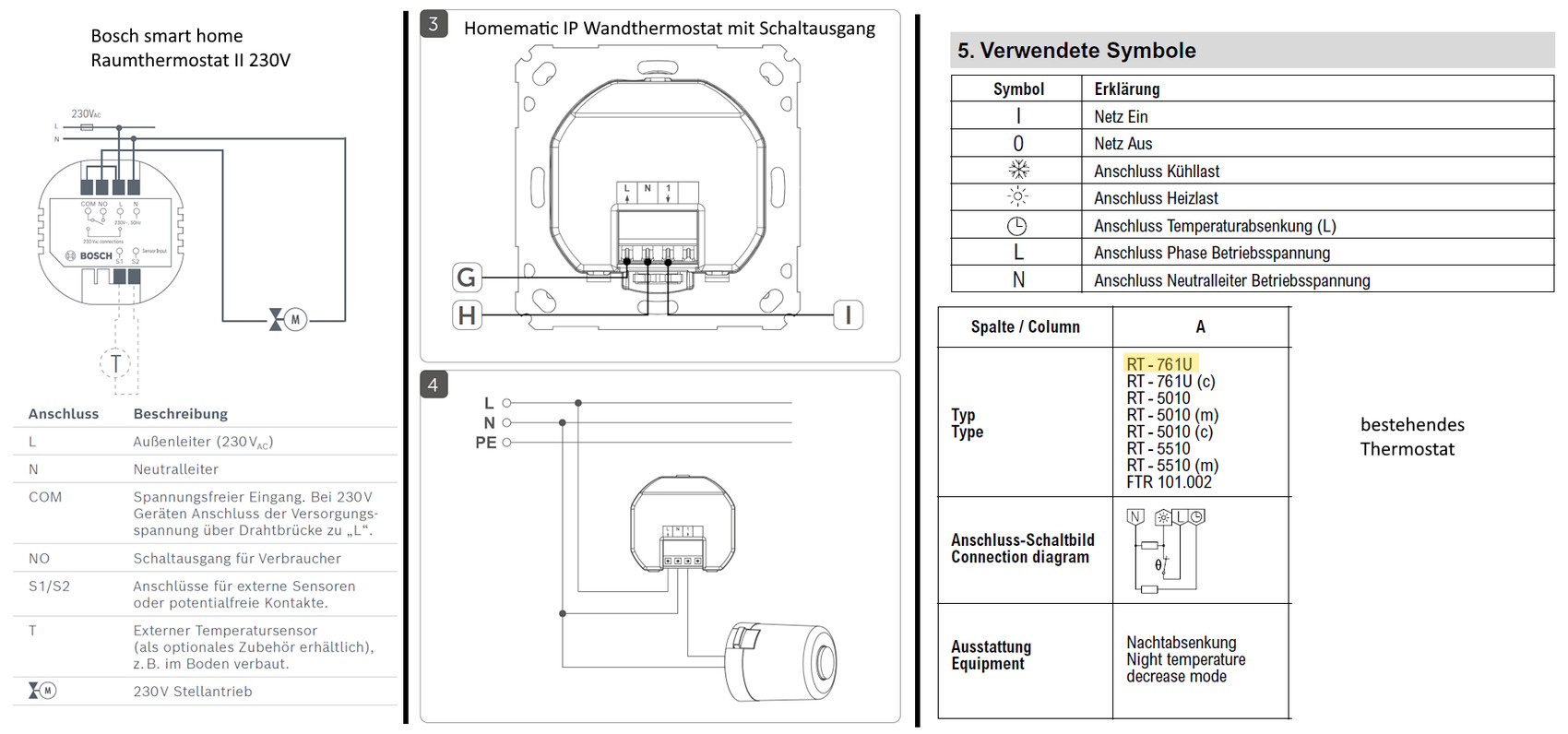
I am especially unsure about this point – here are the relevant wiring diagrams:
Thank you very much in advance!
I have a room in my house with underfloor heating controlled by a room thermostat.
From what I can tell, it is a Halmburger thermostat.
Model RT-76 1U
Here is the distribution:
I am not a specialist, but with some help, I have already found out the following:
The actuators in my existing system are electronically normally closed, which seems important for selecting a new device.
My requirements for a new thermostat:
- a digital display showing temperature
- integration with home automation systems such as Home Assistant
- no forced cloud use by the manufacturer – offline operation must be possible
- ideally no "hub" or other intermediate device from the manufacturer required, e.g. direct integration via ZigBee protocol
After a brief online search, I think either Homematic IP or Bosch Smart Home could be suitable. Both can be used offline without mandatory cloud connection. My options are:
- Bosch Smart Home – Room Thermostat II 230 V
- Homematic IP – Wall Thermostat with switching output – for branded switches, 230 V
If you have any other recommendations, please feel free to share!
Now regarding installation:
Is the existing setup with the four wires compatible with both systems?
I am especially unsure about this point – here are the relevant wiring diagrams:
Thank you very much in advance!
Hi,
make sure to check what type of switching output your actuator has. "Electronically closed" means it remains without power. Many thermostats (Homematic, Bosch) provide potential-free contacts or 230 V, which doesn’t always match and could cause the actuator to stay permanently open or closed.
A related question: Do you know if your RT-76 has a potential-free or direct 230 V output? This determines whether a relay is needed.
Also, clarify if offline operation without a gateway really works. Bosch sometimes relies on gateway functions only, while Homematic IP allows local control.
make sure to check what type of switching output your actuator has. "Electronically closed" means it remains without power. Many thermostats (Homematic, Bosch) provide potential-free contacts or 230 V, which doesn’t always match and could cause the actuator to stay permanently open or closed.
A related question: Do you know if your RT-76 has a potential-free or direct 230 V output? This determines whether a relay is needed.
Also, clarify if offline operation without a gateway really works. Bosch sometimes relies on gateway functions only, while Homematic IP allows local control.
Hello Nauer, thanks for your quick reply!
I turned the thermostat all the way down and then all the way up. Then I sat in front of the manifold and observed the actuators. It is definitely the case that the actuators remain without power.
Regarding the RT-76:
I found the attached document. I couldn’t find anything else online.
I don’t have much equipment, but I do have an old phase tester. What can be observed:
When the thermostat is turned all the way down, almost no current flows. As soon as I turn it up and reach a certain threshold, voltage appears on the "heating load terminal" (see attachment).
Then the question about whether I have a potential-free or direct 230 V output: I’m not sure. How could I test this? I included a photo in the first post; maybe you can guide me.
Regarding whether Bosch or Homematic:
I will read up on this again, but the Bosch device is said to be controllable directly via ZigBee.
I turned the thermostat all the way down and then all the way up. Then I sat in front of the manifold and observed the actuators. It is definitely the case that the actuators remain without power.
Regarding the RT-76:
I found the attached document. I couldn’t find anything else online.
I don’t have much equipment, but I do have an old phase tester. What can be observed:
When the thermostat is turned all the way down, almost no current flows. As soon as I turn it up and reach a certain threshold, voltage appears on the "heating load terminal" (see attachment).
Then the question about whether I have a potential-free or direct 230 V output: I’m not sure. How could I test this? I included a photo in the first post; maybe you can guide me.
Regarding whether Bosch or Homematic:
I will read up on this again, but the Bosch device is said to be controllable directly via ZigBee.
The datasheet is actually quite clear: The RT-76 connects the live wire directly to the heating load when powered by mains voltage. There is no potential-free contact at all, so the output is connected to 230V – all smart home thermostats expecting a purely potential-free contact are immediately incompatible, unless you install a contactor beforehand. This is also evident from the lack of separation between the load and control circuits in the diagram. You really need to carefully check what your new ZigBee devices can handle electrically; otherwise, you could run into serious problems.
The well-known phase tester is only helpful for a rough indication, not for definitive proof. It’s better to get a simple two-pole voltage tester or a multimeter so you can see the exact values and avoid working blind.
The well-known phase tester is only helpful for a rough indication, not for definitive proof. It’s better to get a simple two-pole voltage tester or a multimeter so you can see the exact values and avoid working blind.
I was able to quickly borrow a multimeter from the neighbor. So:
At ☼ (heater load connection), there are about ~115V (volts) even at the lowest setting. When the thermostat switches, there is ~230V (volts).
It should work with both options. If I have read Bosch’s instructions correctly:
L -> Black, power supply
N -> Blue, neutral conductor supply
COM -> bridge from L
NO -> Brown, heater load
But what do I do with the white wire?
At ☼ (heater load connection), there are about ~115V (volts) even at the lowest setting. When the thermostat switches, there is ~230V (volts).
It should work with both options. If I have read Bosch’s instructions correctly:
L -> Black, power supply
N -> Blue, neutral conductor supply
COM -> bridge from L
NO -> Brown, heater load
But what do I do with the white wire?
The white wire is usually intended for temperature reduction/night mode. If you don’t use this function and don’t have a separate timer, it can just be insulated. However, still check with a multimeter to make sure there is no voltage present; otherwise, you might accidentally cut the wrong wire.
Similar topics