
ᐅ Roof with aluminum foil-faced insulation in the bathroom – is an additional vapor barrier or vapor retarder needed?
Created on: 3 Oct 2022 15:16
M
membersoundM
membersound3 Oct 2022 15:16Hi everyone,
I’m about to renovate the bathroom in the attic. When I opened up the wooden ceiling, I noticed that there is neither a vapor barrier nor a vapor retarder. There is only foil-faced insulation wool.
Question: What’s the best way to improve the current situation without risking moisture damage?
Remove everything except the underlay membrane + install new insulation + vapor retarder/barrier + moisture-resistant drywall?
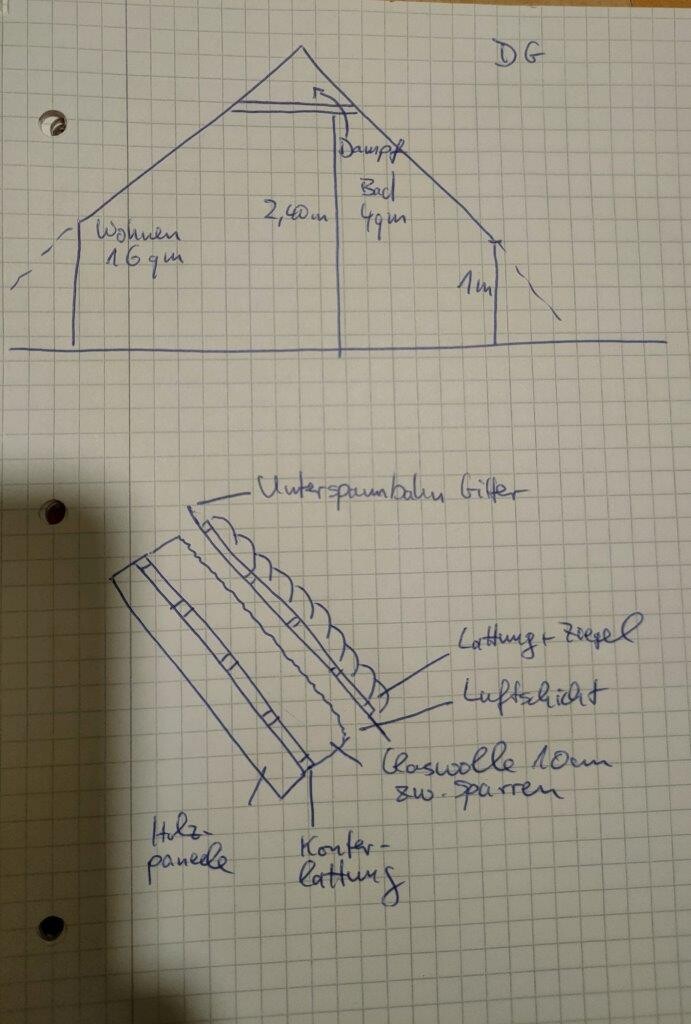
My roof structure (built in 1989) is as follows:
- Wood paneling
- Counter battens
- Aluminum foil-faced glass wool, 10cm (4 inches) cavity insulation between rafters
- Air gap for ventilation
- Grid-reinforced, micro-perforated underlay membrane (similar to Dragofol with Sd=3m)
- Battens
- Roof tiles
The underlay membrane is definitely not vapor open, but due to the perforations, it is semi vapor-permeable. It’s probably intended to allow some vapor escape if needed.
The aluminum foil facing also acts somewhat like a vapor barrier but is not a proper one.
Apparently, this setup hasn’t caused any problems in the last 30 years. Still, I’m wondering how I could improve it now that the ceiling is open. Especially regarding:
1.) Insulation
2.) Vapor retarder/barrier
Question for the experts: Is it reasonable to install a vapor retarder here? Or is a vapor barrier better? Or should I leave it as is?
Also, considering that the collar beams extend into the bathroom, I can’t really create a full moisture barrier if I only attach the new membrane to the rafters. Moisture could still diffuse from the bathroom through the collar beams into the rest of the non-bathroom ceiling (see picture). I could, of course, run the membrane under the collar beams all the way to the bathroom’s interior wall, which would effectively seal off the ceiling and slope of the bathroom from the roof side.
Since this concerns only about 3 square meters (32 square feet) of the roof slope, it probably doesn’t make sense to keep the old insulation, right? If I remove the old paneling, counter battens, and insulation, my plan is as follows:
- New compression insulation wool, 10cm (4 inches), such as Isover 1-032 cavity insulation between rafters, keeping an air gap toward the underlay membrane.
- Vapor retarder, like Isover Vario Duplex (Sd=0.3–5m). Install this under the collar beams and extend it to the bathroom’s interior wall to effectively “box in” the bathroom with the membrane on the roof side.
- Counter battens, 30mm (1.2 inches), with underspar rafters compression insulation, e.g., Integra UKF-32
- Moisture-resistant drywall (GKBI)
Adding insulation thickness on top is not an option, as there wouldn’t be enough space.
Later, in a few years, I plan to renovate the rest of the attic (currently little time due to small children) and connect both insulation and the membrane with the same approach.
Any opinions?
I’ve also spoken with various people and some professional companies, but everyone says something different. The suggested solutions range roughly from:
a) Seal joints, transitions, and wall connections with aluminum tape. No additional membrane.
b) Remove counter battens, install vapor barrier directly over the foil facing, new battens, and drywall.
c) Prefer a vapor retarder so that if something is not completely sealed, moisture won’t get trapped between the foil facing and new membrane, preventing rot in the beams.
If I want to keep it simple, I’d just tape everything with aluminum tape and put drywall on top—done.
If I want it done “properly” and better insulated, then perhaps the plan I described with a vapor retarder/barrier?
Thanks very much for your advice!
I’m about to renovate the bathroom in the attic. When I opened up the wooden ceiling, I noticed that there is neither a vapor barrier nor a vapor retarder. There is only foil-faced insulation wool.
Question: What’s the best way to improve the current situation without risking moisture damage?
Remove everything except the underlay membrane + install new insulation + vapor retarder/barrier + moisture-resistant drywall?
My roof structure (built in 1989) is as follows:
- Wood paneling
- Counter battens
- Aluminum foil-faced glass wool, 10cm (4 inches) cavity insulation between rafters
- Air gap for ventilation
- Grid-reinforced, micro-perforated underlay membrane (similar to Dragofol with Sd=3m)
- Battens
- Roof tiles
The underlay membrane is definitely not vapor open, but due to the perforations, it is semi vapor-permeable. It’s probably intended to allow some vapor escape if needed.
The aluminum foil facing also acts somewhat like a vapor barrier but is not a proper one.
Apparently, this setup hasn’t caused any problems in the last 30 years. Still, I’m wondering how I could improve it now that the ceiling is open. Especially regarding:
1.) Insulation
2.) Vapor retarder/barrier
Question for the experts: Is it reasonable to install a vapor retarder here? Or is a vapor barrier better? Or should I leave it as is?
Also, considering that the collar beams extend into the bathroom, I can’t really create a full moisture barrier if I only attach the new membrane to the rafters. Moisture could still diffuse from the bathroom through the collar beams into the rest of the non-bathroom ceiling (see picture). I could, of course, run the membrane under the collar beams all the way to the bathroom’s interior wall, which would effectively seal off the ceiling and slope of the bathroom from the roof side.
Since this concerns only about 3 square meters (32 square feet) of the roof slope, it probably doesn’t make sense to keep the old insulation, right? If I remove the old paneling, counter battens, and insulation, my plan is as follows:
- New compression insulation wool, 10cm (4 inches), such as Isover 1-032 cavity insulation between rafters, keeping an air gap toward the underlay membrane.
- Vapor retarder, like Isover Vario Duplex (Sd=0.3–5m). Install this under the collar beams and extend it to the bathroom’s interior wall to effectively “box in” the bathroom with the membrane on the roof side.
- Counter battens, 30mm (1.2 inches), with underspar rafters compression insulation, e.g., Integra UKF-32
- Moisture-resistant drywall (GKBI)
Adding insulation thickness on top is not an option, as there wouldn’t be enough space.
Later, in a few years, I plan to renovate the rest of the attic (currently little time due to small children) and connect both insulation and the membrane with the same approach.
Any opinions?
I’ve also spoken with various people and some professional companies, but everyone says something different. The suggested solutions range roughly from:
a) Seal joints, transitions, and wall connections with aluminum tape. No additional membrane.
b) Remove counter battens, install vapor barrier directly over the foil facing, new battens, and drywall.
c) Prefer a vapor retarder so that if something is not completely sealed, moisture won’t get trapped between the foil facing and new membrane, preventing rot in the beams.
If I want to keep it simple, I’d just tape everything with aluminum tape and put drywall on top—done.
If I want it done “properly” and better insulated, then perhaps the plan I described with a vapor retarder/barrier?
Thanks very much for your advice!
M
membersound4 Oct 2022 19:13In the meantime, I have also spoken with various manufacturers. Their recommendations couldn’t be more different:
# Rockwool:
- If the current condition has lasted for 30 years due to the ventilation gap, just leave it as is.
- Or: Cut the aluminum foil and install a vapor retarder (Rockwool Centitop, sd=100).
# Isover:
- Install a vapor retarder (Vario KM Duplex, sd=0.3-5m), if necessary, perforate the aluminum foil beforehand using a spiked roller or remove it.
# Pro Clima:
- Simply place the vapor retarder directly underneath the aluminum foil, e.g., Hydrosafe Pro Clima Intello (sd=0.25-25m), directly below the aluminum foil.
What does this tell us? That the recommendations are more or less arbitrary regarding what can be done?
What do you think about the suggestion to perforate the aluminum foil before installing a vapor retarder?
# Rockwool:
- If the current condition has lasted for 30 years due to the ventilation gap, just leave it as is.
- Or: Cut the aluminum foil and install a vapor retarder (Rockwool Centitop, sd=100).
# Isover:
- Install a vapor retarder (Vario KM Duplex, sd=0.3-5m), if necessary, perforate the aluminum foil beforehand using a spiked roller or remove it.
# Pro Clima:
- Simply place the vapor retarder directly underneath the aluminum foil, e.g., Hydrosafe Pro Clima Intello (sd=0.25-25m), directly below the aluminum foil.
What does this tell us? That the recommendations are more or less arbitrary regarding what can be done?
What do you think about the suggestion to perforate the aluminum foil before installing a vapor retarder?
You need to prevent warm air from cooling down and condensing inside or behind the insulation. This was the purpose of the aluminum foil on the glass wool. Since the 30-year-old insulation is not as effective as modern insulation and the ventilation gap is still present, it worked well.
I would remove the insulation and rebuild it with a vapor retarder. Keep the air gap as a support layer and also retain the underlay membrane. Do not staple the connection points but seal them airtight with adhesive.
I would remove the insulation and rebuild it with a vapor retarder. Keep the air gap as a support layer and also retain the underlay membrane. Do not staple the connection points but seal them airtight with adhesive.
Similar topics