
ᐅ Aligning the Idea of an Attic Conversion with the Building Plan
Created on: 10 Jan 2020 10:29
R
ReplicaHello everyone.
We are considering renovating my parents’ house in NRW and are currently gathering ideas, as the attic conversion is proving to be particularly challenging from a planning perspective.
Maybe you could give me some feedback on whether and how our ideas could comply with the local development plan (building permit / planning permission).
Or perhaps you have completely different suggestions?
I will try to describe the situation:
The development plan allows for 1 or 2 full stories. For both options, it specifies permitted roof pitches (+-30° / +-45°) and eave heights.
For the single-story house, the allowed eave height is so low that the roof basically rests on the ceiling of the floor below.
The house is an older farmhouse. The footprint is sufficiently large (about 170sqm (1830 sq ft) external dimensions). This could easily be divided so that the older generation gets an independent ground floor apartment and we have a large enough entrance / living / dining / kitchen / utility / technical area on the ground floor.
The attic area is problematic. It has already been converted above “our” section and is about 55sqm (592 sq ft). It should accommodate a bathroom, a small “office,” and bedrooms for 4 people.
Due to the sloped roof and the staircase positioned very inconveniently because of the chimney as a fixed point, the upstairs hallway takes up a lot of space, leaving only room for 2 bedrooms beside the bathroom. A mini “office” might still be possible, but a third bedroom won’t fit. We are also not fans of roof windows, but the bathroom, office, and the new room would require them.
Since the roof (old framework and uninsulated) would need to be renewed anyway, our idea is to create a high knee wall (essentially a 2-story section) in that part of the building to gain enough room to fit the spaces we need. The large rest of the house would remain without a knee wall.
The problem seems to be that, due to the ratio to the footprint, the house would still be considered single-story, and my understanding is that adding a knee wall in “our” section of the house would violate the development plan.
Do I understand this correctly, or could it still be possible to incorporate a knee wall somehow?
Or does anyone have different ideas?
Ultimately, we will ask the architect when the time comes.
A last resort would probably be to continue the attic conversion several meters above the older generation’s apartment without a knee wall and accept roof windows. That part of the attic is currently classified as an agricultural storage space (hay storage).
Thanks for your opinions
Replica
We are considering renovating my parents’ house in NRW and are currently gathering ideas, as the attic conversion is proving to be particularly challenging from a planning perspective.
Maybe you could give me some feedback on whether and how our ideas could comply with the local development plan (building permit / planning permission).
Or perhaps you have completely different suggestions?
I will try to describe the situation:
The development plan allows for 1 or 2 full stories. For both options, it specifies permitted roof pitches (+-30° / +-45°) and eave heights.
For the single-story house, the allowed eave height is so low that the roof basically rests on the ceiling of the floor below.
The house is an older farmhouse. The footprint is sufficiently large (about 170sqm (1830 sq ft) external dimensions). This could easily be divided so that the older generation gets an independent ground floor apartment and we have a large enough entrance / living / dining / kitchen / utility / technical area on the ground floor.
The attic area is problematic. It has already been converted above “our” section and is about 55sqm (592 sq ft). It should accommodate a bathroom, a small “office,” and bedrooms for 4 people.
Due to the sloped roof and the staircase positioned very inconveniently because of the chimney as a fixed point, the upstairs hallway takes up a lot of space, leaving only room for 2 bedrooms beside the bathroom. A mini “office” might still be possible, but a third bedroom won’t fit. We are also not fans of roof windows, but the bathroom, office, and the new room would require them.
Since the roof (old framework and uninsulated) would need to be renewed anyway, our idea is to create a high knee wall (essentially a 2-story section) in that part of the building to gain enough room to fit the spaces we need. The large rest of the house would remain without a knee wall.
The problem seems to be that, due to the ratio to the footprint, the house would still be considered single-story, and my understanding is that adding a knee wall in “our” section of the house would violate the development plan.
Do I understand this correctly, or could it still be possible to incorporate a knee wall somehow?
Or does anyone have different ideas?
Ultimately, we will ask the architect when the time comes.
A last resort would probably be to continue the attic conversion several meters above the older generation’s apartment without a knee wall and accept roof windows. That part of the attic is currently classified as an agricultural storage space (hay storage).
Thanks for your opinions
Replica
Replica schrieb:
The development plan Having the complete plan in images and text available is essential for useful assessments.
Replica schrieb:
allowed roof pitches (+-30° / +-45°) Negative roof pitch?
Replica schrieb:
the permitted eave height is so low How low? What is the reference point?
Replica schrieb:
Given is an older farmhouse. Then provide it to us. The complexity of a floor plan is hardly describable in words.
Replica schrieb:
The large remainder of the house is to remain without knee walls. Why? Is the roof structure new and insulated? If yes, how long ago? Are dormers allowed?
Replica schrieb:
The problem seems to be that the house is still considered one-story due to the ratio with the footprint. For that, the age of the plan needs to be known, since the applicable full-story definition depends on it.
Replica schrieb:
Ultimately, we will also ask the architect about this. Good idea. Especially when building on existing structures, an experienced planner can estimate possibilities for exemptions from development plan regulations.
Escroda schrieb:
Negative roof pitch? I was not precise enough:
Two-story: 30°, single-story actually 48°, each with a tolerance of ±3°. Currently, 45° is built.
Escroda schrieb:
How low? Based on what reference point? Eaves height is fixed at 2.75–3.00 m (9.0–9.8 ft) above the top edge of the foundation.
Escroda schrieb:
Then show it to us. The complexity of a floor plan is difficult to describe in words. I’ve attached the attic floor plan. The room in the top left is the bathroom, although it is labeled as a bedroom on the plan.
Escroda schrieb:
Why? Is the roof structure new and insulated here? If yes, how long ago? Are dormer windows allowed? The plan dates back to 1978. At that time, a 5-meter (16 ft) L-shaped extension was added to the south side of the house (based on the floor plan orientation). Otherwise, the house and roof structure are about 90 years old and uninsulated.
As far as I know, dormers are not prohibited by the local development plan.
ypg schrieb:
Generous dormers, if allowed. That seems like a good idea. We’ve already discussed that yesterday.
This won’t work. The floor plan for the attic is incomplete, there is no ground floor plan, no building permit / planning permission, no site plan, and the descriptions of the planned renovations are unclear.
Do I understand correctly that only the already developed part is going to be renovated, while the rest will remain unused?
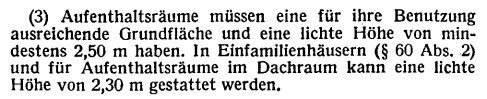
In that case, the previous definitions probably will not allow for a full story:

Do I understand correctly that only the already developed part is going to be renovated, while the rest will remain unused?
In that case, the previous definitions probably will not allow for a full story:
Similar topics