
Hello everyone,
we are planning a prefabricated house using timber frame construction. It will have 180 sqm (1,937 sq ft) of living space with underfloor heating, and about 230 sqm (2,475 sq ft) of usable area.
So far, the offer included an air-to-water heat pump from Daikin (Altherma 3R, formerly Rotex HPSU compact Ultra).
Now it seems that this unit might not have enough capacity (?) and as an alternative (additional cost around 4,000) we have been offered a "Wolf heat pump CHC Monoblock 10/300-35".
The Daikin is available in the 4-9 kW version—would that really be insufficient for this size? And what do you think about this offer?
I have the energy-saving regulation heat protection certification and a renewable energy heat law document available, if any information from those is needed.
Thank you very much!
Best regards
we are planning a prefabricated house using timber frame construction. It will have 180 sqm (1,937 sq ft) of living space with underfloor heating, and about 230 sqm (2,475 sq ft) of usable area.
So far, the offer included an air-to-water heat pump from Daikin (Altherma 3R, formerly Rotex HPSU compact Ultra).
Now it seems that this unit might not have enough capacity (?) and as an alternative (additional cost around 4,000) we have been offered a "Wolf heat pump CHC Monoblock 10/300-35".
The Daikin is available in the 4-9 kW version—would that really be insufficient for this size? And what do you think about this offer?
I have the energy-saving regulation heat protection certification and a renewable energy heat law document available, if any information from those is needed.
Thank you very much!
Best regards

OWLer schrieb:
So, I have received feedback from the engineering office regarding the smaller Vaillant unit. They increased the supply temperature from 33 to 33.5°C (91.4 to 92.3°F) and decreased the return temperature from 29 to 28.5°C (84.2 to 83.3°F), thus raising the temperature difference from 4 to 5 K.
Now the flow rates are lower, and the smaller Vaillant 75/6 A can handle the required volume flow.
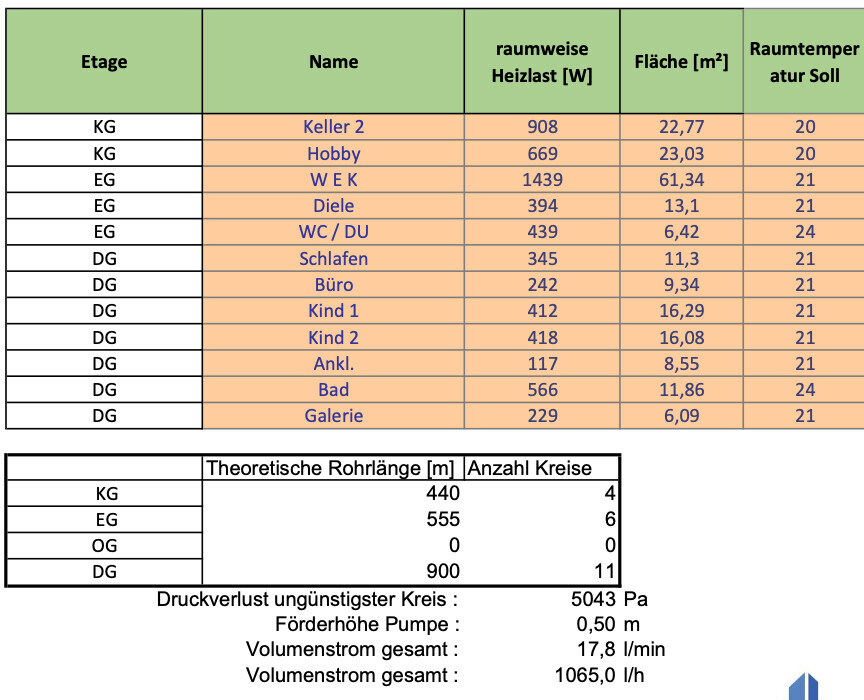
Let's see how I can optimize this in the long term. It almost feels like an older building with a 34°C (93.2°F) supply temperature when I compare the benchmarks here with you. Our building shape, with the gable and bay window plus many floor-to-ceiling windows, really makes a difference. But I’m hoping for solid solar gains in practice so that I can lower the supply temperature over the years.
It’s just a shame that I can’t get the smaller 55/6, which would perfectly fit our heating load, to achieve an annual performance factor of 4.5... I wanted to give a quick practical update on the calculations.
Overall, I am very satisfied. I managed to have the bathroom as the warmest room with a heating curve of 0.2 and a target temperature of 21°C (69.8°F) — I’m not sure whether this is the base point or a parallel shift, as the standard is 20°C (68°F). I can’t quite reach 24°C (75.2°F), but I do get a good 23°C (73.4°F), so noticeably warmer than the rest of the house.
The living room still gets a bit too warm, but we don’t have our loft door installed yet, so there’s still airflow to the open stairwell/hallway. The temperature there is around 22°C (71.6°F), which feels comfortable under the current conditions. I might be able to reduce heating slightly once the door is installed, allowing more flow to the bathrooms.
My experience over the last few days has been temperatures consistently between 1-5°C (34-41°F) during the day without sun. Even during occasional frost, there were no problems. I see this as proof that the effort with the heating load calculation, and the design of the underfloor and wall heating systems, was worth it.
I’m looking forward to the real winter and the next one after our building mass has dried out. Originally, I wanted to run the first year with the wall thermostats unchanged, but I couldn’t resist and performed the hydraulic balancing. And it was definitely worth it!
The thread has become surprisingly quiet here. 🙂
Found a small problem:
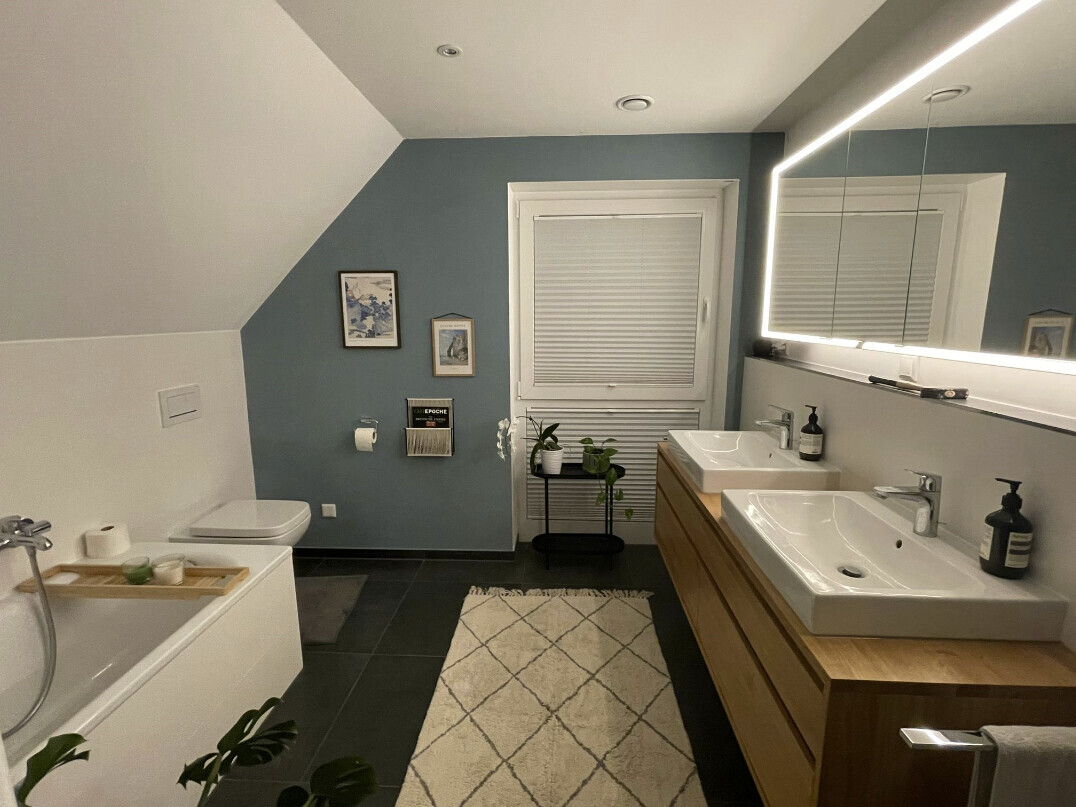
We spent pages discussing the optimal design of the underfloor heating in the bathroom. In the parallel thread about the Arotherm system, trying to get the last bit of efficiency out of it, and then THIS...
2m² (21.5 sq ft), or an estimated 30% of the heating surface, have to be covered by a fluffy rug. No way around it. It just has to be that way.
Makes you wonder.
Found a small problem:
We spent pages discussing the optimal design of the underfloor heating in the bathroom. In the parallel thread about the Arotherm system, trying to get the last bit of efficiency out of it, and then THIS...
2m² (21.5 sq ft), or an estimated 30% of the heating surface, have to be covered by a fluffy rug. No way around it. It just has to be that way.
Makes you wonder.
W
WilderSueden13 Oct 2022 23:54Invoice made without the lady? 😉
S
Stefan00114 Oct 2022 07:59If you have a relatively constant room temperature, the carpet shouldn’t make a difference, right?
I would think that thermal conductivity becomes more relevant with quicker temperature changes. But I have no real sense of the scale involved...
I would think that thermal conductivity becomes more relevant with quicker temperature changes. But I have no real sense of the scale involved...
S
SaniererNRW12314 Oct 2022 08:04OWLer schrieb:
You have to be kidding.Why? What’s the problem? Whether the carpet is there or not doesn’t matter at all. Apart from the visual aspect – it just doesn’t feel that good 😉R
RotorMotor14 Oct 2022 08:42Yes, it makes a big difference. It requires a supply temperature about one degree higher for the same heat input.
Similar topics