
Hello everyone,
we are planning a prefabricated house using timber frame construction. It will have 180 sqm (1,937 sq ft) of living space with underfloor heating, and about 230 sqm (2,475 sq ft) of usable area.
So far, the offer included an air-to-water heat pump from Daikin (Altherma 3R, formerly Rotex HPSU compact Ultra).
Now it seems that this unit might not have enough capacity (?) and as an alternative (additional cost around 4,000) we have been offered a "Wolf heat pump CHC Monoblock 10/300-35".
The Daikin is available in the 4-9 kW version—would that really be insufficient for this size? And what do you think about this offer?
I have the energy-saving regulation heat protection certification and a renewable energy heat law document available, if any information from those is needed.
Thank you very much!
Best regards
we are planning a prefabricated house using timber frame construction. It will have 180 sqm (1,937 sq ft) of living space with underfloor heating, and about 230 sqm (2,475 sq ft) of usable area.
So far, the offer included an air-to-water heat pump from Daikin (Altherma 3R, formerly Rotex HPSU compact Ultra).
Now it seems that this unit might not have enough capacity (?) and as an alternative (additional cost around 4,000) we have been offered a "Wolf heat pump CHC Monoblock 10/300-35".
The Daikin is available in the 4-9 kW version—would that really be insufficient for this size? And what do you think about this offer?
I have the energy-saving regulation heat protection certification and a renewable energy heat law document available, if any information from those is needed.
Thank you very much!
Best regards
N
nordanney7 Jul 2021 23:05netuser schrieb:
That matches my understanding so far. However, that would mean that everyone would also get the buffer tank included. Some might try that in certain cases, but most (reliable) heating installers won’t sell you a buffer tank.
D
Deliverer7 Jul 2021 23:10OWLer schrieb:
I'm interested in how much you can throttle the modified heating circuits and how this affects the head pressure and flow rate. Since apparently not only narrower (and longer) but also more circuits have been installed, this shouldn't be an issue. You can throttle them down to zero flow if necessary.
However, if you can lower the supply temperature enough, this usually won't be needed. Then it balances itself out: the room is warm, heat transfer from the floor to the room stops because the temperature difference (Delta T) becomes too small. The flow rate doesn’t matter. This only works with small pipe spacing. So congratulations. ;-)

Zaba12 schrieb:
5cm (2 inches) 🙂 in the bathroom, 4 circles over 15 sqm (161 sq ft). That’s exactly what I want to see 🙂Haven’t we had someone like that before, including walls? Who was it again?@mete111
For reference, we have about 250 m² (2,690 sq ft) of heated floor area with KfW 70 standard and an 8 kW heating system. A 6 kW system would have been more than enough.
R
RotorMotor7 Jul 2021 23:23I would also say that VA10 with 6 circuits is even somewhat better than VA15 with 4.
Since the bathroom is usually the "problem area," it probably wouldn't have been strictly necessary, but you shouldn't look a gift horse in the mouth...
Since the bathroom is usually the "problem area," it probably wouldn't have been strictly necessary, but you shouldn't look a gift horse in the mouth...

OWLer schrieb:
So, I received feedback from the engineering office regarding the smaller Vaillant unit. They increased the flow temperature from 33 to 33.5°C (91.4 to 92.3°F) and lowered the return temperature from 29 to 28.5°C (84.2 to 83.3°F), so the temperature difference was raised from 4 to 5 K (K=Kelvin).
Now the volumetric flow rates are lower, and the smaller 75/6 A Vaillant can deliver the required flow.
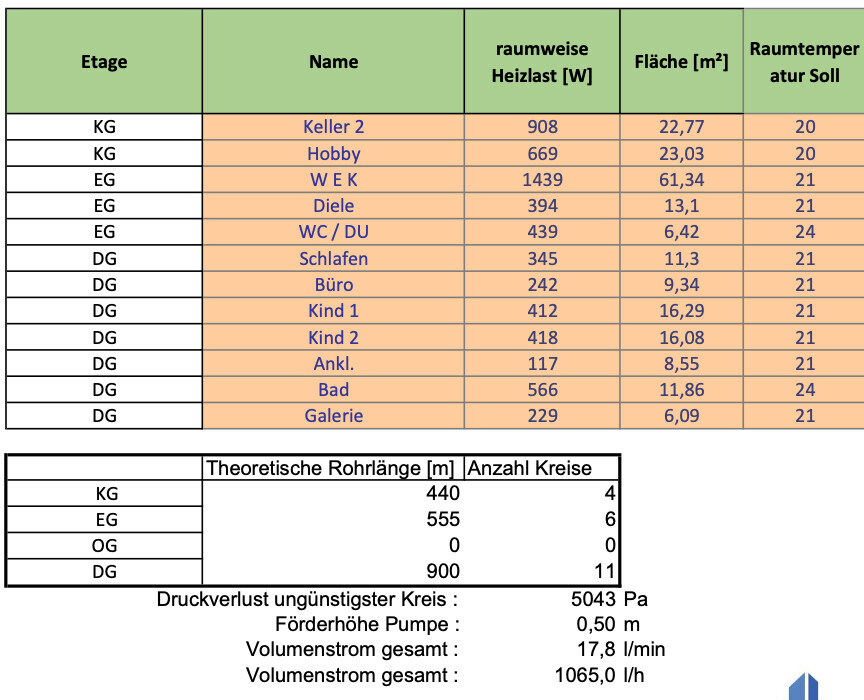
Let’s see how I can optimize this long-term. It almost feels like an old building with a 34°C (93.2°F) flow temperature when I compare the benchmarks here with you. Our building structure with a gable and bay window plus the many floor-to-ceiling windows really seems to make a big difference. On the other hand, I hope to achieve good solar gains in practice so that I can gradually reduce the flow temperature over the years.
The only downside is that I can’t achieve a seasonal performance factor of 4.5 with the smaller 55/6 unit, which would be perfect for our heating load.... So, I was able to solve the mystery. The installers on site were working based on outdated plans. As shown in the quote above, the calculation was optimized last year because with a 4 K temperature spread and a 33°C (91.4°F) flow temperature we were at the maximum volumetric flow rate of the 75/6 unit. As a bonus, the balancing of the heating circuits in the domestic heating unit (WEK) was removed, reducing the number of circuits there from 6 to 4.
This information unfortunately did not make it into the actual execution, even though I had sent both the construction management and the plumbers the updated plans again during the discussion about the underfloor heating.
Well, since this was the only change from the initial design, my focus is now on minimizing the spacing of the heating loops in the bathroom upstairs. The rest should be fine, then I just have to throttle down more in the domestic heating unit or I will be grilled during the hydraulic balancing. I guess I’ll have to send my wife away on vacation during that time because she will probably be very annoyed by constantly alternating between feeling too cold and too hot during the balancing. 🙂
In my opinion, the small area in the upstairs bathroom has been used quite well. Unfortunately, despite lengthy discussions, the general contractor still did not want to completely relocate the shower or move it under the bathtub. Upstairs, however, the 5cm (2 inches) thickness was still achieved quite well.
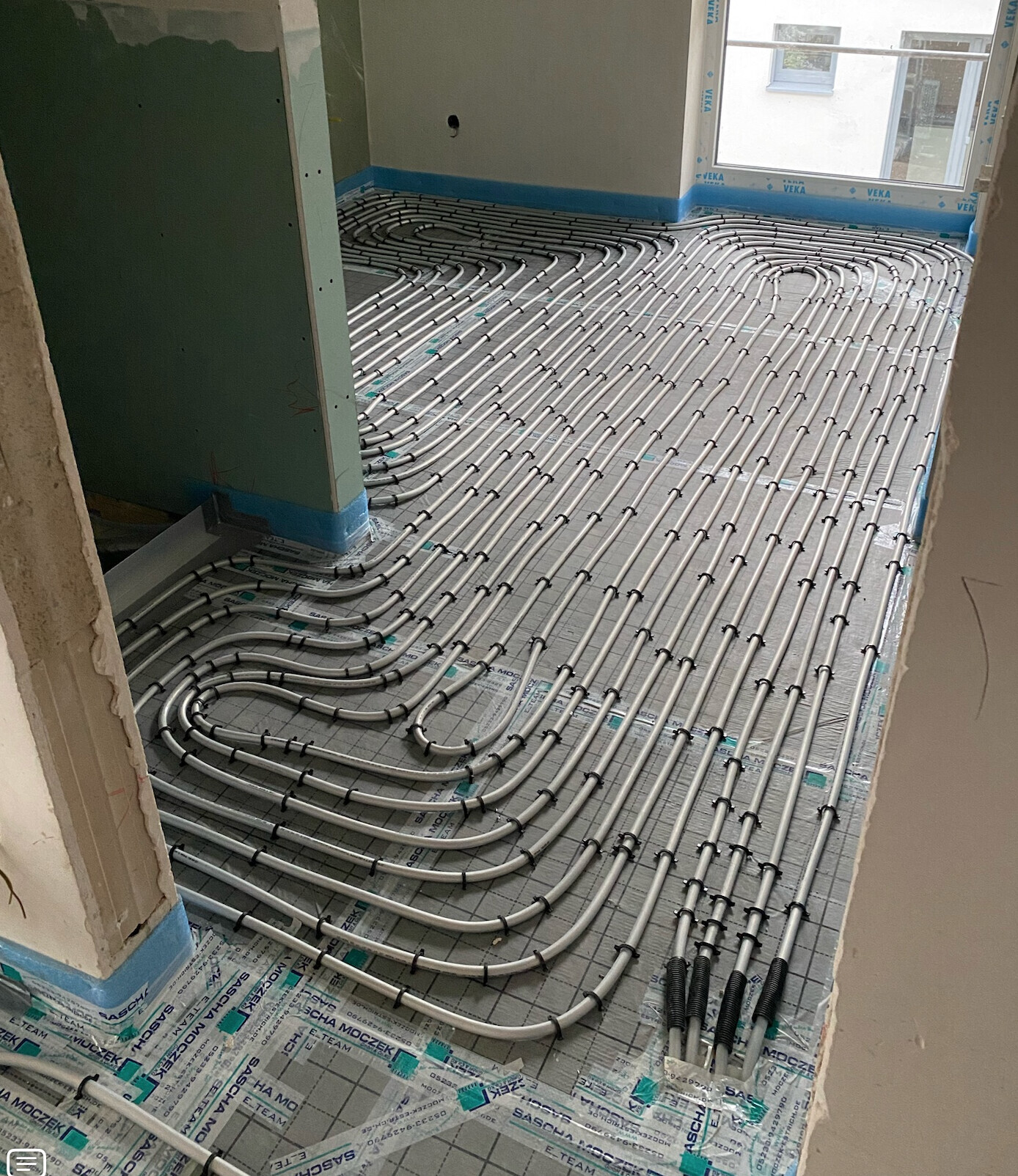
For the downstairs WC, I roughly calculated around 7cm (3 inches) instead of the intended 5cm (2 inches). Apart from the hallways and bathrooms, everything else now has a complete 10cm (4 inches) layer and looks really good to me.
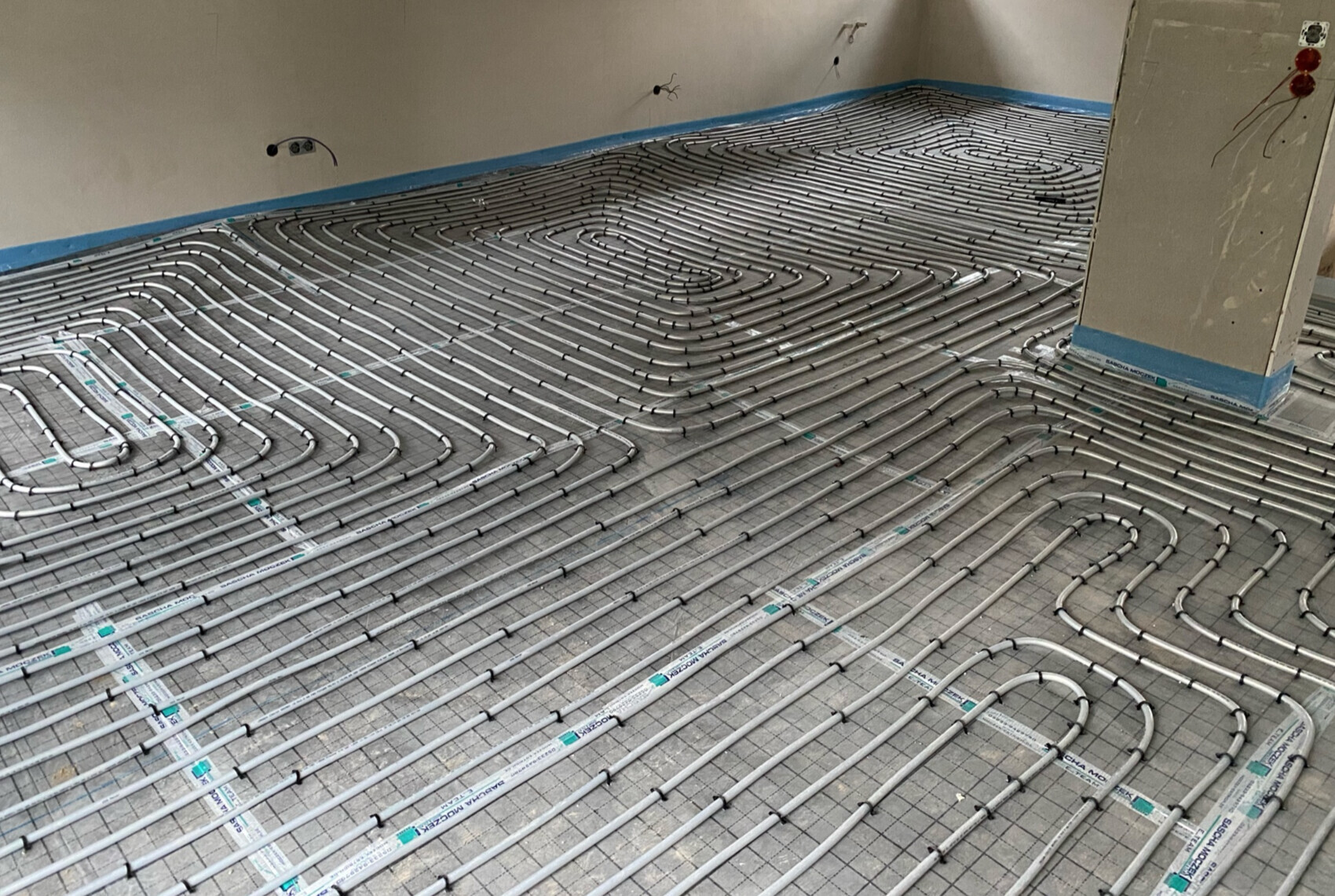
For the downstairs WC, I roughly calculated around 7cm (3 inches) instead of the intended 5cm (2 inches). Apart from the hallways and bathrooms, everything else now has a complete 10cm (4 inches) layer and looks really good to me.