
Hello everyone,
we are planning a prefabricated house using timber frame construction. It will have 180 sqm (1,937 sq ft) of living space with underfloor heating, and about 230 sqm (2,475 sq ft) of usable area.
So far, the offer included an air-to-water heat pump from Daikin (Altherma 3R, formerly Rotex HPSU compact Ultra).
Now it seems that this unit might not have enough capacity (?) and as an alternative (additional cost around 4,000) we have been offered a "Wolf heat pump CHC Monoblock 10/300-35".
The Daikin is available in the 4-9 kW version—would that really be insufficient for this size? And what do you think about this offer?
I have the energy-saving regulation heat protection certification and a renewable energy heat law document available, if any information from those is needed.
Thank you very much!
Best regards
we are planning a prefabricated house using timber frame construction. It will have 180 sqm (1,937 sq ft) of living space with underfloor heating, and about 230 sqm (2,475 sq ft) of usable area.
So far, the offer included an air-to-water heat pump from Daikin (Altherma 3R, formerly Rotex HPSU compact Ultra).
Now it seems that this unit might not have enough capacity (?) and as an alternative (additional cost around 4,000) we have been offered a "Wolf heat pump CHC Monoblock 10/300-35".
The Daikin is available in the 4-9 kW version—would that really be insufficient for this size? And what do you think about this offer?
I have the energy-saving regulation heat protection certification and a renewable energy heat law document available, if any information from those is needed.
Thank you very much!
Best regards
 Schimi17914 Dec 2020 21:04
nordanney schrieb:
If you are prepared to cover the resulting electricity costs, then various heat pumps are possible.
A heating system that requires such high flow temperatures will make you spend a lot more with a heat pump – significantly higher operating costs than the old oil heating system. I expected as much. But if I also install solar panels on the roof, the costs increase dramatically – as I already mentioned. Additionally, the house is not ideally positioned for solar. Currently, I consume about 1,000 liters (264 gallons) of oil per year. I find that acceptable. I am not fixed on using a heat pump.
Schimi1791 schrieb:
Oh? Well, someone clearly thinks they’re smarter ... 🙂No, it’s not about being smart. It’s just about reading a lot. That’s what I recommend, and you’re already doing it. 1000 liters per year sounds really low. Do you keep your heating very tight?

OWLer schrieb:
I will definitely give feedback on how it looks in practice. 🙂So, I can finally give an update from practical experience. Unfortunately, with the first result, I’m already getting a headache again. I need to call the heating installer tomorrow regarding the wall heating system and the overall design. I’m not sure whether either the site manager or the employees on site understood the plans correctly.
Planned: 3 sqm (32 sq ft) wall heating, 17x2 mm (0.67x0.08 inch), installation depth: 5 cm (2 inches), total heating circuit length approx. 60 m (197 feet)
Actual: 2.8 sqm (30 sq ft) wall heating, 16x2 mm (0.63x0.08 inch), installation depth: 10 cm (4 inches), calculated length approx. 50 m (164 feet) including supply and return.
Do you have any tips on how to approach the conversation to get the best possible hydraulic performance?
I think the difference between 16x2 mm and 17x2 mm pipes is not ideal but largely negligible. From my online research, I haven’t found any aluminum composite pipes with 17x2 mm size, only 16x2 mm. The heating installer insists on aluminum composite pipes to be on the safe side.
This is roughly my plan:
- Call and start on a positive note, mentioning how much I appreciate the quick progress and that it looks like top-quality work so far.
- Then ask about the wall heating, especially why a meander pattern was used instead of a spiral. A spiral would be better suited for installation considering the rule of spacing at five times the pipe diameter.
- Point out noticeable differences from the plan and ask what the reasons might be.
- Send the documents again and request a review of the heating circuits.
A brief update from me regarding the above-mentioned issue with my wall heating system.
Last week, I emailed the heating installer with a few questions about the installation plan according to the engineering office and the execution plan after seeing the wall heating, and asked for a callback.
When I didn’t receive any response, I called on Friday and we talked for about 20 minutes.
In short:
He immediately knew what it was about and said he personally chose the 10cm (4 inches) spacing for the installation. He is aware of the risk of thermal short circuits but would throttle the heating circuit.
The reason for the larger spacing is the bending radii, as he has had bad experiences in the past with plaster cracking. When I pointed out that we had hired painters to apply a painter’s fleece, he said that probably wouldn’t be a problem. The previous clients of our general contractor apparently mostly painted directly onto the plaster.
With painter’s fleece, he would adjust the wall heating spacing to 5cm (2 inches) and shift the bending radii accordingly. Then everything would fit.
I will clarify this again with the site manager next week, and then the plaster can likely be applied to the wall in week 19.
Last week, I emailed the heating installer with a few questions about the installation plan according to the engineering office and the execution plan after seeing the wall heating, and asked for a callback.
When I didn’t receive any response, I called on Friday and we talked for about 20 minutes.
In short:
He immediately knew what it was about and said he personally chose the 10cm (4 inches) spacing for the installation. He is aware of the risk of thermal short circuits but would throttle the heating circuit.
The reason for the larger spacing is the bending radii, as he has had bad experiences in the past with plaster cracking. When I pointed out that we had hired painters to apply a painter’s fleece, he said that probably wouldn’t be a problem. The previous clients of our general contractor apparently mostly painted directly onto the plaster.
With painter’s fleece, he would adjust the wall heating spacing to 5cm (2 inches) and shift the bending radii accordingly. Then everything would fit.
I will clarify this again with the site manager next week, and then the plaster can likely be applied to the wall in week 19.
Another update from me:
So far, nothing has changed. The spacing for the wall heating pipes is still at 10cm (4 inches), and the site manager requested an on-site meeting with the heating installer, the site manager, and the general contractor’s site manager. I already had a bad feeling about that.
They tried everything to convince me that a 5cm (2 inch) pipe spacing wouldn’t work.
But the real issue was the warranty concerning cracks. The 5cm (2 inch) wall heating spacing will now be installed, but the general contractor is worried about cracking. The agreement is that they will do their best and may embed reinforcement mesh in the plaster to prevent cracks. However, I will have to sign a waiver releasing them from any warranty claims related to cracks over the 3sqm (32 sq ft) area.
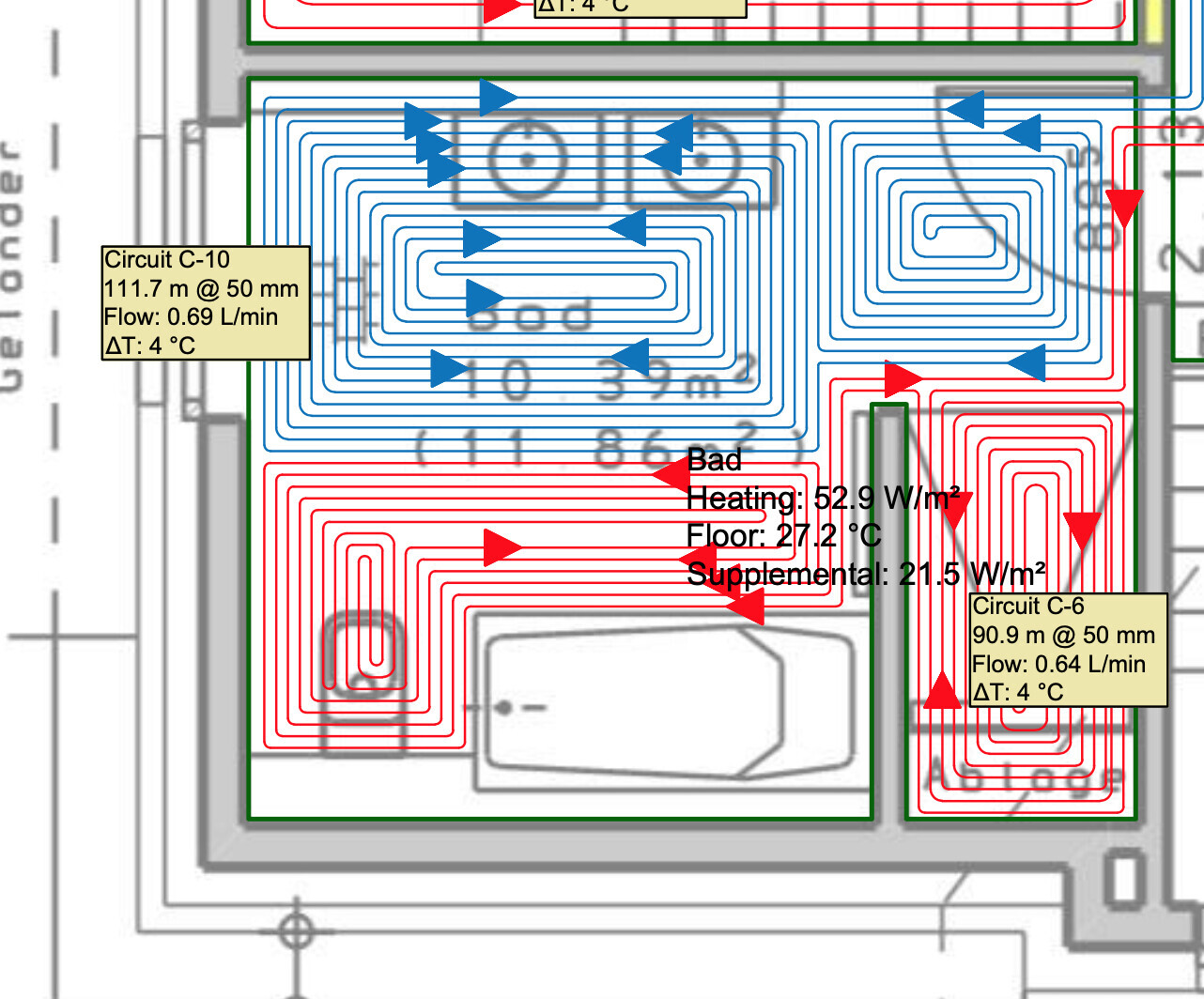
They also discussed the installation of the underfloor heating in general. Unfortunately, fully embedding the heating system in the shower floor won’t be possible. The screed will only be applied over approximately half of the shower area by the screed contractor; the rest will be done by the tiler because of the necessary slope for drainage and the built-up edge at the end.
I had to insist with the site manager to include a “loop” underfloor heating system within the shower area and to extend the screed as far into the shower as possible.
I believe my general contractor has learned a lot about underfloor heating, flow temperatures, pipe spacing, and persistent homeowners with this project. My wife gets really annoyed every time I bring up these topics, but we are paying for this, and we will have to live with it for the next several decades.
So far, nothing has changed. The spacing for the wall heating pipes is still at 10cm (4 inches), and the site manager requested an on-site meeting with the heating installer, the site manager, and the general contractor’s site manager. I already had a bad feeling about that.
They tried everything to convince me that a 5cm (2 inch) pipe spacing wouldn’t work.
But the real issue was the warranty concerning cracks. The 5cm (2 inch) wall heating spacing will now be installed, but the general contractor is worried about cracking. The agreement is that they will do their best and may embed reinforcement mesh in the plaster to prevent cracks. However, I will have to sign a waiver releasing them from any warranty claims related to cracks over the 3sqm (32 sq ft) area.
They also discussed the installation of the underfloor heating in general. Unfortunately, fully embedding the heating system in the shower floor won’t be possible. The screed will only be applied over approximately half of the shower area by the screed contractor; the rest will be done by the tiler because of the necessary slope for drainage and the built-up edge at the end.
I had to insist with the site manager to include a “loop” underfloor heating system within the shower area and to extend the screed as far into the shower as possible.
I believe my general contractor has learned a lot about underfloor heating, flow temperatures, pipe spacing, and persistent homeowners with this project. My wife gets really annoyed every time I bring up these topics, but we are paying for this, and we will have to live with it for the next several decades.
S
Smirnoff198314 May 2021 13:19OWLer schrieb:
Another update from me:May I ask why you chose an air-to-water heat pump instead of geothermal energy? Or was geothermal never an option?
Similar topics