
Hello everyone,
we are planning a prefabricated house using timber frame construction. It will have 180 sqm (1,937 sq ft) of living space with underfloor heating, and about 230 sqm (2,475 sq ft) of usable area.
So far, the offer included an air-to-water heat pump from Daikin (Altherma 3R, formerly Rotex HPSU compact Ultra).
Now it seems that this unit might not have enough capacity (?) and as an alternative (additional cost around 4,000) we have been offered a "Wolf heat pump CHC Monoblock 10/300-35".
The Daikin is available in the 4-9 kW version—would that really be insufficient for this size? And what do you think about this offer?
I have the energy-saving regulation heat protection certification and a renewable energy heat law document available, if any information from those is needed.
Thank you very much!
Best regards
we are planning a prefabricated house using timber frame construction. It will have 180 sqm (1,937 sq ft) of living space with underfloor heating, and about 230 sqm (2,475 sq ft) of usable area.
So far, the offer included an air-to-water heat pump from Daikin (Altherma 3R, formerly Rotex HPSU compact Ultra).
Now it seems that this unit might not have enough capacity (?) and as an alternative (additional cost around 4,000) we have been offered a "Wolf heat pump CHC Monoblock 10/300-35".
The Daikin is available in the 4-9 kW version—would that really be insufficient for this size? And what do you think about this offer?
I have the energy-saving regulation heat protection certification and a renewable energy heat law document available, if any information from those is needed.
Thank you very much!
Best regards
D
Daniel-Sp23 Oct 2020 12:54OWLer schrieb:
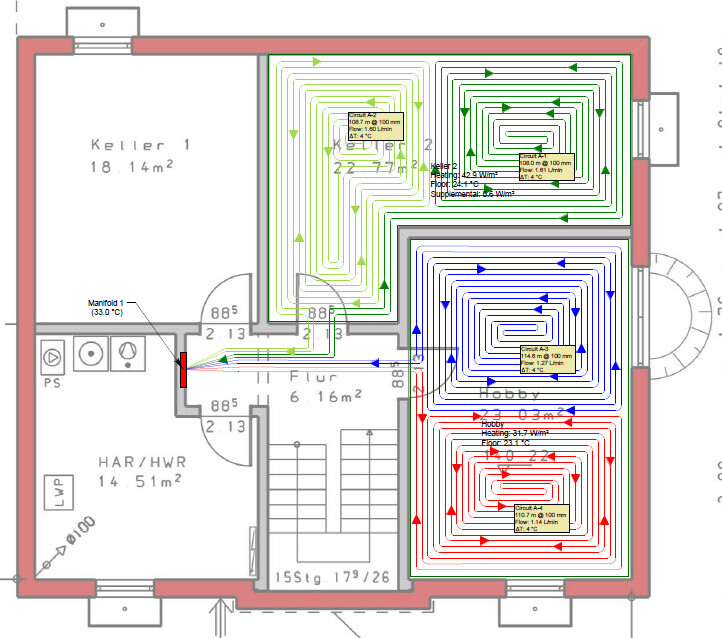
Basement layout plan:
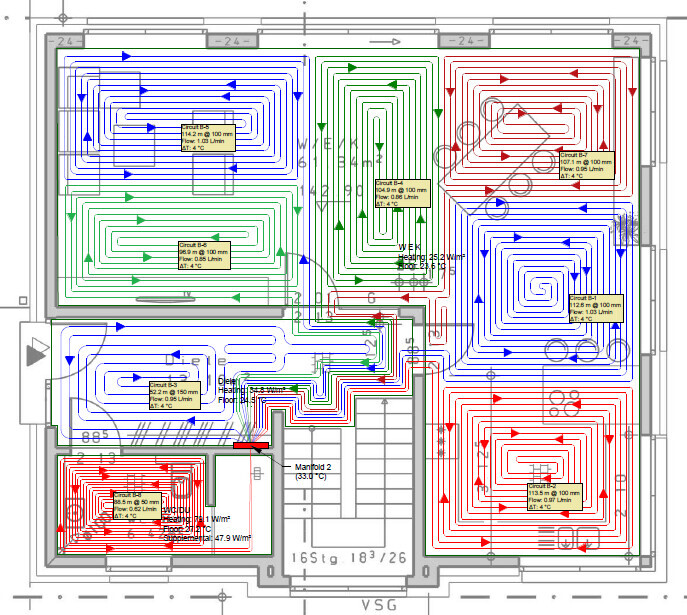
Ground floor:
Upper floor:
I’ve lost track now. But seeing that the utility room is located under the bathroom/shower, I would definitely recommend installing underfloor heating there. You can always turn it off later. You don’t want to lose heat from the bathroom into the utility room afterward...
I spoke again with the heating engineer today. I’m feeling more and more confident and will probably end up satisfied.
Installation plan:
He is noticeably not very keen on it. He prefers to stick to his standard (15cm (6 inches) spacing in living areas, 7.5cm (3 inches) in bathrooms). Currently, there are a few more heating circuits than he would ideally like or than the standard for which the general contractor pays him. He is concerned that the many bends at 5cm (2 inches) spacing could damage the screed. In summary, however, he said he will do his best to follow the installation plan. The topic of wall heating is no longer a problem for him; it seems he has come around to it. The additional cost for the shorter pipe spacing is 4€/sqm (square meter).
Heat pump:
He would prefer to install a Daikin unit because he knows the models well, has good contacts with the sales department, and even used to provide their customer service until a few years ago. The model would have been the 6kW Daikin Altherma 3 R F, which seems to be a solid unit. Unfortunately, my wife really does not like the outdoor unit. He advised against the black outdoor unit because it only gets sent to a painter by Daikin, and the result, in his opinion, is only mediocre.
Most likely, it will now be a Viessmann VWL 105/6 A combined with the Viessmann ventilation system. However, I just noticed it has a heating capacity of 9.2kW. I definitely need to double-check if I understood that correctly and insist on a minimum of VWL 75/6 A with 7kW.
Viessmann would be quieter, more efficient, and also greener thanks to the propane refrigerant. What could be the catch besides the oversizing of the 105/6? As a customer, I find the heat pump manufacturers’ websites really terrible. Why isn’t there an easy-to-find technical datasheet for the heat pumps?
Buffer tank:
During the conversation, he mentioned that he would install a 100-liter (26 gallons) buffer tank on the return line. This would allow the heat pump to charge it when the energy recovery ventilation (ERV) is turned off. I immediately pointed out that I wouldn’t need that if I plan to deactivate the ERV in the future. He agreed quickly and said that would be pointless. He would only do it as a standard because otherwise the ERV would cause the heat pump to cycle excessively, which would be unpleasant for both him and the customer.
Overflow valve:
He will definitely install an overflow valve at the top of the heating circuit distributor. He won’t be convinced otherwise. He said he has to deliver it with the ERV; otherwise, it would be borderline illegal. He said if I close it when I deactivate the ERV, it will corrode within three years anyway—so it’s basically the same as not installing it at all.
Installation plan:
He is noticeably not very keen on it. He prefers to stick to his standard (15cm (6 inches) spacing in living areas, 7.5cm (3 inches) in bathrooms). Currently, there are a few more heating circuits than he would ideally like or than the standard for which the general contractor pays him. He is concerned that the many bends at 5cm (2 inches) spacing could damage the screed. In summary, however, he said he will do his best to follow the installation plan. The topic of wall heating is no longer a problem for him; it seems he has come around to it. The additional cost for the shorter pipe spacing is 4€/sqm (square meter).
Heat pump:
He would prefer to install a Daikin unit because he knows the models well, has good contacts with the sales department, and even used to provide their customer service until a few years ago. The model would have been the 6kW Daikin Altherma 3 R F, which seems to be a solid unit. Unfortunately, my wife really does not like the outdoor unit. He advised against the black outdoor unit because it only gets sent to a painter by Daikin, and the result, in his opinion, is only mediocre.
Most likely, it will now be a Viessmann VWL 105/6 A combined with the Viessmann ventilation system. However, I just noticed it has a heating capacity of 9.2kW. I definitely need to double-check if I understood that correctly and insist on a minimum of VWL 75/6 A with 7kW.
Viessmann would be quieter, more efficient, and also greener thanks to the propane refrigerant. What could be the catch besides the oversizing of the 105/6? As a customer, I find the heat pump manufacturers’ websites really terrible. Why isn’t there an easy-to-find technical datasheet for the heat pumps?
Buffer tank:
During the conversation, he mentioned that he would install a 100-liter (26 gallons) buffer tank on the return line. This would allow the heat pump to charge it when the energy recovery ventilation (ERV) is turned off. I immediately pointed out that I wouldn’t need that if I plan to deactivate the ERV in the future. He agreed quickly and said that would be pointless. He would only do it as a standard because otherwise the ERV would cause the heat pump to cycle excessively, which would be unpleasant for both him and the customer.
Overflow valve:
He will definitely install an overflow valve at the top of the heating circuit distributor. He won’t be convinced otherwise. He said he has to deliver it with the ERV; otherwise, it would be borderline illegal. He said if I close it when I deactivate the ERV, it will corrode within three years anyway—so it’s basically the same as not installing it at all.
T
T_im_Norden9 Nov 2020 19:13That sounds reasonable.
If he is required to do so without an exemption, it’s understandable that he insists on it.
5-meter (16-foot) loops are not a problem for the screed.
What type of screed are you getting?
Viessmann or Vaillant?
If he is required to do so without an exemption, it’s understandable that he insists on it.
5-meter (16-foot) loops are not a problem for the screed.
What type of screed are you getting?
Viessmann or Vaillant?
T_im_Norden schrieb:
That sounds reasonable.
If he is required to do it without an exemption, it’s understandable that he insists on it.
5-meter (16 feet) circles are not a problem for the screed.
What kind of screed are you getting?
Viessmann or Vaillant? VAILLANT!!!!!
Screed… no idea, I think it will be gray. In total, including insulation, it should be 18cm (7 inches).
T
T_im_Norden9 Nov 2020 19:54No, I meant cement or anhydrite 🙂
I would opt for a small heat pump since you have your heating load calculated and know what you need.
I would opt for a small heat pump since you have your heating load calculated and know what you need.
Similar topics