
Hello everyone,
we are planning a prefabricated house using timber frame construction. It will have 180 sqm (1,937 sq ft) of living space with underfloor heating, and about 230 sqm (2,475 sq ft) of usable area.
So far, the offer included an air-to-water heat pump from Daikin (Altherma 3R, formerly Rotex HPSU compact Ultra).
Now it seems that this unit might not have enough capacity (?) and as an alternative (additional cost around 4,000) we have been offered a "Wolf heat pump CHC Monoblock 10/300-35".
The Daikin is available in the 4-9 kW version—would that really be insufficient for this size? And what do you think about this offer?
I have the energy-saving regulation heat protection certification and a renewable energy heat law document available, if any information from those is needed.
Thank you very much!
Best regards
we are planning a prefabricated house using timber frame construction. It will have 180 sqm (1,937 sq ft) of living space with underfloor heating, and about 230 sqm (2,475 sq ft) of usable area.
So far, the offer included an air-to-water heat pump from Daikin (Altherma 3R, formerly Rotex HPSU compact Ultra).
Now it seems that this unit might not have enough capacity (?) and as an alternative (additional cost around 4,000) we have been offered a "Wolf heat pump CHC Monoblock 10/300-35".
The Daikin is available in the 4-9 kW version—would that really be insufficient for this size? And what do you think about this offer?
I have the energy-saving regulation heat protection certification and a renewable energy heat law document available, if any information from those is needed.
Thank you very much!
Best regards
T
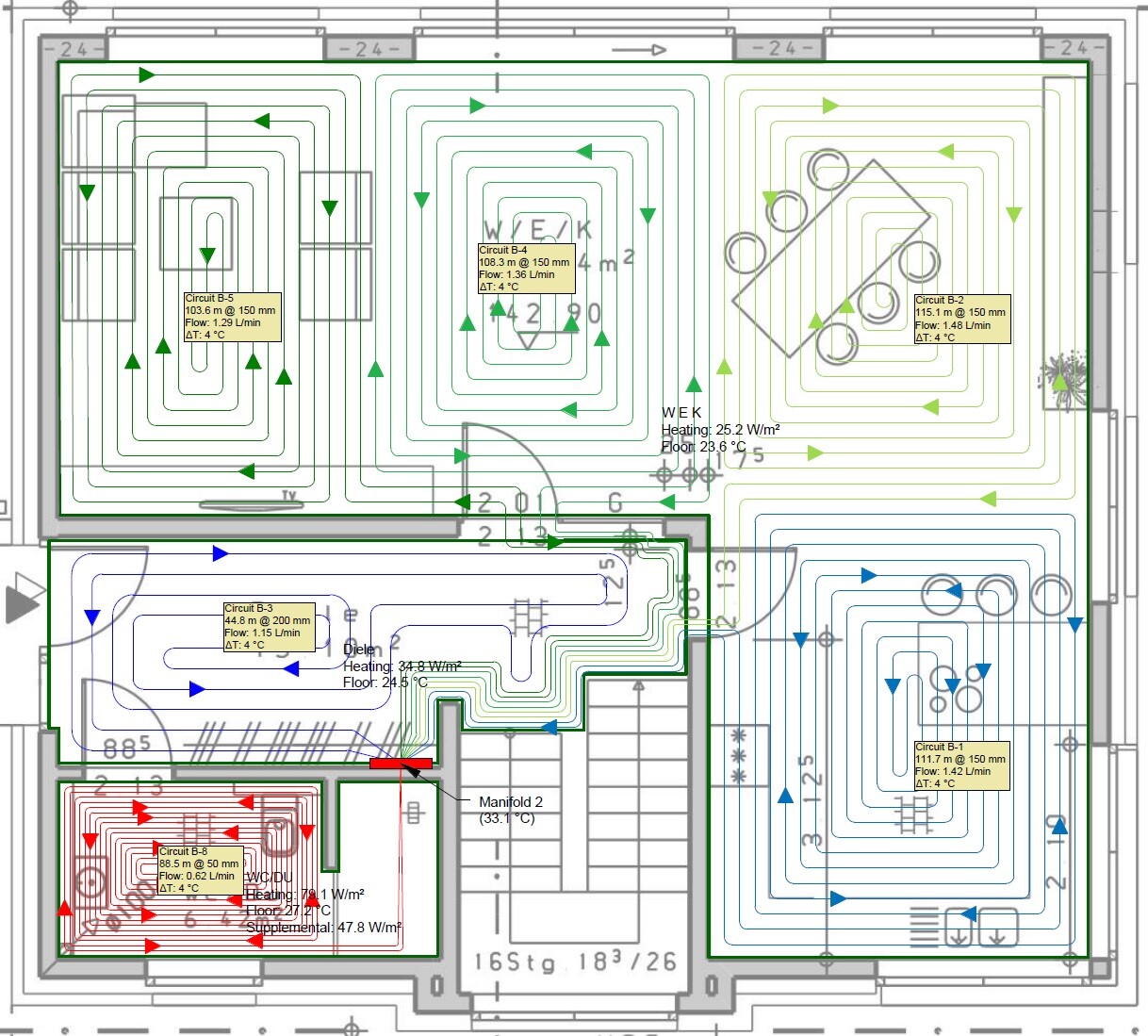
T_im_Norden22 Oct 2020 21:27I think it looks quite good; the circuits are fairly balanced.
You could consider whether to include the shower with underfloor heating in the guest bathroom, and possibly have 5 circuits of 80 meters (260 feet) each in the living area.
Has the connection of the heating control valve also been calculated by the office? Its diameter must not be too small.
You could consider whether to include the shower with underfloor heating in the guest bathroom, and possibly have 5 circuits of 80 meters (260 feet) each in the living area.
Has the connection of the heating control valve also been calculated by the office? Its diameter must not be too small.
T
T_im_Norden23 Oct 2020 10:27Try to arrange with the heating installer to lay the loops in one continuous length without pressing the pipes together.
He may ask for a higher price, but you will avoid joints that cause pressure loss and potential weak points.
He may ask for a higher price, but you will avoid joints that cause pressure loss and potential weak points.

Lumpi_LE schrieb:
The hallway will be warmer than the bathroom. You can spread out all the pipes running through there a bit and omit the dedicated loop. I used to think the same, and normally there wouldn’t be a heating loop planned in the upstairs hallway since it heats up anyway. However, after reading the relevant threads here about heat pumps, supply temperatures, and cold bathrooms, I’m unsure.
I would have said, sure: all those pipes pass through the hallway and heat it up. But if the hallway has its own heating loop, the pipes running through deliver less energy to their target room. In low-temperature systems, every heated room warms the adjacent unheated spaces as well. In my case, wouldn’t that mean that my upstairs bathroom warms the hallway and then lacks energy to heat itself properly?
So having heating in the hallway might be better than needing it. I can always shut off the flow at the manifold if it really gets too warm, right?
Basement hallway:
Ground floor hallway:
This area also heats the underside of the basement ceiling from the unheated zone and thus the basement hallway and the two basement rooms.
The upstairs hallway looks a bit exaggerated. However, there is also an exhaust vent here from the mechanical ventilation with heat recovery—so the warm air is constantly being extracted.
T_im_Norden schrieb:
Try to arrange with the heating installer to lay the circuits continuously without joining pipes by press fittings.
They might want more money for that, but then you won’t have any transitions causing pressure loss or potential weak points. First, I want to make sure they even agree to this and stick to the installation spacing and lengths. Then the details can come.

OWLer schrieb:
However, if the hallway has its own heating circuit, the pipes running through it transfer less energy before reaching their target room. Install it, since you can always completely shut it off later if needed, or set it to 0.2 liters (0.05 gallons).
D
Daniel-Sp23 Oct 2020 12:47OWLer schrieb:
Is this a tiled walk-in shower? If so, please also provide the substrate or base details. Maybe you could then create two heating circuits and, to gain length on one circuit, route the return pipe in the hallway. That way, you also increase the average water temperature for the bathroom section and can better balance the pipe lengths. I did the same in my setup.Similar topics