
Hello,
we will install a ventilation system from Pluggit, which will be located in the basement.
The supply and exhaust air are planned to be routed through an opening in the basement wall that ends in a small light well. Is this a feasible approach? I am a bit concerned about the supply air coming in below ground level.
Also, it seems to me that the supply and exhaust air openings are quite close together.
Are there any regulations or guidelines that the construction company must follow regarding this?
Good luck,
daniels87
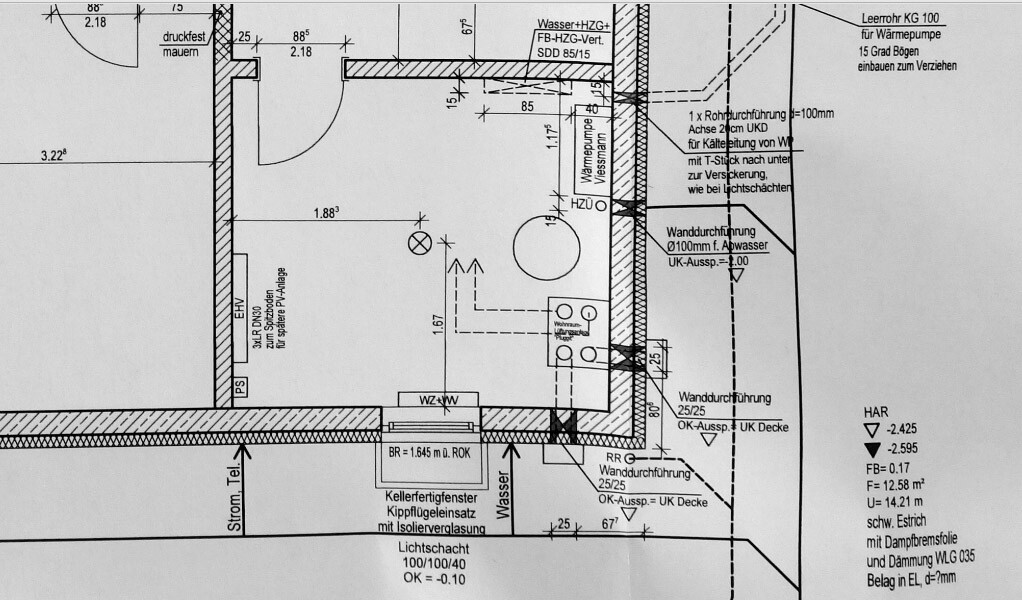
we will install a ventilation system from Pluggit, which will be located in the basement.
The supply and exhaust air are planned to be routed through an opening in the basement wall that ends in a small light well. Is this a feasible approach? I am a bit concerned about the supply air coming in below ground level.
Also, it seems to me that the supply and exhaust air openings are quite close together.
Are there any regulations or guidelines that the construction company must follow regarding this?
Good luck,
daniels87

Sebastian79 schrieb:
Well, these are exactly the problems I see with air intake in the basement without towers – we also have this issue with chimney fresh air intake.
Besides, I would never draw air close to the floor. Towers definitely look unpleasant; shafts are a better option.
But you say that low-level air intake is not good.
Another dilemma, so the attic could be an alternative.
On the other hand, I visited my brother-in-law yesterday. He has an LWZ403 in the basement, with the intake around the corner through basement shafts.
Basically, it works for him.
However, there are some negative points:
During construction, one shaft filled completely with water, and everything flowed into the unit.
A technician from Stiebel Eltron came, disassembled and cleaned the device, and everything worked again. That was 10 years ago.
The only protection against water backflow is that the duct is open at the bottom to allow drainage. Since then, no recurrence. Personally, I find that somewhat risky.
On level 3 out of 3, the system could be heard clearly outside if you were quiet. On level 1 of 3, it was only audible when close (which is a concern for me since I plan to place my terrace there).
The air outlet sounded louder than the inlet to me.
Inside it is similar. At level 3, it is clearly audible; at level 1, there is a faint noise. Breathing with an open mouth while sleeping is louder than that.
At some diffuser outlets, there is noticeable dirt on the surrounding wall or ceiling. It can be wiped off easily, but it is there. I wonder if increased dirt is promoted by air intake close to the floor.
He changes the filter regularly, so something always gets through.
What bothers him most is the dryness in winter. On average, according to his hygrometer, humidity is below 20% (<20% relative humidity), and at really low temperatures it is even less. Two humidifiers used over several weeks had practically no effect.
In some places, plaster cracks and veneers warp. The house is too dry. But that is not the topic of this thread.
B
Bieber08159 Sep 2016 10:15The air intake should be positioned at least 2 m (6.5 ft) above ground level. Today, I would recommend an enthalpy heat exchanger (i.e., with moisture recovery). This is also what my colleague suggests, who has a roughly 10-year-old controlled mechanical ventilation system without moisture recovery in a passive house... they also used humidifiers during winter (and had very positive experiences with them, as these devices also help filter dust from the air, a beneficial side effect).
Outside, at the supply and exhaust air openings, our system is most noticeable (and of course in the utility room next to the unit). I definitely wouldn’t want it near my terrace. Here, it is located at the front of the house, which is visually a matter of taste, but otherwise everything is fine.
Since we don’t have swirl diffusers, I can’t comment on other aspects, but yes, over time, the airflow may leave traces there.
Outside, at the supply and exhaust air openings, our system is most noticeable (and of course in the utility room next to the unit). I definitely wouldn’t want it near my terrace. Here, it is located at the front of the house, which is visually a matter of taste, but otherwise everything is fine.
Since we don’t have swirl diffusers, I can’t comment on other aspects, but yes, over time, the airflow may leave traces there.
D
daniels879 Sep 2016 10:22Kaspatoo schrieb:
He is particularly bothered by the dryness in winter. According to the hygrometer, the average humidity is below 20%, and it is even lower during severe freezing temperatures. Two humidifiers have been used for several weeks but have practically made no difference.
In some areas, the plaster is cracking, and veneers are warping. The house is too dry. But this is not the main topic of this thread here.We have planned a controlled ventilation system to protect the house from damage caused by moisture. If the air is too dry, why not simply set the system to a lower level or turn it off completely for a period of time?
Well, if the device is installed in the basement, which is an option for many, the pipes would have to run through the living room or whatever space is directly above.
I just thought of another question.
A general contractor planned for two basement shafts, one for supply air and one for exhaust air.
The room was already supposed to have a window well.
Does it make sense to use separate shafts there, or should they be combined?
I just thought of another question.
A general contractor planned for two basement shafts, one for supply air and one for exhaust air.
The room was already supposed to have a window well.
Does it make sense to use separate shafts there, or should they be combined?
S
Sebastian799 Sep 2016 10:26Kaspatoo schrieb:
Does it make sense to use separate ducts there, or should they be combined?Huh?
I would separate supply air, exhaust air, and lighting.
B
Bieber08159 Sep 2016 10:44daniels87 schrieb:
If the air is too dry, why not simply lower the system to a smaller setting or turn it off completely for a while? You still have to ventilate somehow, and dry air in winter is nothing new (in the past, when houses were quite drafty, people still hung water containers on radiators to add moisture; those were traditional ribbed radiators that got really hot). Today, you can choose the straightforward, worry-free solution: mechanical ventilation with heat recovery and moisture recovery.
Similar topics