
Hello,
we will install a ventilation system from Pluggit, which will be located in the basement.
The supply and exhaust air are planned to be routed through an opening in the basement wall that ends in a small light well. Is this a feasible approach? I am a bit concerned about the supply air coming in below ground level.
Also, it seems to me that the supply and exhaust air openings are quite close together.
Are there any regulations or guidelines that the construction company must follow regarding this?
Good luck,
daniels87
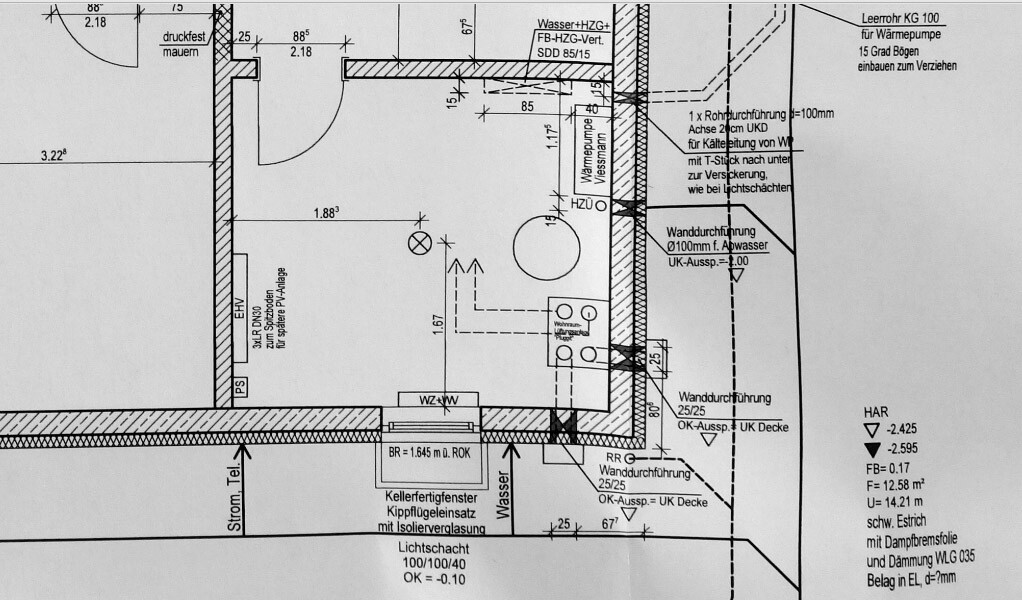
we will install a ventilation system from Pluggit, which will be located in the basement.
The supply and exhaust air are planned to be routed through an opening in the basement wall that ends in a small light well. Is this a feasible approach? I am a bit concerned about the supply air coming in below ground level.
Also, it seems to me that the supply and exhaust air openings are quite close together.
Are there any regulations or guidelines that the construction company must follow regarding this?
Good luck,
daniels87

If
If the slope is directed toward the house, then use a dry trap inside the house. Otherwise, you will draw air from the mechanical ventilation system's installation room when the trap dries out.
daniels87 schrieb:
What about the condensate? A slight slope toward the house, and then a drain with a trap there?
If the slope is directed toward the house, then use a dry trap inside the house. Otherwise, you will draw air from the mechanical ventilation system's installation room when the trap dries out.

Regarding the question about the air intake:
It is often said that it is best to have the air intake on the north side to capture cooler air during the summer. Okay, agreed.
But in winter, wouldn’t that be counterproductive? I mean, if the intake is on the south side, wouldn’t you tend to save on heating costs?
And how problematic exactly is it to have the intake on the south side?
In our situation, we don’t have much flexibility to choose a different intake location, except in the attic, but I’m concerned that the system would be noisier at night there than if it were in the basement (I’m quite sensitive to noise). Also, I plan to finish the attic later, so having such a device there wouldn’t be ideal.
It is often said that it is best to have the air intake on the north side to capture cooler air during the summer. Okay, agreed.
But in winter, wouldn’t that be counterproductive? I mean, if the intake is on the south side, wouldn’t you tend to save on heating costs?
And how problematic exactly is it to have the intake on the south side?
In our situation, we don’t have much flexibility to choose a different intake location, except in the attic, but I’m concerned that the system would be noisier at night there than if it were in the basement (I’m quite sensitive to noise). Also, I plan to finish the attic later, so having such a device there wouldn’t be ideal.
S
Sebastian798 Sep 2016 15:20You only hear the system at the ridge when it's on a high setting, which is normally not used.
And counterproductive? We're talking about temperature differences that you won't even notice later—don’t let something like that drive you crazy—and anyway, this should be planned by someone who knows what they’re doing.
Or do you really think the AIR temperature differs by 10 degrees between the two sides?
And counterproductive? We're talking about temperature differences that you won't even notice later—don’t let something like that drive you crazy—and anyway, this should be planned by someone who knows what they’re doing.
Or do you really think the AIR temperature differs by 10 degrees between the two sides?
I haven’t figured out yet how much difference that really makes.
So, do you mean that if I intake air through light wells on the southwest side and exhaust it around the corner on the southeast side, it’s not really a problem?
It would be nicer the other way, but it works like that too?
The general contractor suggested exactly that, or as an alternative, placing both on the southeast side about 3m (10 feet) apart (which would be quite close to the front door, but still inside the light well).
I’m wondering how it works if water gets in there.
The other light wells are installed as watertight against hydrostatic pressure, without drainage, with the note that drainage systems often get clogged over time.
If the mechanical ventilation system were to draw in water, that wouldn’t be ideal.
Also, what happens if the light well fills with snow overnight? Would the mechanical ventilation system and possibly the air-to-water heat pump stop working?
So, do you mean that if I intake air through light wells on the southwest side and exhaust it around the corner on the southeast side, it’s not really a problem?
It would be nicer the other way, but it works like that too?
The general contractor suggested exactly that, or as an alternative, placing both on the southeast side about 3m (10 feet) apart (which would be quite close to the front door, but still inside the light well).
I’m wondering how it works if water gets in there.
The other light wells are installed as watertight against hydrostatic pressure, without drainage, with the note that drainage systems often get clogged over time.
If the mechanical ventilation system were to draw in water, that wouldn’t be ideal.
Also, what happens if the light well fills with snow overnight? Would the mechanical ventilation system and possibly the air-to-water heat pump stop working?
S
Sebastian798 Sep 2016 15:43Well, these are the problems I see with an intake in the basement without towers – we have the same issue with the chimney fresh air supply.
Also, I would never draw air from ground level – partly because of radon (if present) and mainly because of dust.
And definitely not at the front door, as you will hear that.
Also, I would never draw air from ground level – partly because of radon (if present) and mainly because of dust.
And definitely not at the front door, as you will hear that.
Similar topics