
Hello,
We are starting to get really frustrated... every builder tells us something different...
We want to build a 130sqm (1,399 sq ft) KfW 70 house with the living room facing south, and we are unsure whether to choose gas or an air source heat pump. Some providers, at almost the same price level, offer us air source heat pumps and claim that the annual costs are significantly (30%) lower compared to gas, while others doubt this.
We understand that insulation with gas/solar systems is usually better because an air source heat pump boosts efficiency more towards KfW 70 standards compared to gas/solar, which might argue in favor of gas. An air source heat pump might fail somewhat sooner, and in case of problems, you can usually get quick and competent local support with gas. With air source heat pumps, there could be more difficulties. Additionally, the noise of air source heat pumps (in our case about 3 meters (10 feet) from the neighbor) is not insignificant. Some say that sooner or later, everyone ends up having issues with neighbors for this reason.
We are interested in air source heat pumps with storage tanks from these providers: Vaillant, Mitsubishi Zubadan, and Rotex.
What we are really curious about is the annual cost for heating and hot water with both systems.
We live near Kassel.
What should we choose, and what would be cost-effective TODAY? What is your opinion on Vaillant?
Regards
Gigi
We are starting to get really frustrated... every builder tells us something different...
We want to build a 130sqm (1,399 sq ft) KfW 70 house with the living room facing south, and we are unsure whether to choose gas or an air source heat pump. Some providers, at almost the same price level, offer us air source heat pumps and claim that the annual costs are significantly (30%) lower compared to gas, while others doubt this.
We understand that insulation with gas/solar systems is usually better because an air source heat pump boosts efficiency more towards KfW 70 standards compared to gas/solar, which might argue in favor of gas. An air source heat pump might fail somewhat sooner, and in case of problems, you can usually get quick and competent local support with gas. With air source heat pumps, there could be more difficulties. Additionally, the noise of air source heat pumps (in our case about 3 meters (10 feet) from the neighbor) is not insignificant. Some say that sooner or later, everyone ends up having issues with neighbors for this reason.
We are interested in air source heat pumps with storage tanks from these providers: Vaillant, Mitsubishi Zubadan, and Rotex.
What we are really curious about is the annual cost for heating and hot water with both systems.
We live near Kassel.
What should we choose, and what would be cost-effective TODAY? What is your opinion on Vaillant?
Regards
Gigi
R
R.Hotzenplotz7 Jun 2018 23:19We are getting a gas heating system with solar support, including underfloor heating.
What factors need to be considered when designing the underfloor heating to ensure it will still be suitable in the future if a heat pump is installed? I once read that the underfloor heating must meet certain requirements for this, but I can’t remember what they are. I want to clarify this in time before installation so I don’t limit any flexibility for the future.
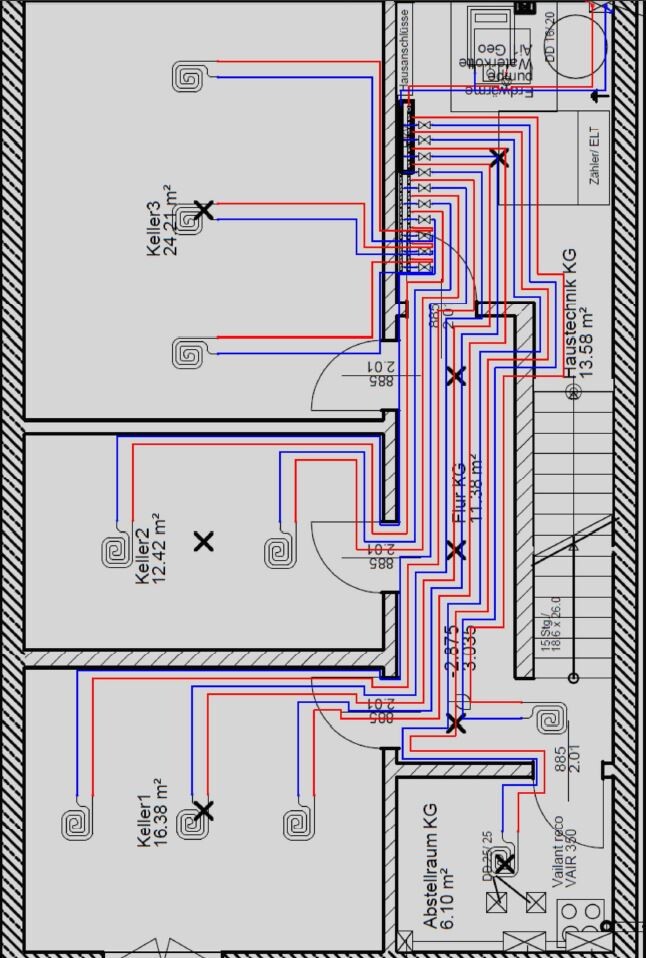
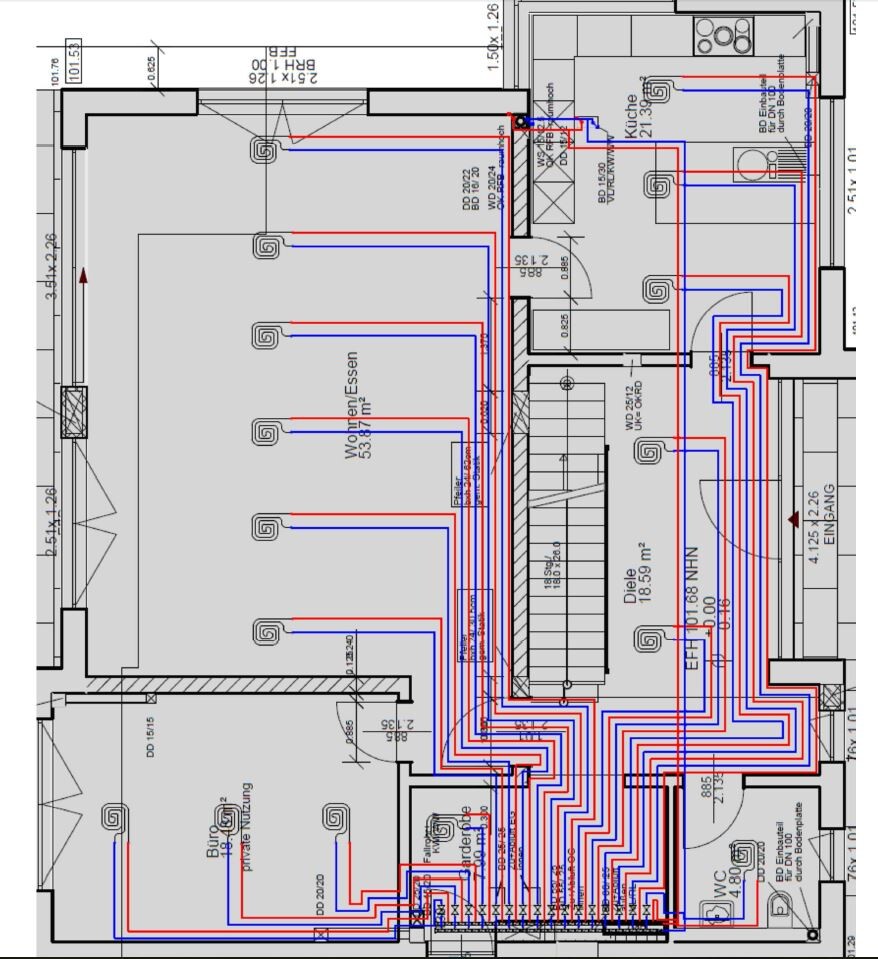
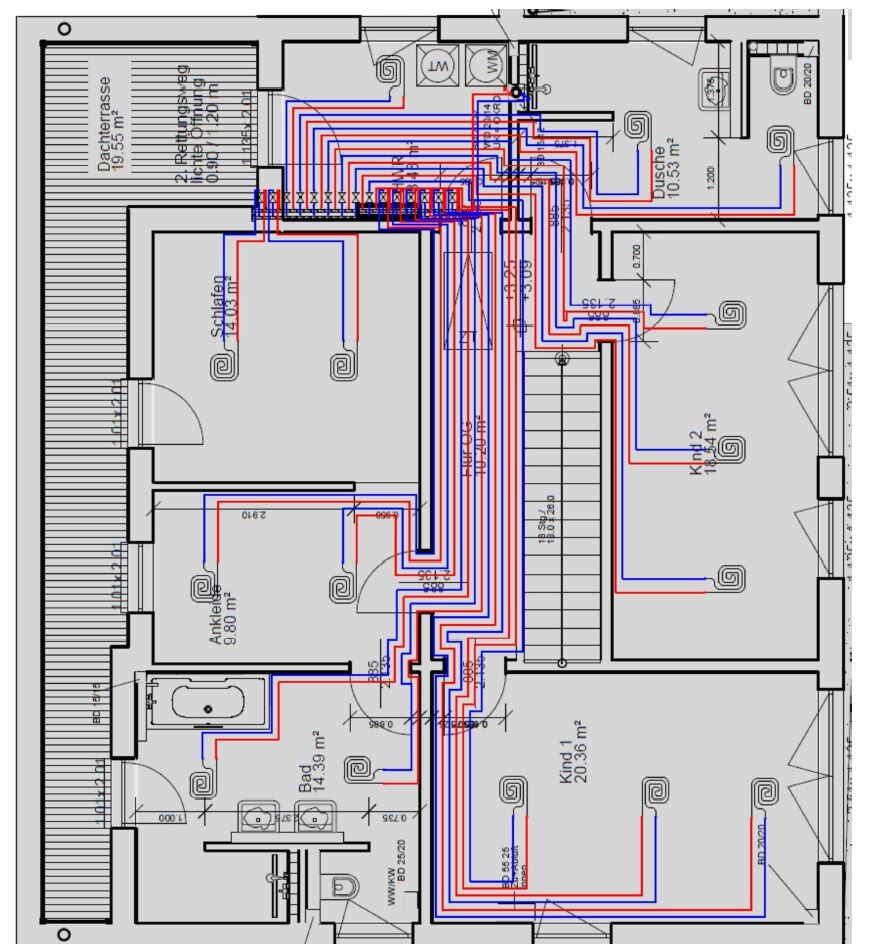
This is the current heating plan.
In the basement, however, there is a change: only the rooms at the top left and bottom left will be heated. The room in between and the bottom right room will not be heated.
That surprises me as well. Although this is exactly what is contractually agreed, during discussions with other solid construction house builders at the time, I was told it is mandatory to heat the entire basement. Otherwise, due to legal reasons, the entire stairway access to the basement from the ground floor hallway would have to be sealed off with a door. But this seems not to be the case here. The construction supervisor says he is not an expert on heating (but it really shouldn’t be necessary to have a separate heating expert as an additional inspector).
What factors need to be considered when designing the underfloor heating to ensure it will still be suitable in the future if a heat pump is installed? I once read that the underfloor heating must meet certain requirements for this, but I can’t remember what they are. I want to clarify this in time before installation so I don’t limit any flexibility for the future.
This is the current heating plan.
In the basement, however, there is a change: only the rooms at the top left and bottom left will be heated. The room in between and the bottom right room will not be heated.
That surprises me as well. Although this is exactly what is contractually agreed, during discussions with other solid construction house builders at the time, I was told it is mandatory to heat the entire basement. Otherwise, due to legal reasons, the entire stairway access to the basement from the ground floor hallway would have to be sealed off with a door. But this seems not to be the case here. The construction supervisor says he is not an expert on heating (but it really shouldn’t be necessary to have a separate heating expert as an additional inspector).
The installation spacing must be close enough to reach the desired temperature with a maximum supply temperature of 35°C (95°F). This way, the heat pump will work efficiently later on. In practice, this means a maximum spacing of 15cm (6 inches), preferably continuous 10cm (4 inches), and in bathrooms even 5cm (2 inches), if the installation system still allows this.
The reference to the engineers is quite amusing again. The energy consultant is probably also an HVAC planner.
The reference to the engineers is quite amusing again. The energy consultant is probably also an HVAC planner.
R
R.Hotzenplotz8 Jun 2018 07:24In our contract, only two basement rooms were specified to be heated. Then the heating load calculation was done, which included every basement room and planned underfloor heating throughout.
I was then told that this would no longer be changed and would remain as is. Likewise, the original layout of the underfloor heating, which was initially designed for a brine heat pump, would also stay unchanged—so they said I would still have some flexibility later on.
However, now that they say the rooms will be executed exactly as described in the contract, this implies to me that the entire heating load calculation is incorrect. It also raises doubts about whether the underfloor heating will truly be flexible in use later.
What is the best way to protect myself in this situation? I have contacted them to confirm in writing that the underfloor heating will be installed in a way that allows for a potential system change in the future. We’ll see if I get a response.
I was then told that this would no longer be changed and would remain as is. Likewise, the original layout of the underfloor heating, which was initially designed for a brine heat pump, would also stay unchanged—so they said I would still have some flexibility later on.
However, now that they say the rooms will be executed exactly as described in the contract, this implies to me that the entire heating load calculation is incorrect. It also raises doubts about whether the underfloor heating will truly be flexible in use later.
What is the best way to protect myself in this situation? I have contacted them to confirm in writing that the underfloor heating will be installed in a way that allows for a potential system change in the future. We’ll see if I get a response.
R
R.Hotzenplotz9 Jun 2018 17:31What would be your recommended course of action? Nothing has been installed yet.

Similar topics