
Hello,
We are starting to get really frustrated... every builder tells us something different...
We want to build a 130sqm (1,399 sq ft) KfW 70 house with the living room facing south, and we are unsure whether to choose gas or an air source heat pump. Some providers, at almost the same price level, offer us air source heat pumps and claim that the annual costs are significantly (30%) lower compared to gas, while others doubt this.
We understand that insulation with gas/solar systems is usually better because an air source heat pump boosts efficiency more towards KfW 70 standards compared to gas/solar, which might argue in favor of gas. An air source heat pump might fail somewhat sooner, and in case of problems, you can usually get quick and competent local support with gas. With air source heat pumps, there could be more difficulties. Additionally, the noise of air source heat pumps (in our case about 3 meters (10 feet) from the neighbor) is not insignificant. Some say that sooner or later, everyone ends up having issues with neighbors for this reason.
We are interested in air source heat pumps with storage tanks from these providers: Vaillant, Mitsubishi Zubadan, and Rotex.
What we are really curious about is the annual cost for heating and hot water with both systems.
We live near Kassel.
What should we choose, and what would be cost-effective TODAY? What is your opinion on Vaillant?
Regards
Gigi
We are starting to get really frustrated... every builder tells us something different...
We want to build a 130sqm (1,399 sq ft) KfW 70 house with the living room facing south, and we are unsure whether to choose gas or an air source heat pump. Some providers, at almost the same price level, offer us air source heat pumps and claim that the annual costs are significantly (30%) lower compared to gas, while others doubt this.
We understand that insulation with gas/solar systems is usually better because an air source heat pump boosts efficiency more towards KfW 70 standards compared to gas/solar, which might argue in favor of gas. An air source heat pump might fail somewhat sooner, and in case of problems, you can usually get quick and competent local support with gas. With air source heat pumps, there could be more difficulties. Additionally, the noise of air source heat pumps (in our case about 3 meters (10 feet) from the neighbor) is not insignificant. Some say that sooner or later, everyone ends up having issues with neighbors for this reason.
We are interested in air source heat pumps with storage tanks from these providers: Vaillant, Mitsubishi Zubadan, and Rotex.
What we are really curious about is the annual cost for heating and hot water with both systems.
We live near Kassel.
What should we choose, and what would be cost-effective TODAY? What is your opinion on Vaillant?
Regards
Gigi
R
R.Hotzenplotz23 Mar 2018 21:06There are four options for the solar collectors. See attachment. In my opinion, the flat plate collectors are not suitable at all, even though they are cheaper.
I also would not place them facing the street, so effectively only one option remains.

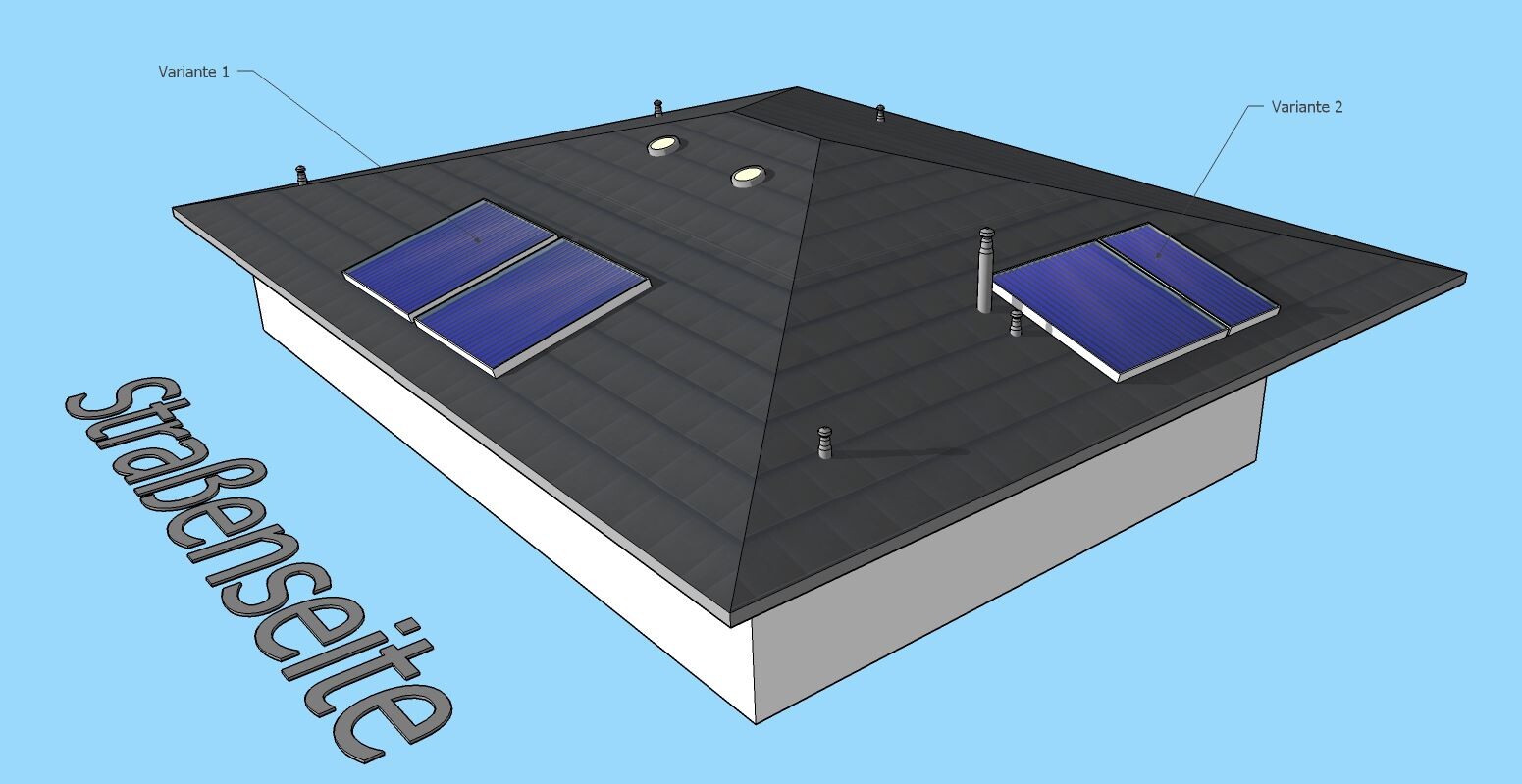
I also would not place them facing the street, so effectively only one option remains.
R
R.Hotzenplotz23 Mar 2018 21:36Addendum:
On this oriented plan, you can see the street side at the bottom left and the other option at the bottom right....

On this oriented plan, you can see the street side at the bottom left and the other option at the bottom right....
Elevating the structure looks bad, that much is clear.
Are they elevating it because it’s more effective, or just because it “has” to be done to meet the requirements?
I would choose the inefficient but visually appealing way and just write off the hassle.
The alternatives will cost you more. Or you could install an air-to-water heat pump, with the well-known pros and cons.
Are they elevating it because it’s more effective, or just because it “has” to be done to meet the requirements?
I would choose the inefficient but visually appealing way and just write off the hassle.
The alternatives will cost you more. Or you could install an air-to-water heat pump, with the well-known pros and cons.
R
R.Hotzenplotz23 Mar 2018 23:28I will definitely not install an air-to-water heat pump. Why would I, if a ground-source heat pump also works?
I might call the building authority on Monday to ask for an exemption to avoid installing solar panels.
Whether mounting the system on supports is mandatory or just more efficient, I need to check. Elevating the system is out of the question, especially since the installer says these systems are more likely to be ripped out of their anchoring in storms.
I suspect that even if flat-plate collectors without supports were possible, the whole setup would still be less cost-effective than using the more expensive evacuated tube collectors. I think it will come down to the evacuated tube collector solution, which is what I initially imagined—lying flat on the roof. It’s interesting how much more expensive they are.
I might call the building authority on Monday to ask for an exemption to avoid installing solar panels.
Whether mounting the system on supports is mandatory or just more efficient, I need to check. Elevating the system is out of the question, especially since the installer says these systems are more likely to be ripped out of their anchoring in storms.
I suspect that even if flat-plate collectors without supports were possible, the whole setup would still be less cost-effective than using the more expensive evacuated tube collectors. I think it will come down to the evacuated tube collector solution, which is what I initially imagined—lying flat on the roof. It’s interesting how much more expensive they are.
Wasn't a brine heat pump outrageously expensive for you?
I would rather invest a few thousand in visually acceptable solar collectors than go for a brine heat pump at a horror price. Or, priced between both solutions, pellets. With pellets, you don’t need solar, and you’ll need a flue vent anyway with gas.
I would rather invest a few thousand in visually acceptable solar collectors than go for a brine heat pump at a horror price. Or, priced between both solutions, pellets. With pellets, you don’t need solar, and you’ll need a flue vent anyway with gas.

Similar topics