
ᐅ Air well / Drainage pipe for pre-tempering domestic hot water?
Created on: 10 Jun 2022 21:30
K
karl.jonasK
karl.jonas10 Jun 2022 21:30Next to an existing shed and two planned houses, I will install a DN100 (4-inch) rainwater pipe at a depth of about 1.7 m (5.5 ft) (see sketch). A DN100 (4-inch) drainage pipe with a coconut fiber covering will be placed beside it, surrounded by some gravel. This means I will dig a trench approximately 30 m (98 ft) long, 1.7 m (5.5 ft) deep (gradually decreasing), and 0.6 m (2 ft) wide, and fill it with about 50 cm (20 inches) of gravel, with soil on top.
I recently read about an earth-to-air heat exchanger (sometimes called an air well). In this system, supply air for the mechanical ventilation is drawn through a drainage pipe, making it cooler than the outside air in summer (and warmer in winter). This is generally beneficial but often not cost-effective. The air passes through the gravel into the pipe, and possibly also through inspection chambers at both pipe ends.
Since I am digging the trench anyway, the additional costs are relatively low: 30 m (98 ft) of plain drainage pipe and a few more cubic meters of gravel. The excavated soil can be spread over the property.
What do you think? Could this help me avoid using air conditioning in summer? Is there any reason not to use the preconditioned supply air for both planned houses? Or is the air exchange rate of a controlled mechanical ventilation system so high that the air inside the pipe does not have enough time to cool down or warm up?
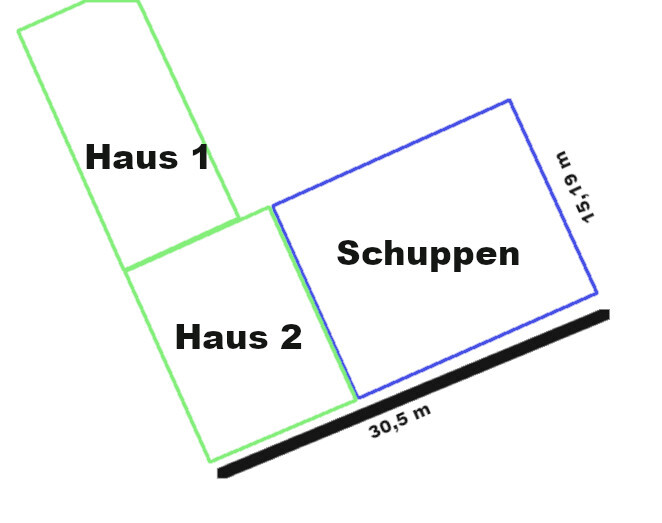
I recently read about an earth-to-air heat exchanger (sometimes called an air well). In this system, supply air for the mechanical ventilation is drawn through a drainage pipe, making it cooler than the outside air in summer (and warmer in winter). This is generally beneficial but often not cost-effective. The air passes through the gravel into the pipe, and possibly also through inspection chambers at both pipe ends.
Since I am digging the trench anyway, the additional costs are relatively low: 30 m (98 ft) of plain drainage pipe and a few more cubic meters of gravel. The excavated soil can be spread over the property.
What do you think? Could this help me avoid using air conditioning in summer? Is there any reason not to use the preconditioned supply air for both planned houses? Or is the air exchange rate of a controlled mechanical ventilation system so high that the air inside the pipe does not have enough time to cool down or warm up?
The idea is good, but I am not familiar with this particular implementation. I know of a closed pipe system that draws air from somewhere in the garden and is tempered through the pipe wall in the ground.
Either way, I consider this the best method for a mechanical ventilation system with heat recovery. It avoids the typical issues.
Regarding the calculations, I’m out of my depth.
Either way, I consider this the best method for a mechanical ventilation system with heat recovery. It avoids the typical issues.
Regarding the calculations, I’m out of my depth.
Similar topics