
Hello,
I am currently planning a new build (my first), which is intended to have 2-3 residential units and will likely aim for an energy efficiency rating of 40+. Essentially, it could be called a multi-generational house. Initially, only 2 units will be developed (one on the ground floor and one on the upper floor), but in the future, a third unit is planned for the attic. I would like to leave the attic unit as a shell at first, but have all the connections, wiring, and so on installed. The goal is to avoid any further construction work later so that it can be used as a separate unit.
As far as I know, a separate residential unit requires the following conditions:
- Its own lockable entrance
- Its own electricity meter
- One kitchen connection each
- One bathroom connection each (toilet and shower)
I hope I haven’t missed anything here. If so, please let me know.
Now to my question: To plan a bit better, I would like to get an idea of how much an additional residential unit costs in terms of installing connections for an extra kitchen and an additional bathroom, as well as setting up a separate electrical circuit with its own electricity meter in the utility room. In other words, the extra costs you should budget for when turning a standard single-family house into a house with 2 or 3 units.
For now, I am only interested in the cost of the connections—that is, the potential for an additional unit—not the cost of the kitchen or bathroom fixtures themselves.
I hope you can help. Many thanks in advance for any comments and explanations!
I am currently planning a new build (my first), which is intended to have 2-3 residential units and will likely aim for an energy efficiency rating of 40+. Essentially, it could be called a multi-generational house. Initially, only 2 units will be developed (one on the ground floor and one on the upper floor), but in the future, a third unit is planned for the attic. I would like to leave the attic unit as a shell at first, but have all the connections, wiring, and so on installed. The goal is to avoid any further construction work later so that it can be used as a separate unit.
As far as I know, a separate residential unit requires the following conditions:
- Its own lockable entrance
- Its own electricity meter
- One kitchen connection each
- One bathroom connection each (toilet and shower)
I hope I haven’t missed anything here. If so, please let me know.
Now to my question: To plan a bit better, I would like to get an idea of how much an additional residential unit costs in terms of installing connections for an extra kitchen and an additional bathroom, as well as setting up a separate electrical circuit with its own electricity meter in the utility room. In other words, the extra costs you should budget for when turning a standard single-family house into a house with 2 or 3 units.
For now, I am only interested in the cost of the connections—that is, the potential for an additional unit—not the cost of the kitchen or bathroom fixtures themselves.
I hope you can help. Many thanks in advance for any comments and explanations!
11ant schrieb:
I can only admire your tirelessness and must admit that I personally have to surrender to the brilliance of the original poster and can probably do no more than wish him all the best in this case. I can only once again ask where the basis for such strong criticism of my idea can be found. I have been explaining for quite some time what I want to do and how I arrive at these conclusions. I keep stressing that I am neither infallible, nor a professional, nor fully committed to my plans. I gladly welcome well-founded counterarguments so I can return to the planning stage with them. Yet I see no concrete objections, or they have been addressed or still need to be verified on site (for example, the important note regarding parking spaces). Or did you have one that I might have missed?
If it is so simple and I am, in boundless ignorance, completely off track, then please briefly and clearly summarize the misconceptions or planning errors I am making here. That would be helpful.
But making fun of it together and dismissing it, unfortunately, does not help.
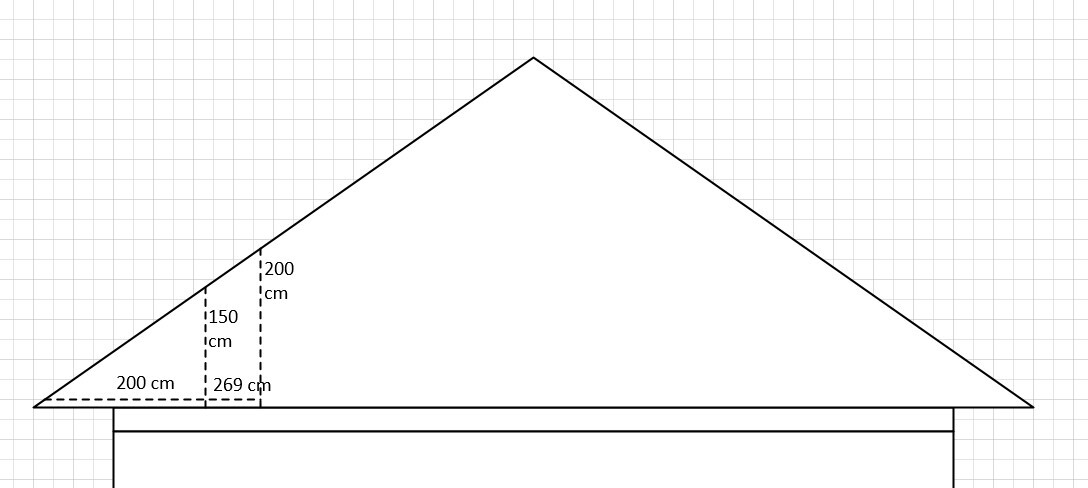
Here is a brief sketch of the roof (pitch 35 degrees) and an attempt to show at which roof pitch which height is reached. As mentioned before, insulation/roof thickness has not been taken into account here.
In my opinion, the attic space cannot be said to have only 20 square meters of area.
Am I overlooking something here? Or is there an error in your calculation?
In my opinion, the attic space cannot be said to have only 20 square meters of area.
Am I overlooking something here? Or is there an error in your calculation?
Felix85 schrieb:
With a roof overhang of 1 meter (3 feet 3 inches) The roof overhang is basically irrelevant.
Felix85 schrieb:
At a pitch of 35 degrees, you roughly reach 1.5 meters (5 feet) of headroom after about 2 meters (6 feet 7 inches) of roof slope. Felix85 schrieb:
From what you wrote, I can’t really tell what exactly is supposed to be wrong with my estimate. Based on your sketch, it is clear that you are including a knee wall for your roof. Roof rafters usually rest on the exterior wall. In your case? What kind of structure is that? By adding the knee wall, you are naturally raising your roof by about 1 meter (3 feet 3 inches) or 70 cm (28 inches).
The roof overhang in your sketch is supported, the rafters lie above the exterior wall, essentially on a knee wall.
But you keep coming up with new surprises 😉
Anyway, I forgot earlier that with a knee wall of 1.5 meters (5 feet), a second emergency exit is not possible because it cannot be reached.
ypg schrieb:
The roof overhang is planned according to your sketch, with the rafters extending beyond the exterior wall, basically sitting on a knee wall. But you keep coming up with new surprises 😉To be honest, these weren't surprises for me. I had mentioned the roof overhang and am still not fully confident with the terms. From a layperson’s perspective, it seemed logical to me to plan the roof starting from the overhang. I frankly can’t imagine it any other way right now… I can’t start the roof on the walls and then somehow build a meter (3 feet) ahead of that. But maybe that’s possible and I just don’t understand it.For me, a knee wall always meant raising the base walls higher, so the roof would be set on top later, somewhere within the attic. In my case, it’s just a roof overhang. Of course, this ends up with a similar effect (the roof is higher and the interior space larger).
To clarify, was my rough floor area estimate for the attic correct with this kind of roof design? I couldn’t really follow your figures, even assuming a roof starting directly on the base walls. And if the roof overhang can’t be done like that, how do you do it when you want an overhang? The slope has to start at the “tip” of the roof, meaning at the overhang, not only at the main wall, right?
Felix85 schrieb:
With a 35-degree pitch, I reach a room height of 1.50 m (5 feet) within just a few meters, from where I would want to set the walls inwards and start the room. One meter further, the room height is already about 2 m (6.5 feet).However, that is not permitted for an emergency escape route. The fire department cannot place a ladder there, nor can the occupant exit through such a high window. Just plan a dormer window extending forward—you will need it.Felix85 schrieb:
If it’s so simple and I am, in boundless foolishness, miles away from any sense, then please briefly and clearly summarize which misconceptions or planning errors I am falling for here. I’ll reply on behalf of 11ant:
You feel like the third person this week who, driven by fanciful ideas, insists on planning a granny flat just to at least theoretically get a taste of building a house. We’re not stupid here either, even though some like to pretend otherwise. Arguments come up... hehe, hopefully 11ant has documented it well by now.
We certainly don’t claim to know everything, as I already said. But many of us are knowledgeable, have done some research here, and know a thing or two. When the original poster then has a “but” for every point and doesn’t believe anything—basically chasing those mentioned fanciful ideas—you can recognize that by now. Normally, people here don’t waste time with those who want to use taxpayers’ money for something that isn’t intended for the purpose KfW (the development bank) sees it for—creating living space.
I’m responding to you because I can’t really assess your intention. But I can recognize the dominant role of the apartment in your plan: the house will be even taller, and it will have a very expensive roof structure, which already eats up the subsidy.
That’s already a recipe for a hard landing and ongoing headaches beforehand.
My personal opinion: the idea stinks if I plan to build and then have a stranger living above me.
Similar topics