
Hello,
I am currently planning a new build (my first), which is intended to have 2-3 residential units and will likely aim for an energy efficiency rating of 40+. Essentially, it could be called a multi-generational house. Initially, only 2 units will be developed (one on the ground floor and one on the upper floor), but in the future, a third unit is planned for the attic. I would like to leave the attic unit as a shell at first, but have all the connections, wiring, and so on installed. The goal is to avoid any further construction work later so that it can be used as a separate unit.
As far as I know, a separate residential unit requires the following conditions:
- Its own lockable entrance
- Its own electricity meter
- One kitchen connection each
- One bathroom connection each (toilet and shower)
I hope I haven’t missed anything here. If so, please let me know.
Now to my question: To plan a bit better, I would like to get an idea of how much an additional residential unit costs in terms of installing connections for an extra kitchen and an additional bathroom, as well as setting up a separate electrical circuit with its own electricity meter in the utility room. In other words, the extra costs you should budget for when turning a standard single-family house into a house with 2 or 3 units.
For now, I am only interested in the cost of the connections—that is, the potential for an additional unit—not the cost of the kitchen or bathroom fixtures themselves.
I hope you can help. Many thanks in advance for any comments and explanations!
I am currently planning a new build (my first), which is intended to have 2-3 residential units and will likely aim for an energy efficiency rating of 40+. Essentially, it could be called a multi-generational house. Initially, only 2 units will be developed (one on the ground floor and one on the upper floor), but in the future, a third unit is planned for the attic. I would like to leave the attic unit as a shell at first, but have all the connections, wiring, and so on installed. The goal is to avoid any further construction work later so that it can be used as a separate unit.
As far as I know, a separate residential unit requires the following conditions:
- Its own lockable entrance
- Its own electricity meter
- One kitchen connection each
- One bathroom connection each (toilet and shower)
I hope I haven’t missed anything here. If so, please let me know.
Now to my question: To plan a bit better, I would like to get an idea of how much an additional residential unit costs in terms of installing connections for an extra kitchen and an additional bathroom, as well as setting up a separate electrical circuit with its own electricity meter in the utility room. In other words, the extra costs you should budget for when turning a standard single-family house into a house with 2 or 3 units.
For now, I am only interested in the cost of the connections—that is, the potential for an additional unit—not the cost of the kitchen or bathroom fixtures themselves.
I hope you can help. Many thanks in advance for any comments and explanations!
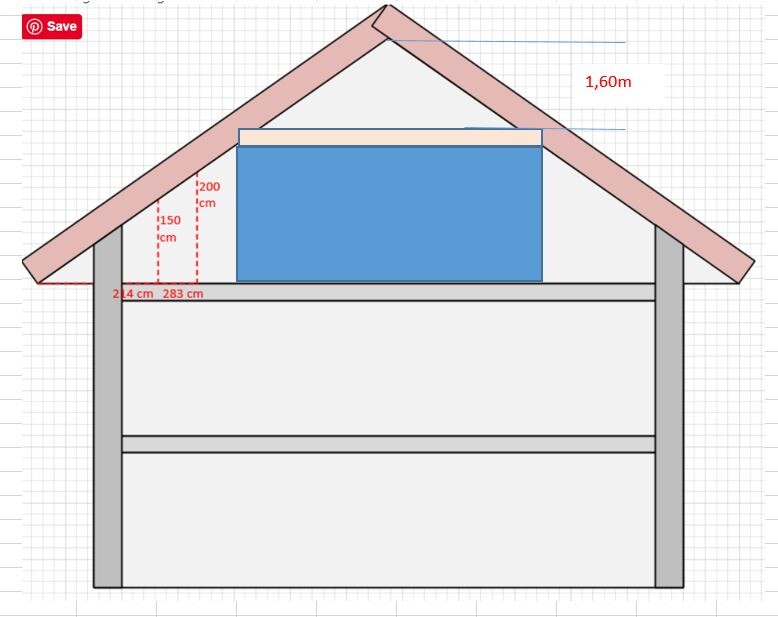
You should mark the 2-meter (6.6 feet) line in your attic. 1.50 (5 feet) is not relevant.
Roof topic:
A cold roof is planned when you want a cost-optimized standard hip roof with, for example, a 20-degree slope, where the standing height in the center barely reaches 1.50 meters (5 feet). The roof can then be used for storing boxes.
The ceiling also makes a difference: for a storage roof, wood is used, not concrete. For a small bedroom, more expensive concrete would make more sense.
Overall, your roof is already quite expensive.
The 10 square meters (108 square feet) mentioned by @hanghaus2000 is the generalized insulation saving. After all, planning is cost-optimized. Every square meter counts in the calculation sometimes. That is why the roof structure that cannot be walked on is used. It is much cheaper than a walkable roof.
Planning is need-oriented, not generic: some are satisfied with a cold roof, others are not.
Roof topic:
Felix85 schrieb:
During the discussion, I understood that insulating the ceiling of the upper floor (i.e., creating a cold roof) versus insulating the roof itself (meaning the possibility to convert the attic) does not differ significantly in price.
If that is the case, why would anyone choose a cold roof at all?
A cold roof is planned when you want a cost-optimized standard hip roof with, for example, a 20-degree slope, where the standing height in the center barely reaches 1.50 meters (5 feet). The roof can then be used for storing boxes.
The ceiling also makes a difference: for a storage roof, wood is used, not concrete. For a small bedroom, more expensive concrete would make more sense.
Overall, your roof is already quite expensive.
Felix85 schrieb:
No matter how impractical a hipped roof (or any roof) is for conversion, if insulating the space there causes no or only minor additional costs, wouldn’t it always be better to secure that potential?
The 10 square meters (108 square feet) mentioned by @hanghaus2000 is the generalized insulation saving. After all, planning is cost-optimized. Every square meter counts in the calculation sometimes. That is why the roof structure that cannot be walked on is used. It is much cheaper than a walkable roof.
Planning is need-oriented, not generic: some are satisfied with a cold roof, others are not.
Felix85 schrieb:
Or is a cold roof that advantageous?
ypg schrieb:
You should mark the 2-meter (6.5 feet) line in your attic. 1.50 meters (5 feet) is not relevant. The interior walls of the floor start at 2 meters (6.5 feet). So, the entire living area visible in the attic has a ceiling height of over 2 meters (6.5 feet). However, I don’t want to rule out that I might be misunderstanding something about the roof structure.
The dashed red lines on the floor plan show the four slopes of the roof. At the end of the grey wall, there would be approximately 280 cm (110 inches) of roof slope length, which should correspond to a height of 2 meters (6.5 feet) in that room. Here is the cross-section again:
But as I said, I can’t exclude the possibility that I’m mistaken.
If this roughly matches, it might help clarify why I am still committed to developing the hip roof. According to the calculations and visualizations, this adds a significant number of square meters of living space. I would consider it a waste not to utilize this potential. Of course, in the end, it also depends on the cost to make it habitable at all.
Or put another way: If I don’t finish the attic, I won’t need a hip roof with a 35-degree pitch. In that case, a 18-degree pitch or similar with a cold roof would suffice. But I don’t find that as visually appealing or I’d consider it more “ordinary.” The alternative would be to increase the building’s overall footprint somewhat, to create more living space on the ground and upper floors to compensate for losing the attic.
I just found a mistake in the current version. The roof windows in the attic bathroom and bedroom are currently positioned right in the middle of the slope of the two lower ridges 🙄. Annoying, I had already corrected that in an earlier version. It probably wasn’t carried over. They need to be arranged differently. In general, they could be placed slightly lower and a bit more towards the center.
H
hanghaus20005 Jul 2021 17:12Here is a representation of the attic.
Felix85 schrieb:
Or in other words: If I don’t finish that space, I don’t need a tent roof with a 35-degree pitch. I completely agree with you.
I found my set square, marked your knee wall at one meter (about 3.3 feet), etc., and if the house were built here in Lower Saxony (where the 2.20 meters and two-thirds rule apply, and with a gable roof it would qualify as a full story 😉) the area would become huge, since the knee wall plays a significant role.
Why don’t you simply design a knee wall of two meters (about 6.6 feet) for your attic, use a 22-degree roof pitch, and thus reduce your house height by about 50 centimeters (20 inches), but end up with a three-story building with many escape routes? 😎
H
hanghaus20005 Jul 2021 17:29@ypg I had the same thought. However, the pitched roof is actually a positive aspect here because it prevents the space from quickly becoming a full story. In my opinion, having a living and dining area with only roof windows is not acceptable. At least a large dormer is necessary.
To plan for three full stories, you would first need to know if they are even permitted.
To plan for three full stories, you would first need to know if they are even permitted.
Similar topics