
ᐅ Additional Costs Due to Incorrectly Designed Ventilation System and Floor-to-Ceiling Windows?
Created on: 29 Nov 2016 01:14
3
305er
Hi, we have our final planning meeting on December 13th, after which everything will be sent to the building authority (building permit / planning permission).
From the beginning, I told my salesperson that the outdoor unit of the Rotex ventilation system was incorrectly positioned in the first offer. The layout shown is not possible because the garage is supposed to be there.
I was told, "No problem. This can be changed in the planning phase and moved up."
Now I wrote to the CEO to have this corrected.
The reply was only:
On your floor plan, you moved the outdoor unit of the heat pump to a different location. This is not possible with the contractual Rotex heat pump. A Novelan LAD heat pump is required, and the outdoor unit must be moved further to the right, against the outer wall of the study room.
Here are the costs: Change to Novelan LAD + 2,138.00 €
Extension of the outdoor unit + 1,509.00 €
The reason is that the outdoor and indoor units have to be aligned at the same height/line.
Of course, I disagree with this.
Do you have any suggestions on how to solve this without extra costs or significant loss of space?
The pantry shown in the picture will be removed, and the utility room (HAR) will be made larger instead.
Point 2:
I wanted to replace the two large floor-to-ceiling terrace windows in the kitchen with one standard window, because the kitchen island will be placed against that wall.
Reply:
– Changing the floor-to-ceiling windows in the kitchen to standard windows with a masonry sill is possible at the same price in the project planning.
Question: By “standard” you mean? So two large floor-to-ceiling windows cost the same as one normal window?
Point 3:
Colored front door with a small side panel, ADDITIONAL COST 1,464€???? That seems quite high for just a bit of paint or finish, right?
Point 4:
I want to install a horizontal window at the top of the hallway to bring light into the room (we don’t want double casement windows). We saw this in a prefab house with the same knee wall height as ours.
Reply:
In the current plan, the window is not possible because the wall height is insufficient. Otherwise, the window would have to be fixed and equipped with TRAV glazing. The cost would be around 1,400.00 € to 1,600.00 €.
What do you think?
Point 5:
Price reduction for removing the standard front door: -1,315.00 €
But if I want an additional door, it costs me over 4,000 €. How is that possible?
See the attached picture.
Maybe they want to remove it because the door is not good enough — no RC2 rating, no windows with privacy glass, etc.
Here is the description:
Your contract includes a white plastic front door from the standard range with a small side panel.
The side panel has clear glass; satin glass can of course be added separately.
The front door has basic security, which should correspond approximately to WK 1, but a higher standard is possible and can be arranged.
According to the contract, a handle about 30 cm (12 inches) long is agreed.
Point 6:
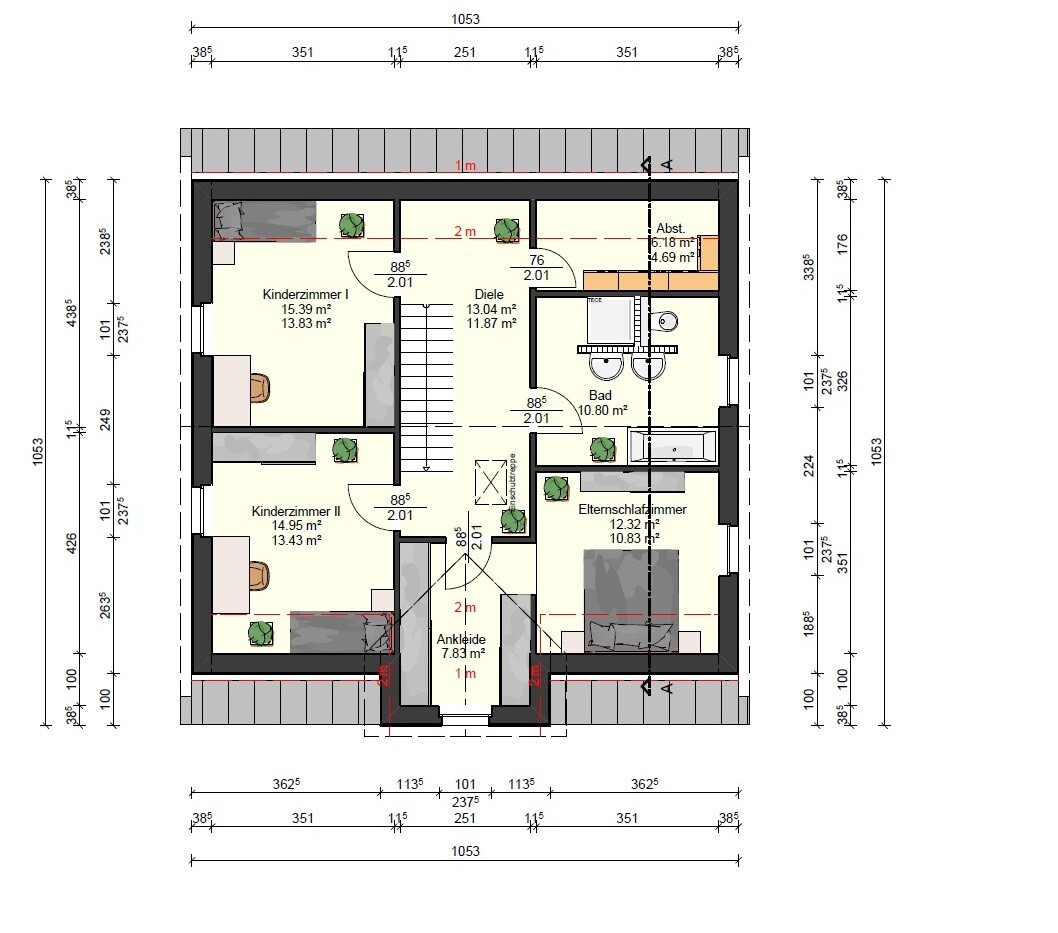
Are the floor-to-ceiling windows on the upper floor acceptable? Or do they let in too little light?
Would a standard window be better? What is considered standard? What size is that?
So, that’s it for now. I actually wanted to write very little, just one or two points.
Thanks
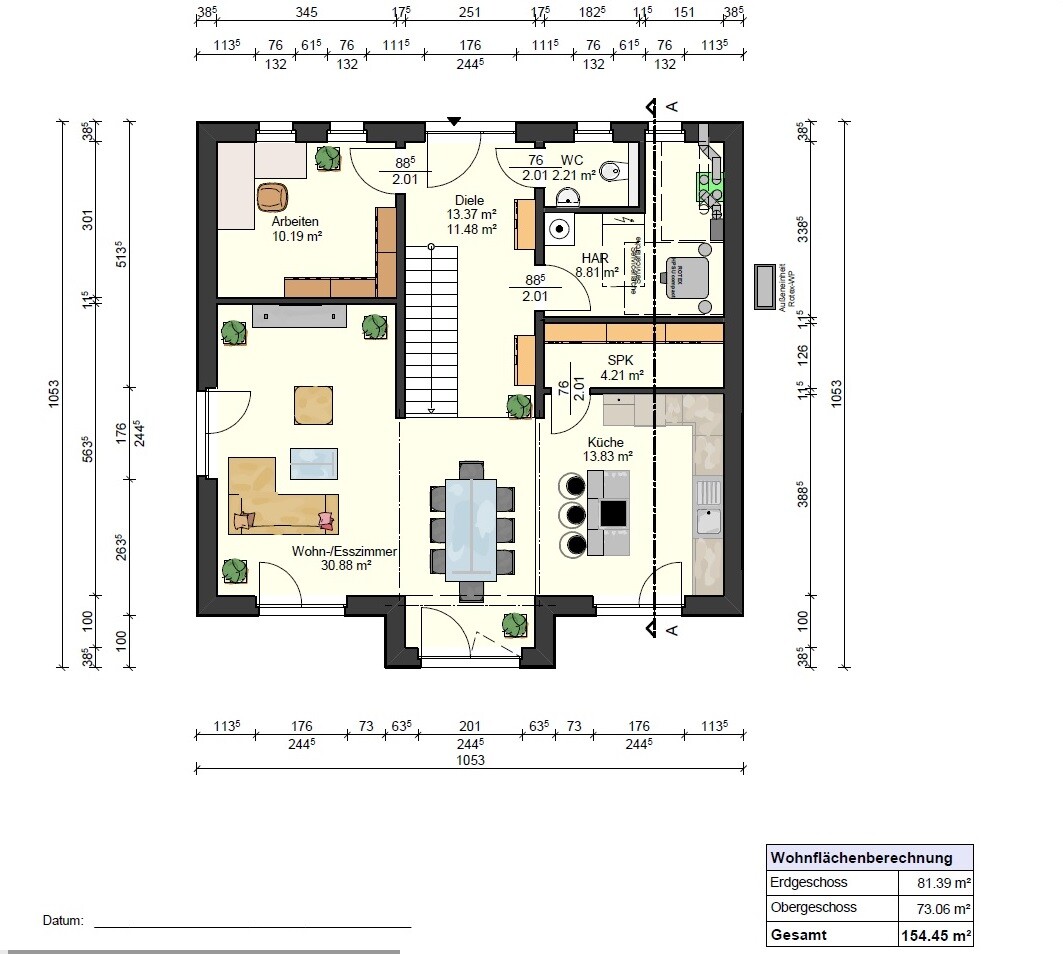
From the beginning, I told my salesperson that the outdoor unit of the Rotex ventilation system was incorrectly positioned in the first offer. The layout shown is not possible because the garage is supposed to be there.
I was told, "No problem. This can be changed in the planning phase and moved up."
Now I wrote to the CEO to have this corrected.
The reply was only:
On your floor plan, you moved the outdoor unit of the heat pump to a different location. This is not possible with the contractual Rotex heat pump. A Novelan LAD heat pump is required, and the outdoor unit must be moved further to the right, against the outer wall of the study room.
Here are the costs: Change to Novelan LAD + 2,138.00 €
Extension of the outdoor unit + 1,509.00 €
The reason is that the outdoor and indoor units have to be aligned at the same height/line.
Of course, I disagree with this.
Do you have any suggestions on how to solve this without extra costs or significant loss of space?
The pantry shown in the picture will be removed, and the utility room (HAR) will be made larger instead.
Point 2:
I wanted to replace the two large floor-to-ceiling terrace windows in the kitchen with one standard window, because the kitchen island will be placed against that wall.
Reply:
– Changing the floor-to-ceiling windows in the kitchen to standard windows with a masonry sill is possible at the same price in the project planning.
Question: By “standard” you mean? So two large floor-to-ceiling windows cost the same as one normal window?
Point 3:
Colored front door with a small side panel, ADDITIONAL COST 1,464€???? That seems quite high for just a bit of paint or finish, right?
Point 4:
I want to install a horizontal window at the top of the hallway to bring light into the room (we don’t want double casement windows). We saw this in a prefab house with the same knee wall height as ours.
Reply:
In the current plan, the window is not possible because the wall height is insufficient. Otherwise, the window would have to be fixed and equipped with TRAV glazing. The cost would be around 1,400.00 € to 1,600.00 €.
What do you think?
Point 5:
Price reduction for removing the standard front door: -1,315.00 €
But if I want an additional door, it costs me over 4,000 €. How is that possible?
See the attached picture.
Maybe they want to remove it because the door is not good enough — no RC2 rating, no windows with privacy glass, etc.
Here is the description:
Your contract includes a white plastic front door from the standard range with a small side panel.
The side panel has clear glass; satin glass can of course be added separately.
The front door has basic security, which should correspond approximately to WK 1, but a higher standard is possible and can be arranged.
According to the contract, a handle about 30 cm (12 inches) long is agreed.
Point 6:
Are the floor-to-ceiling windows on the upper floor acceptable? Or do they let in too little light?
Would a standard window be better? What is considered standard? What size is that?
So, that’s it for now. I actually wanted to write very little, just one or two points.
Thanks

Payday schrieb:
who says that? The Value Added Tax law.
B
Bauexperte29 Nov 2016 15:55Hello,
Best regards, Bauexperte
305er schrieb:The answer is neither completely right nor completely wrong. A longer piping route is possible with the Rotex as well, but it involves performance losses and additional costs for the extra meters. However, you can have the Rotex installed above the garage attached to the exterior wall in front of the bathroom. It cannot be placed on top of the garage because that would violate setback regulations.
[...] That is not possible with the contractual Rotex heat pump. [...]
Obviously, I don’t agree with that.
Do you have a solution on how to still make it work without extra costs or significant loss of space?
305er schrieb:It’s not “just” about the window! When swapping floor-to-ceiling windows for windows with a parapet, masonry work, possibly insulation, base and final plaster on the exterior, and interior plaster all have to be taken into account.
- Changing the floor-to-ceiling kitchen windows to regular windows with a masonry parapet is possible in the project plan at no additional cost.
Question: Regular? So two large floor-to-ceiling windows cost the same as regular ones?
305er schrieb:Aluminum door? Colored on both sides?
Point 3:
Colored front door with a small side panel, EXTRA COST €1464 ???? That seems quite high for just some paint, right?
305er schrieb:Correct answer. Not everything shown in a show home can be approved.
With the current plan, the window is not possible because the necessary wall height is simply missing. Otherwise, the window would have to be fixed and fitted with TRAV glazing. The costs would be around €1,400 to €1,600.
Your opinion?
305er schrieb:
Point 5:
305er schrieb:You are comparing apples to oranges.
Discount for omitting the standard front door – €1,315
But if I want an additional one, it costs me over €4,000. How can that be?
305er schrieb:The rule of thumb is one eighth of the floor area; so everything is fine.
Point 6:
Are the floor-to-ceiling windows on the upper floor okay? Or is there too little light?
Best regards, Bauexperte
305er schrieb:
Point 6:
Are the floor-to-ceiling windows on the upper floor okay? Or do they let in too little light?
Would a regular window be better? What exactly is a normal window size?Bauexperte schrieb:
One eighth of the floor area is the rule; so everything is fine.I completely disagree. Interestingly, I wanted to write about this yesterday but forgot, and today I looked for this thread about the house with floor-to-ceiling windows on the upper floor and couldn’t find it until Bauexperte responded.
I am familiar with the one-eighth rule, and it might apply for diffuse light.
However, from my own experience and training in optics and lighting science:
a narrow opening of about 80–90 cm (31–35 inches) can never let in as much radiation as a wider opening of about 160–180 cm (63–71 inches).
I also like to compare a narrow floor-to-ceiling window to a high sill window regarding direct sunlight.
A room is usually wider than it is tall, so it makes sense to bring light in more across the width of the room. In addition, reflective surfaces such as walls or floors play a role: a floor illuminated through a floor-to-ceiling window is likely to reflect less light due to its color and texture (often not smooth white) than a (sloped) wall painted white. Also, sooner or later you will probably place furniture in front of these floor-to-ceiling windows.
If you want to brighten a room that is 420 cm (165 inches) wide, ignoring the slope here, and it faces west, so it hardly receives any sunlight in winter, I would therefore prioritize window width.
To illustrate this, I hope it’s clear what I mean...
For summer, you can demonstrate this more clearly by drawing arrows on the plan horizontally, i.e. coming from the west.
My advice is to visit one or two model homes (there are always some nearby) and take a look at these classic rooms under the roof slope with narrow windows at the top floor.
B
Bieber081529 Nov 2016 21:56Bauexperte schrieb:
However, you can have the Rotex installed on the house wall above the garage, in front of the bathroom. It cannot be placed on the garage itself because it would then be located within the required setback area. Is the knowledge about the setback area again inferred from another thread, or is it an assumption? But if that were the case: how would the orientation, whether standing or hanging, be relevant since the unit would be in the same location—within the setback area?
Other factors for me would be noise generation if the outdoor unit is positioned so exposed. Also, the installation: ideally at ground level on its own foundation attached to the house. Putting it on the garage will cause problems anyway—garage roof or house wall (compared to vibrations recently reported by another user). So, it’s best to place the outdoor unit down low. I would therefore choose the other heat pump and pay the extra cost.
B
Bauexperte30 Nov 2016 01:56Bieber0815 schrieb:
Is the knowledge about the setback requirement a transfer of learning from another thread or an assumption? But if that were the case: how would it matter whether the installation is vertical or suspended, since the unit would remain in the same spot – within the setback area? Transfer of learning?
Paragraph 6 Building Regulations NRW – Setback Areas**
(11) Buildings with an average wall height up to 3 m (10 feet) above the ground surface at the boundary, used as a garage, greenhouse, or for storage purposes, are permitted without their own setback areas and within the setback areas of a building
- without openings on the walls facing the neighboring boundary,
- including subordinate structures installed on them for solar energy generation and antenna systems, each up to 1.5 m (5 feet) in height,
- even if they are not attached to the property boundary or another building,
- even if the building has access to another building.
**Source: Building Regulations for the state of NRW
I simply assume that the above applies similarly for BW.
Best regards, Bauexperte
B
Bieber081530 Nov 2016 06:59I don’t see a site plan... Somehow, the outdoor unit would be installed at ground level within the same setback area. If that was initially planned legally, it seems the house is more than 3 m (10 feet) away from the property boundary. Or the outdoor unit is allowed to be placed close to the boundary... But I wouldn’t want to be the neighbor in that case, because it can blow quite a lot (personal experience).
Similar topics