
ᐅ 42.5 cm aerated concrete and 400 cm wide windows with external venetian blinds
Created on: 23 Jan 2025 16:32
S
Steffen_S
Hello everyone,
We hope to start our single-family house construction project this year. We are building a single-story house, and I would like to build monolithically with 42.5 cm (17 inches) aerated concrete, so without additional thermal insulation.
My father is very involved and, as an experienced "construction phase" person, he is quite skeptical because for him only 36.5 cm (14.5 inches) hollow brick with external thermal insulation system (ETICS) comes into question. He sees many problems with the roller shutter / venetian blind boxes in connection with thermal bridges and plaster cracks.
I would like to better understand this topic and have done some research with the following results:
42.5 cm (17 inches) thick wall, with two fixed glazed windows of 400 cm x 250 cm (157 x 98 inches).
Right above the window, one can install, for example, pre-insulated venetian blind boxes. These are (if I understand correctly) exactly 42.5 cm (17 inches) deep and insulated. The maximum width of up to 500 cm (197 inches) seems to fit – does anyone know if these are really custom-made in 400 cm (157 inches) lengths, or are we talking about 2 x 200 cm (79 inches)?
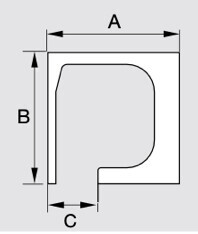
A = 42.5 cm (17 inches)
B = 29.0 cm (11.5 inches)
It seems there are no ready-made, load-bearing aerated concrete lintels for spans over 4 m (13 ft).
Since we are building only a single story and the timber flat roof will rest directly on the wall at the top, could one then use aerated concrete U-blocks (42.5 cm (17 inches) deep, 49.9 cm (20 inches) wide) to make a ring beam, which in the area of the window openings would simultaneously serve as a lintel?
This way, you would ultimately avoid material changes—except in the area of the venetian blind boxes.
You would still embed reinforcing mesh across these transitions anyway to prevent plaster cracks caused by different material expansions, correct?
Thanks for some explanations—I just want to better understand the whole topic.
We hope to start our single-family house construction project this year. We are building a single-story house, and I would like to build monolithically with 42.5 cm (17 inches) aerated concrete, so without additional thermal insulation.
My father is very involved and, as an experienced "construction phase" person, he is quite skeptical because for him only 36.5 cm (14.5 inches) hollow brick with external thermal insulation system (ETICS) comes into question. He sees many problems with the roller shutter / venetian blind boxes in connection with thermal bridges and plaster cracks.
I would like to better understand this topic and have done some research with the following results:
42.5 cm (17 inches) thick wall, with two fixed glazed windows of 400 cm x 250 cm (157 x 98 inches).
Right above the window, one can install, for example, pre-insulated venetian blind boxes. These are (if I understand correctly) exactly 42.5 cm (17 inches) deep and insulated. The maximum width of up to 500 cm (197 inches) seems to fit – does anyone know if these are really custom-made in 400 cm (157 inches) lengths, or are we talking about 2 x 200 cm (79 inches)?
A = 42.5 cm (17 inches)
B = 29.0 cm (11.5 inches)
It seems there are no ready-made, load-bearing aerated concrete lintels for spans over 4 m (13 ft).
Since we are building only a single story and the timber flat roof will rest directly on the wall at the top, could one then use aerated concrete U-blocks (42.5 cm (17 inches) deep, 49.9 cm (20 inches) wide) to make a ring beam, which in the area of the window openings would simultaneously serve as a lintel?
This way, you would ultimately avoid material changes—except in the area of the venetian blind boxes.
You would still embed reinforcing mesh across these transitions anyway to prevent plaster cracks caused by different material expansions, correct?
Thanks for some explanations—I just want to better understand the whole topic.
I think you prefer or find something better, and then you should go with that; whether it is ultimately better, faster, or easier overall remains to be seen. I believe a construction company can explain why they consider something to be sensible, and then I can decide whether to follow their advice. The advantages you mentioned, measured against the goal of a comfortably livable and reliably built house, are not quite how I see them or I would weight them differently. Usually, problems happen where you least expect them; otherwise, you could generally prevent them. The decisive factor is more the people involved, because the best materials are useless if the person handling them doesn’t know how to use them properly. Therefore, I always try to at least use materials that my chosen craftsman is familiar with, or I would change the craftsman. But as you could read, I then failed elsewhere.
We also have very large and numerous window surfaces, and ultimately your energy consultant will tell you which lever to pull to improve your insulation performance. Your statement on that is a bit too simplistic for me.
If this offers you a significant advantage as an allergy sufferer, then the decision is made, although I would doubt that the stone beneath the later plaster with primer and multiple coats of paint or similar finish would penetrate inside in a disturbing way. As an allergy sufferer, I would rather focus on issues like wall plaster and paint or the general use of materials indoors, including furniture fronts, light sources, and so on. Those are what you will be exposed to continuously, not so much the stone wall.
I read that you know exactly what you want, and perhaps that makes you see the glass as half full, which is why I would also go with my idea in my house. Still, it’s not true that more mistakes are made on one side than the other; poor workmanship always happens depending on the craftsman, so be prepared for that. As I said, it’s always more about the people involved, otherwise the decision would always be easy, and your version would always be the right one; wouldn’t that be nice.
We also have very large and numerous window surfaces, and ultimately your energy consultant will tell you which lever to pull to improve your insulation performance. Your statement on that is a bit too simplistic for me.
Steffen_S schrieb:Maybe you want to obtain a subsidy, then it matters, or you want to insulate your house as much as possible, in which case the quality of the insulation is already an important factor. This can be influenced by different windows as well as by the masonry, etc.; the relative shares or to what extent it makes no difference can be calculated by your energy consultant. Furthermore, there are many considerations with very large window areas that can affect living comfort.
The thermal insulation is relative anyway
If this offers you a significant advantage as an allergy sufferer, then the decision is made, although I would doubt that the stone beneath the later plaster with primer and multiple coats of paint or similar finish would penetrate inside in a disturbing way. As an allergy sufferer, I would rather focus on issues like wall plaster and paint or the general use of materials indoors, including furniture fronts, light sources, and so on. Those are what you will be exposed to continuously, not so much the stone wall.
Steffen_S schrieb:Exactly our situation, and this nearly caused me to fail. For example, I only expected sounds of sheep and birds but then got very loud wind noise, which is common in our region here but unfamiliar to me from my original region. Since we eliminated another costly mistake and carried out additional retrofit insulation measures, it has gotten significantly better; I was already thinking about selling the house because it was so bad at first with our open construction. I should have inserted a sound-insulating layer of wood fiber insulation in the roof insulation to decouple it, but it was too late then. Maybe your situation is different, just for your information.
Regarding sound insulation, we have no special requirements - the property is in a residential area near the forest.
I read that you know exactly what you want, and perhaps that makes you see the glass as half full, which is why I would also go with my idea in my house. Still, it’s not true that more mistakes are made on one side than the other; poor workmanship always happens depending on the craftsman, so be prepared for that. As I said, it’s always more about the people involved, otherwise the decision would always be easy, and your version would always be the right one; wouldn’t that be nice.
Steffen_S schrieb:I agree with you there. In construction, you ultimately have to pay attention to everything, but especially to the choice of the executing people (which, despite much effort, did not work so well for us), because a skilled and committed craftsman will not install poor quality work. As I said, as an allergy sufferer, I would make maximum considerations, especially regarding the directly acting elements. Maybe you will set up your Pro.
That means I am clear about the material properties, and everything fits. Now I want to know what to pay attention to during construction – even as a client, it doesn’t hurt to know what is important and not always rely solely on others.
Nida35a schrieb:This thought is justified and also shows that it is more about considering your own needs and sensitivities than a particular wall structure. A visit from @Nida35a to us is still pending, and I will then try to convince him that living in a greenhouse can be comfortable. I understand his basic point, which is why I would also focus on effects like sun, heat, climate, and air quality.
We have a house made of filled expanded clay bricks, locally sourced, 42.5cm (17 inches).
Have you heard of the “Octameter” in solid houses? Less cutting, no sloppy pockets, almost no plaster cracks. Do you really want to live in a greenhouse? Think about the windows; 4m (13 feet) windows are already very heavy to open.
Steffen_S schrieb:
Unfortunately, the reality is that you keep seeing construction defects or homeowners complaining about poor decisions, even when “professionals” were involved. Yes, there are also “Monday cars” (lemon vehicles), even though many skilled robots and humans work on these cars.
However, you can’t really call it a wrong decision if you select certain options and don’t get a flawless result.
Problems could be caused, for example, by unskilled workers who don’t understand physical laws, material properties, etc., and then apply the materials incorrectly.
Other issues might include unrealistic construction deadlines, insufficient drying times, overly exotic or extravagant desired features or dimensions, and also excessive span lengths, many angles (poor planning), badly prepared ground conditions, and so forth. Many of these factors are in the hands of the homeowner or are causes they can influence.
You also can’t call something a construction defect if you find out that, for example, ETICS (external thermal insulation composite systems) are not the best choice for your house. For instance, we built with ETICS but would not do so anymore (the reasons are irrelevant here). This doesn’t mean we have construction defects or that the neighbor with a monolithic wall is free from defects or guaranteed to have no facade cracks.
Your own (partial) knowledge is only somewhat useful: you would essentially need to be on site during the work. Then, even with your partial knowledge, you wouldn’t be able to instruct the worker, since you don’t have authority over them. This could ultimately lead to consequences that result in construction defects—and then without warranty, because you may have interfered improperly.
If you approach the site manager with half-knowledge, they can choose to be polite or respond differently. Ultimately, your years of accumulated half-knowledge may be based on one or more false statements or assumptions. What you were told four years ago doesn’t necessarily still apply today.
Steffen_S schrieb:
I only have very dangerous half-knowledge in a few areas and would like to change that. A statement from you in 2021. If in the meantime—almost four years have passed—you have done a (self-)study in construction or learned a related profession, then hats off. But apparently not, because otherwise you would not be asking.
So it remains “dangerous half-knowledge.”
Steffen_S schrieb:
So it must be valid to gather as much information as possible about “building a house” as an aspiring homeowner in a “homebuilding forum,” right? Of course, people inform themselves here about homebuilding.
However, there are no mechanics, masons, electricians, or architects in this forum. They are all working right now. The advice here may come from DIY enthusiasts who install materials themselves. No one here has been through a complex house construction project on their own.
You know that the forum mainly consists of homeowners who know which materials were used in their house but, because of that, can only discuss the “properties” of the materials, if at all.
But ultimately, very few have spent hours behind the workers, watching their every move or asking which compression tape is being used or whether they are cutting corners.
Steffen_S schrieb:
I just want to understand the whole topic better. And that is exactly the point when it comes to “building a house”:
Find a good company and don’t just focus on the lowest price, which often indicates that not enough skilled workers are involved.
Have tenders prepared by a professional who understands the subject.
As a layperson, ask the expert directly and not other laypeople.
And many other things, such as commissioning a soil survey, not pushing span lengths to the limit, and avoiding leading questions.
… and when you have a good gut feeling, trust your contracting partner.
I know you don’t want to hear or read this.
In my opinion, though, this is exactly what is constructive regarding house building.
You will—my guess—never fully understand a complex house construction project, and that’s exactly the issue you’re indirectly addressing. The forum itself can offer you individual solutions—just as individual as the user and their experience.

You are so successful in your profession that you can afford to buy a house.
When outsiders who claim to know everything come to explain your job to you, how do you feel about that?
Your main task is to find professionals who can turn your large investment into your desired results.
Having some basic knowledge yourself doesn’t hurt, but it should not be the standard for building without mistakes.
PS: Inspections never hurt, but they should also be done with a certified building expert.
When outsiders who claim to know everything come to explain your job to you, how do you feel about that?
Your main task is to find professionals who can turn your large investment into your desired results.
Having some basic knowledge yourself doesn’t hurt, but it should not be the standard for building without mistakes.
PS: Inspections never hurt, but they should also be done with a certified building expert.
Thank you @Nida35a, I forgot it!
Of course, it is the building expert (without an "l") who has the knowledge and whom you hire to apply their expertise.
Because even a
so the construction veteran (without a "p"), you don’t become one, and the knowledge of the old hand is probably no longer up to date.
Nida35a schrieb:
Building expert
Of course, it is the building expert (without an "l") who has the knowledge and whom you hire to apply their expertise.
Because even a
Steffen_S schrieb:
old "construction phase"
so the construction veteran (without a "p"), you don’t become one, and the knowledge of the old hand is probably no longer up to date.
S
Steffen_S24 Jan 2025 14:37Thank you for the very detailed response!
If we go back to my original post, my intention was less to discuss different wall constructions – I have already chosen my preferred option (also in consultation with the structural builder, who has worked with it many times) and mainly want to clarify whether my considerations regarding the roller shutter box, ring beam, and reinforcement mesh are correct – "is this feasible? Am I overlooking anything?"
Well, if you want to call it that, then I suppose that’s what I want. If you search for "glass bungalow" on Google, you’ll get an idea of what I’m picturing. Taste is subjective – but that’s a matter you can set aside.
Well, beyond a certain point, it’s just physics. Even a quadruple-glazed window doesn’t come close to the U-value of a 42.5 cm (17 inches) aerated concrete wall or one made of bricks plus external thermal insulation composite system (ETICS). If 60% of the main living area’s walls are windows, the adjustment potential is quite limited. Of course, if you are referring to funding requirements, you might be right. In my view, that’s just a formality. Currently, I don’t see that we need or would receive any subsidies.
Regarding wind, I have no concerns – we are building on a plot in the second row, surrounded by forest property and residential development – it is very sheltered.
If we go back to my original post, my intention was less to discuss different wall constructions – I have already chosen my preferred option (also in consultation with the structural builder, who has worked with it many times) and mainly want to clarify whether my considerations regarding the roller shutter box, ring beam, and reinforcement mesh are correct – "is this feasible? Am I overlooking anything?"
Do you really want to live in a greenhouse?
Well, if you want to call it that, then I suppose that’s what I want. If you search for "glass bungalow" on Google, you’ll get an idea of what I’m picturing. Taste is subjective – but that’s a matter you can set aside.
Or you want to insulate your house as much as possible, then the quality of the insulation is already a significant factor. This can be influenced by other windows as well as by the masonry, etc., and the respective shares or to what extent it “doesn’t matter” can be calculated by the energy consultant.
Well, beyond a certain point, it’s just physics. Even a quadruple-glazed window doesn’t come close to the U-value of a 42.5 cm (17 inches) aerated concrete wall or one made of bricks plus external thermal insulation composite system (ETICS). If 60% of the main living area’s walls are windows, the adjustment potential is quite limited. Of course, if you are referring to funding requirements, you might be right. In my view, that’s just a formality. Currently, I don’t see that we need or would receive any subsidies.
Regarding wind, I have no concerns – we are building on a plot in the second row, surrounded by forest property and residential development – it is very sheltered.
Steffen_S schrieb:
Thank you for the very detailed answer!But from what I gather, you didn’t really understand it.Similar topics