
ᐅ 42.5 cm aerated concrete and 400 cm wide windows with external venetian blinds
Created on: 23 Jan 2025 16:32
S
Steffen_SS
Steffen_S23 Jan 2025 16:32Hello everyone,
We hope to start our single-family house construction project this year. We are building a single-story house, and I would like to build monolithically with 42.5 cm (17 inches) aerated concrete, so without additional thermal insulation.
My father is very involved and, as an experienced "construction phase" person, he is quite skeptical because for him only 36.5 cm (14.5 inches) hollow brick with external thermal insulation system (ETICS) comes into question. He sees many problems with the roller shutter / venetian blind boxes in connection with thermal bridges and plaster cracks.
I would like to better understand this topic and have done some research with the following results:
42.5 cm (17 inches) thick wall, with two fixed glazed windows of 400 cm x 250 cm (157 x 98 inches).
Right above the window, one can install, for example, pre-insulated venetian blind boxes. These are (if I understand correctly) exactly 42.5 cm (17 inches) deep and insulated. The maximum width of up to 500 cm (197 inches) seems to fit – does anyone know if these are really custom-made in 400 cm (157 inches) lengths, or are we talking about 2 x 200 cm (79 inches)?
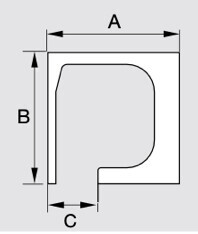
A = 42.5 cm (17 inches)
B = 29.0 cm (11.5 inches)
It seems there are no ready-made, load-bearing aerated concrete lintels for spans over 4 m (13 ft).
Since we are building only a single story and the timber flat roof will rest directly on the wall at the top, could one then use aerated concrete U-blocks (42.5 cm (17 inches) deep, 49.9 cm (20 inches) wide) to make a ring beam, which in the area of the window openings would simultaneously serve as a lintel?
This way, you would ultimately avoid material changes—except in the area of the venetian blind boxes.
You would still embed reinforcing mesh across these transitions anyway to prevent plaster cracks caused by different material expansions, correct?
Thanks for some explanations—I just want to better understand the whole topic.
We hope to start our single-family house construction project this year. We are building a single-story house, and I would like to build monolithically with 42.5 cm (17 inches) aerated concrete, so without additional thermal insulation.
My father is very involved and, as an experienced "construction phase" person, he is quite skeptical because for him only 36.5 cm (14.5 inches) hollow brick with external thermal insulation system (ETICS) comes into question. He sees many problems with the roller shutter / venetian blind boxes in connection with thermal bridges and plaster cracks.
I would like to better understand this topic and have done some research with the following results:
42.5 cm (17 inches) thick wall, with two fixed glazed windows of 400 cm x 250 cm (157 x 98 inches).
Right above the window, one can install, for example, pre-insulated venetian blind boxes. These are (if I understand correctly) exactly 42.5 cm (17 inches) deep and insulated. The maximum width of up to 500 cm (197 inches) seems to fit – does anyone know if these are really custom-made in 400 cm (157 inches) lengths, or are we talking about 2 x 200 cm (79 inches)?
A = 42.5 cm (17 inches)
B = 29.0 cm (11.5 inches)
It seems there are no ready-made, load-bearing aerated concrete lintels for spans over 4 m (13 ft).
Since we are building only a single story and the timber flat roof will rest directly on the wall at the top, could one then use aerated concrete U-blocks (42.5 cm (17 inches) deep, 49.9 cm (20 inches) wide) to make a ring beam, which in the area of the window openings would simultaneously serve as a lintel?
This way, you would ultimately avoid material changes—except in the area of the venetian blind boxes.
You would still embed reinforcing mesh across these transitions anyway to prevent plaster cracks caused by different material expansions, correct?
Thanks for some explanations—I just want to better understand the whole topic.
Steffen_S schrieb:
But you would generally embed reinforcing mesh in these transitions anyway to prevent plaster cracks caused by different material expansion, right? Do you want to do it yourself?
Steffen_S schrieb:
I just want to understand the whole topic. Or do you have a building consultant who doesn’t explain it to you?
I am always very skeptical when homeowners are certain about what is best without knowing whether that is even the material commonly used by contractors in the area.
S
Steffen_S24 Jan 2025 10:00Hey,
no, I don’t want to handle anything related to the structural work myself. What I want, after some research, is to build monolithically with aerated concrete. My builder (the one responsible for the shell construction) is fine with that, has a lot of experience with it (and with other methods), and supports this decision.
I didn’t say that I know exactly what is best. I said that I am receiving different information from various sources. Therefore, I want to get a comprehensive understanding to grasp the issues and possibly question them. I hope this is the right place for that.
Regarding the materials used in the region – we are building near Leipzig. In the immediate neighborhood as well as in the future development area, you see everything, really everything. There is no specific material that everyone uses. Lime sand brick, precast concrete elements, clay bricks, aerated concrete, all kinds of external thermal insulation composite systems (ETICS).
Edit: I have noticed in this forum before that specific questions about construction details, materials, practices, etc., are often dismissed with comments like “Don’t you have a building contractor?” or “You don’t want to do that yourself, do you?” or “There is the person responsible for that...!” Unfortunately, the reality is that building defects keep appearing, and homeowners often regret wrong decisions, even when “professionals” were involved. So it has to be valid for a prospective homeowner to inform themselves about house construction as much as possible in a “house building forum,” right? If I ask in a car forum about repairing a vehicle, no one just says “Go to a garage!” – a bit strange...
no, I don’t want to handle anything related to the structural work myself. What I want, after some research, is to build monolithically with aerated concrete. My builder (the one responsible for the shell construction) is fine with that, has a lot of experience with it (and with other methods), and supports this decision.
I didn’t say that I know exactly what is best. I said that I am receiving different information from various sources. Therefore, I want to get a comprehensive understanding to grasp the issues and possibly question them. I hope this is the right place for that.
Regarding the materials used in the region – we are building near Leipzig. In the immediate neighborhood as well as in the future development area, you see everything, really everything. There is no specific material that everyone uses. Lime sand brick, precast concrete elements, clay bricks, aerated concrete, all kinds of external thermal insulation composite systems (ETICS).
Edit: I have noticed in this forum before that specific questions about construction details, materials, practices, etc., are often dismissed with comments like “Don’t you have a building contractor?” or “You don’t want to do that yourself, do you?” or “There is the person responsible for that...!” Unfortunately, the reality is that building defects keep appearing, and homeowners often regret wrong decisions, even when “professionals” were involved. So it has to be valid for a prospective homeowner to inform themselves about house construction as much as possible in a “house building forum,” right? If I ask in a car forum about repairing a vehicle, no one just says “Go to a garage!” – a bit strange...
I understand your father’s preference for the tried-and-true method just as much as you wanting to try a different approach. However, the question for me is why you chose this particular type of block and what advantages it offers you. Not far from you, my situation was similar: I wanted to build with Liapor (I had used brick before and it was simply a gut feeling). The general contractor then told me just a few days before the start that we would have to build with Poroton instead because he needed to change the shell construction company (in our case, the ever-present excuse was COVID) and this new company only builds with Poroton. We didn’t want any more delays, so we agreed and the house was built. Now, after living in it for three years, I can honestly say I wouldn’t notice any difference if the walls had been constructed differently.
If I were you, I would be more interested in the overall quality of the insulation, since that really affects your living comfort.
We also have external venetian blinds, and I know the installation was not done optimally. We had to significantly improve the insulation in that area afterward. But I think both options are feasible; otherwise, they wouldn’t be offered. For me, the type of block is less important than thoroughly questioning the specifics that truly impact how comfortable the house will feel later on.
We chose a wooden facade out of necessity because, once again, the plasterer was sick, unreachable, or unavailable, just like many other trades. We simply wanted to get through the process by that point, and at the same time, we had a reliable carpenter available. Although this meant accepting a less-than-ideal block and wall construction, the house stands, and TODAY we feel very comfortable living in it.
If I were in your position, my questions would focus more on: maximizing the house’s insulation, controlled ventilation, climate control, shading, and the sense of space. The type of block is more or less irrelevant and will have zero impact on your living experience.
If I were you, I would be more interested in the overall quality of the insulation, since that really affects your living comfort.
We also have external venetian blinds, and I know the installation was not done optimally. We had to significantly improve the insulation in that area afterward. But I think both options are feasible; otherwise, they wouldn’t be offered. For me, the type of block is less important than thoroughly questioning the specifics that truly impact how comfortable the house will feel later on.
We chose a wooden facade out of necessity because, once again, the plasterer was sick, unreachable, or unavailable, just like many other trades. We simply wanted to get through the process by that point, and at the same time, we had a reliable carpenter available. Although this meant accepting a less-than-ideal block and wall construction, the house stands, and TODAY we feel very comfortable living in it.
If I were in your position, my questions would focus more on: maximizing the house’s insulation, controlled ventilation, climate control, shading, and the sense of space. The type of block is more or less irrelevant and will have zero impact on your living experience.
S
Steffen_S24 Jan 2025 11:43Thank you for your reply!
Personally, I prefer monolithic construction based on my own research because of its simplicity and speed in building. Simple is better for me than a combination of stone XYZ plus additional materials and work steps for a second layer. More things can go wrong with that, the manufacturing is more complex, and in the end, different materials are combined again to achieve various effects. Thermal insulation is relative anyway—we have very large windows. In the living room alone, there are four windows measuring 400cm x 250cm (160 inches x 98 inches) each—so the thermal insulation of the few walls still between them doesn’t really matter. The insulation provided by the 42.5cm (17 inches) aerated concrete blocks is completely sufficient, and the difference compared to a double-shell wall construction is negligible. Additionally, I have allergies and have only heard positive feedback regarding aerated concrete in this regard.
Regarding soundproofing, we have no special requirements—the property is located in a residential area near a forest.
I have lived in two hollow brick houses and disliked how thin the walls sounded—if someone plugged something into an outlet, you could hear it next door—"you can hear the walls." Also, sometimes drafts came through the outlets (yes, there may have been improper or sloppy electrical work). The typical solution here is more insulation, special outlet boxes, and spraying building foam everywhere—I don’t think that’s a good approach.
My structural carpenter also finds hollow bricks inconvenient to work with, as they can’t be cut as precisely as aerated concrete, and the blocks are not exact in size. In the end, you have to fill everything up with mortar and adhesive, and often the external thermal insulation composite system (ETICS) is just used to prevent plaster cracking. Of course, there are also perlite-filled blocks that could be used for monolithic construction.
So, I am aware of the material properties, and everything fits. Now, I want to know what to pay attention to during construction—even as a builder, it doesn’t hurt to know what is important and not always rely solely on others.
Personally, I prefer monolithic construction based on my own research because of its simplicity and speed in building. Simple is better for me than a combination of stone XYZ plus additional materials and work steps for a second layer. More things can go wrong with that, the manufacturing is more complex, and in the end, different materials are combined again to achieve various effects. Thermal insulation is relative anyway—we have very large windows. In the living room alone, there are four windows measuring 400cm x 250cm (160 inches x 98 inches) each—so the thermal insulation of the few walls still between them doesn’t really matter. The insulation provided by the 42.5cm (17 inches) aerated concrete blocks is completely sufficient, and the difference compared to a double-shell wall construction is negligible. Additionally, I have allergies and have only heard positive feedback regarding aerated concrete in this regard.
Regarding soundproofing, we have no special requirements—the property is located in a residential area near a forest.
I have lived in two hollow brick houses and disliked how thin the walls sounded—if someone plugged something into an outlet, you could hear it next door—"you can hear the walls." Also, sometimes drafts came through the outlets (yes, there may have been improper or sloppy electrical work). The typical solution here is more insulation, special outlet boxes, and spraying building foam everywhere—I don’t think that’s a good approach.
My structural carpenter also finds hollow bricks inconvenient to work with, as they can’t be cut as precisely as aerated concrete, and the blocks are not exact in size. In the end, you have to fill everything up with mortar and adhesive, and often the external thermal insulation composite system (ETICS) is just used to prevent plaster cracking. Of course, there are also perlite-filled blocks that could be used for monolithic construction.
So, I am aware of the material properties, and everything fits. Now, I want to know what to pay attention to during construction—even as a builder, it doesn’t hurt to know what is important and not always rely solely on others.

We have a house made from locally sourced filled expanded clay blocks, 42.5cm (17 inches) thick.
Have you heard of the Octameter system for solid construction houses? It means less cutting, no patchwork gaps, and almost no plaster cracks.
Do you really want to live in a greenhouse?
Consider the windows carefully; 4m (13 feet) wide windows are already very heavy to open.
Have you heard of the Octameter system for solid construction houses? It means less cutting, no patchwork gaps, and almost no plaster cracks.
Do you really want to live in a greenhouse?
Consider the windows carefully; 4m (13 feet) wide windows are already very heavy to open.
Similar topics