
ᐅ 150 sqm Single-Family House – Demolition & New Construction – Any Recommendations?
Created on: 15 Feb 2020 21:00
V
voicepoint
Hello Everyone!
First, the mandatory part:
Development Plan / Restrictions
Plot Size 800 sqm (8,611 sq ft)
Slope Yes, steep
Site Occupation Index / Floor Area Ratio (FAR) 0.3
Floor Space Index / Floor Area Ratio (FAR) 0.6
Number of Parking Spaces 1
Number of Stories Basement + Ground Floor + Upper Floor
Roof Type Gable, 40° pitch without dormers
Architectural Style Modern
Orientation South-facing
Maximum Heights / Restrictions None known
Additional Requirements The development plan is very old, so few restrictions apply.
Homeowner Requirements
Style, Roof Type, Building Type Simple building with gable roof, knee wall 120 cm (47 inches)
Basement, Floors Basement extends forward as terrace
Number of Occupants, Age 2 adults + 2 planned children
Office: Family Use or Home Office? Rarely used
Overnight Guests per Year 3 (who are welcome to share our bathroom)
Open or Closed Architecture Open
Conservative or Modern Construction Modern
Open Kitchen, Kitchen Island Yes & yes
Number of Dining Seats 6
Fireplace No
Music / Stereo Wall Yes, in the living room
Balcony, Roof Terrace Terrace on extended basement
Garage, Carport Garage in basement
Vegetable Garden, Greenhouse Yes, already existing
Additional Wishes / Special Features / Daily Routine, including reasons for certain choices or exclusions
Yes, the entrance is at the back of the house. We do not want to use any south-facing space for the entrance and prefer the entrance on the ground floor, not in the basement.
The basement is deliberately planned without windows; a door with glass elements might be installed in the utility room. If the plot had no slope, we would build without a basement. Mainly, the basement will be used as a garage. There are few side windows because they would just face neighboring buildings.
House Design
Designed by: Ourselves, self-drawn
What is especially liked? Why? Open living area, large south-facing windows
What is disliked? Why? Basement depth, see below
Cost estimate by architect/planner: Not yet considered
Personal budget limit for house, including fixtures and demolition: 350,000€
Preferred heating technology: Heat pump, if budget allows, preferably with deep drilling
Brief overview of construction / budget:
- Basement as prefabricated basement
- House in timber frame construction
- Roof tiles to be reused from the existing building, roof renewed last year
- Electrical installation (except main connection and meter cabinet) by electricians, planned to use a Loxone system; many components are already available
- Photovoltaics with battery storage by electricians if compatible with subsidies
- Flooring and painting by electricians
- Staircase from ground floor to upper floor by electricians
- Sanitary, central ventilation and heating in self-contracting
- Bathroom + toilet by electricians
- Blinds / shutters only for sun protection, no need on north side
- No gold faucets, but also no “standard” mass-market products with 200% markup from prefab house manufacturer
Additional building costs can be kept low, as the plot is already family-owned, and temporary construction power and water can be supplied by neighbors.
Demolition costs were estimated at approximately 20,000€ by the contractor.
Our preferred house provider builds to KfW 40 standard; with photovoltaics, we could achieve KfW 40+.
If you had to give up on certain details / upgrades:
- Could give up on: Basement size
- Cannot give up on: Large south-facing windows + terrace, photovoltaics because heat pump is desired and electric car is owned
Why is the design as it is?
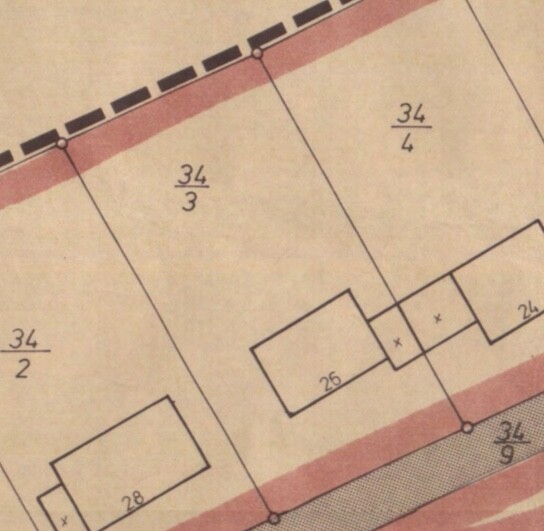
There is currently an existing post-war building on the plot that will be demolished. The house footprint cannot be changed much because the lot is quite narrow and sloped. The demolition will automatically create a fitting excavation pit. We want to take advantage of the southern view (which cannot be built over anymore as only a narrow dead-end street runs in front of the house) as well as the northern view of the garden with adjacent forest.
What is the most important / basic question about the floor plan in 130 characters?
What can be optimized? The last few meters of the basement toward the slope (behind the staircase) are unnecessary for us. Would it make financial sense to shorten the basement and extend only the basement ceiling slightly? Demolition will leave surplus material that could possibly be used on-site for backfilling (broken directly on site) instead of costly disposal?
Which architect should we commission? Use the house provider’s planning or choose an independent architect and, for example, tender the basement separately?
Is the budget realistic?
We look forward to your suggestions!
Best regards,
Noel
First, the mandatory part:
Development Plan / Restrictions
Plot Size 800 sqm (8,611 sq ft)
Slope Yes, steep
Site Occupation Index / Floor Area Ratio (FAR) 0.3
Floor Space Index / Floor Area Ratio (FAR) 0.6
Number of Parking Spaces 1
Number of Stories Basement + Ground Floor + Upper Floor
Roof Type Gable, 40° pitch without dormers
Architectural Style Modern
Orientation South-facing
Maximum Heights / Restrictions None known
Additional Requirements The development plan is very old, so few restrictions apply.
Homeowner Requirements
Style, Roof Type, Building Type Simple building with gable roof, knee wall 120 cm (47 inches)
Basement, Floors Basement extends forward as terrace
Number of Occupants, Age 2 adults + 2 planned children
Office: Family Use or Home Office? Rarely used
Overnight Guests per Year 3 (who are welcome to share our bathroom)
Open or Closed Architecture Open
Conservative or Modern Construction Modern
Open Kitchen, Kitchen Island Yes & yes
Number of Dining Seats 6
Fireplace No
Music / Stereo Wall Yes, in the living room
Balcony, Roof Terrace Terrace on extended basement
Garage, Carport Garage in basement
Vegetable Garden, Greenhouse Yes, already existing
Additional Wishes / Special Features / Daily Routine, including reasons for certain choices or exclusions
Yes, the entrance is at the back of the house. We do not want to use any south-facing space for the entrance and prefer the entrance on the ground floor, not in the basement.
The basement is deliberately planned without windows; a door with glass elements might be installed in the utility room. If the plot had no slope, we would build without a basement. Mainly, the basement will be used as a garage. There are few side windows because they would just face neighboring buildings.
House Design
Designed by: Ourselves, self-drawn
What is especially liked? Why? Open living area, large south-facing windows
What is disliked? Why? Basement depth, see below
Cost estimate by architect/planner: Not yet considered
Personal budget limit for house, including fixtures and demolition: 350,000€
Preferred heating technology: Heat pump, if budget allows, preferably with deep drilling
Brief overview of construction / budget:
- Basement as prefabricated basement
- House in timber frame construction
- Roof tiles to be reused from the existing building, roof renewed last year
- Electrical installation (except main connection and meter cabinet) by electricians, planned to use a Loxone system; many components are already available
- Photovoltaics with battery storage by electricians if compatible with subsidies
- Flooring and painting by electricians
- Staircase from ground floor to upper floor by electricians
- Sanitary, central ventilation and heating in self-contracting
- Bathroom + toilet by electricians
- Blinds / shutters only for sun protection, no need on north side
- No gold faucets, but also no “standard” mass-market products with 200% markup from prefab house manufacturer
Additional building costs can be kept low, as the plot is already family-owned, and temporary construction power and water can be supplied by neighbors.
Demolition costs were estimated at approximately 20,000€ by the contractor.
Our preferred house provider builds to KfW 40 standard; with photovoltaics, we could achieve KfW 40+.
If you had to give up on certain details / upgrades:
- Could give up on: Basement size
- Cannot give up on: Large south-facing windows + terrace, photovoltaics because heat pump is desired and electric car is owned
Why is the design as it is?
There is currently an existing post-war building on the plot that will be demolished. The house footprint cannot be changed much because the lot is quite narrow and sloped. The demolition will automatically create a fitting excavation pit. We want to take advantage of the southern view (which cannot be built over anymore as only a narrow dead-end street runs in front of the house) as well as the northern view of the garden with adjacent forest.
What is the most important / basic question about the floor plan in 130 characters?
What can be optimized? The last few meters of the basement toward the slope (behind the staircase) are unnecessary for us. Would it make financial sense to shorten the basement and extend only the basement ceiling slightly? Demolition will leave surplus material that could possibly be used on-site for backfilling (broken directly on site) instead of costly disposal?
Which architect should we commission? Use the house provider’s planning or choose an independent architect and, for example, tender the basement separately?
Is the budget realistic?
We look forward to your suggestions!
Best regards,
Noel
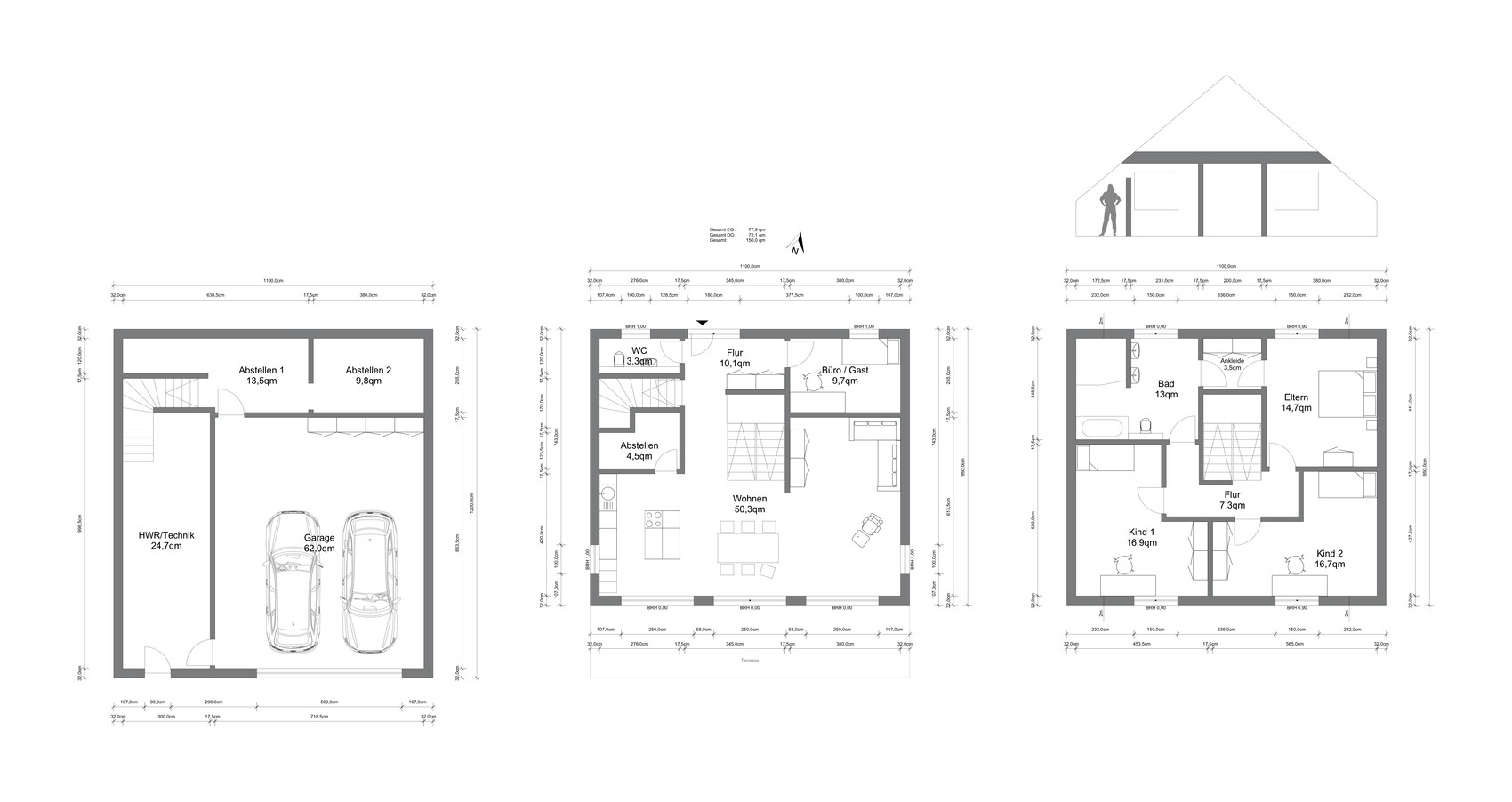
I’m not happy with the floor plan. The ground floor is still acceptable, even though space is wasted by two staircases. But upstairs... the L-shaped children's rooms... the "walk-in closet" that just seems like it's left over from a passageway to the bathroom and now we’re left wondering what to do with it... the shower under the sloping roof... This has to be done better. It seems to me the internal staircase is the problem; it somehow ruins everything.
The two staircases need to be removed.
The south-facing terrace is nice, but there is no access to the garden, which is especially important with children.
Having the main entrance on the north side is not ideal. Visitors have to walk all the way around the house to enter, which means they pass through the private garden.
I would place the entrance on the east side, with the kitchen, living, and dining areas including the terrace more towards the west.
On the upper floor, the two-meter (6.5 feet) clearance line has not been taken into account. The shower is located under the sloped ceiling, and there is no tall wardrobe space in the master bedroom area.
The children’s rooms are dark; side windows should be included, especially to improve natural light given the shading.
The house needs a different staircase and a different layout for the rooms.
The south-facing terrace is nice, but there is no access to the garden, which is especially important with children.
Having the main entrance on the north side is not ideal. Visitors have to walk all the way around the house to enter, which means they pass through the private garden.
I would place the entrance on the east side, with the kitchen, living, and dining areas including the terrace more towards the west.
On the upper floor, the two-meter (6.5 feet) clearance line has not been taken into account. The shower is located under the sloped ceiling, and there is no tall wardrobe space in the master bedroom area.
The children’s rooms are dark; side windows should be included, especially to improve natural light given the shading.
The house needs a different staircase and a different layout for the rooms.
V
voicepoint16 Feb 2020 10:35Thank you for your comments.
The current existing house also has its entrance on the north side. You walk along the west side of the house. To the east there is currently a garage (the house is shown in the development plan, so this can be seen; the new house is planned for the same location). We actually like this layout quite a bit; we don’t have to hide the garden. The garden is mainly intended for planting and as a play area for the children. The outdoor living area for the family is primarily on the terrace. Access to the garden could be created from the terrace by passing along the east side of the house, which is similar to the solution in the existing building.
Regarding the staircase: initially, we had a design with the stairs to the basement and the upper floor aligned above each other, but we didn’t like that. Our preference is for an open staircase to the upper floor, which we don’t want to hide in a stairwell. Only a closed staircase is an option for the basement, as it is not going to be heated.
At first, we also thought about “saving space” with the staircase, but now we see the stairs more as a design element that can be visible. Additionally, I find the open space under the stairs useful for our dog, children’s toys, etc.
We want to orient the windows mainly to the south and north, since there are only neighbors to the east and west. We prefer enlarging the windows at the front and back rather than adding more on the sides.
The knee wall height on the upper floor is 1.20 m (4 feet), so at most roof windows can be installed in the children’s rooms there, which would be less ideal for the photovoltaic system.
Some women require a lot of closet space; currently, however, we have a combined wardrobe about 1.80 m (6 feet) wide (and no basement or similar storage room). The dressing room (a walk-in closet would be the better term) plus the wardrobe next to the bed is actually sufficient; if not, there is also space available under the window and opposite the bed for chests of drawers.
I am still not happy with the shower under the sloped ceiling in the bathroom and am open to new ideas on this.
The current existing house also has its entrance on the north side. You walk along the west side of the house. To the east there is currently a garage (the house is shown in the development plan, so this can be seen; the new house is planned for the same location). We actually like this layout quite a bit; we don’t have to hide the garden. The garden is mainly intended for planting and as a play area for the children. The outdoor living area for the family is primarily on the terrace. Access to the garden could be created from the terrace by passing along the east side of the house, which is similar to the solution in the existing building.
Regarding the staircase: initially, we had a design with the stairs to the basement and the upper floor aligned above each other, but we didn’t like that. Our preference is for an open staircase to the upper floor, which we don’t want to hide in a stairwell. Only a closed staircase is an option for the basement, as it is not going to be heated.
At first, we also thought about “saving space” with the staircase, but now we see the stairs more as a design element that can be visible. Additionally, I find the open space under the stairs useful for our dog, children’s toys, etc.
We want to orient the windows mainly to the south and north, since there are only neighbors to the east and west. We prefer enlarging the windows at the front and back rather than adding more on the sides.
The knee wall height on the upper floor is 1.20 m (4 feet), so at most roof windows can be installed in the children’s rooms there, which would be less ideal for the photovoltaic system.
Some women require a lot of closet space; currently, however, we have a combined wardrobe about 1.80 m (6 feet) wide (and no basement or similar storage room). The dressing room (a walk-in closet would be the better term) plus the wardrobe next to the bed is actually sufficient; if not, there is also space available under the window and opposite the bed for chests of drawers.
I am still not happy with the shower under the sloped ceiling in the bathroom and am open to new ideas on this.
voicepoint schrieb:
For the current existing house, the entrance is also on the north side. You walk past the house on the west side. But that doesn’t make much sense, does it? Why build a house? A large plot? You won’t have any connection to the garden at all; you’ll be squeezed up against the street...
voicepoint schrieb:
Only a fully enclosed staircase is an option for the basement, since it is not intended to be heated. I don’t think that complies with energy efficiency regulations at all...
voicepoint schrieb:
Currently, together we have a 1.80m (5 ft 11 in) wide closet (and no basement or similar storage space). The dressing room (walk-in closet would be a better term) plus the closet next to the bed is actually more than enough; if not, then under the window and You’re still young and don’t have children. Trust me: it all grows, and you’ll need to store a lot more. Your closet just covers the laundry needs for a household.
Personally, I find the entrance situation limited by going through the utility room, the office is too small, and the dining area lined up with the entrance, combined with the busy view and layout of the staircase, feels extremely uncomfortable.
Why don’t you position the garage beside the house and use the basement?
Not having any view or access from the living area to the play area or shaded garden is very unfortunate. With winters like these, the sandbox season never really ends. You’re not building a house to feel like you’re living in an apartment.
There is a lack of natural light. This isn’t about maximizing feed-in tariffs or views of the neighbors. Inside, it gets dark, and the children’s rooms might as well be rented out to vampires.
Not having any view or access from the living area to the play area or shaded garden is very unfortunate. With winters like these, the sandbox season never really ends. You’re not building a house to feel like you’re living in an apartment.
There is a lack of natural light. This isn’t about maximizing feed-in tariffs or views of the neighbors. Inside, it gets dark, and the children’s rooms might as well be rented out to vampires.
haydee schrieb:
Why don’t you place the garage next to the house and use the basement?Yes, it’s almost a crime to place a garage on a ground-level south-facing side. Apparently, the car is very much loved here. The garage looks more like a hall.
Similar topics