
ᐅ 12 x 9.6 m, 2 full stories, basement, attic, 4 children's bedrooms
Created on: 26 Apr 2018 22:24
J
Johannes L
Hello everyone,
After more than six years of searching, we will soon be able to purchase a plot of land, so it’s time to advance the planning.
Since we are still undecided whether to build with an architect or a developer, we started drawing ourselves and have been diligently browsing internet forums like this one. The floor plans below are the result, thanks to SketchUp.
I hope we understand the floor area ratio correctly, meaning the basement is not included. Otherwise, we have a problem...
Development plan/restrictions
Plot size 15.6 x 29.95 m = 436 sqm (51.2 x 98.3 ft = 4,692 sq ft)
Slope no
Site coverage ratio 0.4 = 174.4 sqm (1,878 sq ft)
Floor area ratio 0.8 = 348.8 sqm (3,753 sq ft)
Building envelope, building line and boundary 12 m depth (39 ft)
Setbacks 3 m (10 ft) on right and left
Number of parking spaces only in front of the garage planned
Number of storeys 2 full storeys
Roof type Gable roof 42 degrees
Style brick + Wienerberger Poroton T7 P 36.5
Orientation garden facing east-northeast
Maximum height restrictions 10 m (33 ft) high
Other requirements finished floor level at least 30 cm (12 inches) above reference mark
Client requirements
Style, roof shape, building type gable roof is mandatory
Basement, number of storeys 2 full
Number and ages of occupants 6 (37, 36, 6, 4, 2, 0)
Space requirements on ground and upper floors (see plan)
Office: family use or home office? both
Guests sleeping per year the attic provides enough space
Open or closed architecture
Traditional or modern design it will be a smart home with KNX, photovoltaic system, heat pump, possibly battery storage…
Open kitchen, kitchen island open kitchen
Number of dining seats 6
Fireplace no
Music/stereo wall I was thinking of multi-room audio, i.e. one ceiling speaker per room
Balcony, roof terrace no
Garage, carport garage
Utility garden, greenhouse later
Additional wishes/particulars/daily routine, also reasons why certain things are required or excluded The house should be divisible in 25 years, hence the staircase placement. There is a kitchen shown on the upper floor, but it will only be relevant in 25 years. I roughly marked the ventilation system, indicating where ceiling or wall outlets might be and where ducts lead to the upper floors. The two offices are important. The master bedroom on the ground floor is future-proof. Everyone gets old!
House design
Who designed the plan: us amateurs
What do you like most? Why? four equally sized children’s rooms
What do you like least? Why? the upstairs hallway might be somewhat dark
Price estimate according to architect/planner: if only we knew
Personal price limit for the house including fittings: 400 + building allowance
Preferred heating technology: ground-source heat pump
If you have to give up features or extensions
- what can you do without: I hope we don’t have to
- what can you not do without: we definitely want to keep the base dimensions and the basement is a must, but we may have to save on components.
Why is the design like it is now? 4 children’s rooms, two offices, ground floor master bedroom, divisibility in 25 years…
What do you think makes it particularly good or bad? that’s what we want to know from you
What is the most important/basic question about the floor plan in 130 characters?
What would you do differently and why?
After more than six years of searching, we will soon be able to purchase a plot of land, so it’s time to advance the planning.
Since we are still undecided whether to build with an architect or a developer, we started drawing ourselves and have been diligently browsing internet forums like this one. The floor plans below are the result, thanks to SketchUp.
I hope we understand the floor area ratio correctly, meaning the basement is not included. Otherwise, we have a problem...
Development plan/restrictions
Plot size 15.6 x 29.95 m = 436 sqm (51.2 x 98.3 ft = 4,692 sq ft)
Slope no
Site coverage ratio 0.4 = 174.4 sqm (1,878 sq ft)
Floor area ratio 0.8 = 348.8 sqm (3,753 sq ft)
Building envelope, building line and boundary 12 m depth (39 ft)
Setbacks 3 m (10 ft) on right and left
Number of parking spaces only in front of the garage planned
Number of storeys 2 full storeys
Roof type Gable roof 42 degrees
Style brick + Wienerberger Poroton T7 P 36.5
Orientation garden facing east-northeast
Maximum height restrictions 10 m (33 ft) high
Other requirements finished floor level at least 30 cm (12 inches) above reference mark
Client requirements
Style, roof shape, building type gable roof is mandatory
Basement, number of storeys 2 full
Number and ages of occupants 6 (37, 36, 6, 4, 2, 0)
Space requirements on ground and upper floors (see plan)
Office: family use or home office? both
Guests sleeping per year the attic provides enough space
Open or closed architecture
Traditional or modern design it will be a smart home with KNX, photovoltaic system, heat pump, possibly battery storage…
Open kitchen, kitchen island open kitchen
Number of dining seats 6
Fireplace no
Music/stereo wall I was thinking of multi-room audio, i.e. one ceiling speaker per room
Balcony, roof terrace no
Garage, carport garage
Utility garden, greenhouse later
Additional wishes/particulars/daily routine, also reasons why certain things are required or excluded The house should be divisible in 25 years, hence the staircase placement. There is a kitchen shown on the upper floor, but it will only be relevant in 25 years. I roughly marked the ventilation system, indicating where ceiling or wall outlets might be and where ducts lead to the upper floors. The two offices are important. The master bedroom on the ground floor is future-proof. Everyone gets old!
House design
Who designed the plan: us amateurs
What do you like most? Why? four equally sized children’s rooms
What do you like least? Why? the upstairs hallway might be somewhat dark
Price estimate according to architect/planner: if only we knew
Personal price limit for the house including fittings: 400 + building allowance
Preferred heating technology: ground-source heat pump
If you have to give up features or extensions
- what can you do without: I hope we don’t have to
- what can you not do without: we definitely want to keep the base dimensions and the basement is a must, but we may have to save on components.
Why is the design like it is now? 4 children’s rooms, two offices, ground floor master bedroom, divisibility in 25 years…
What do you think makes it particularly good or bad? that’s what we want to know from you
What is the most important/basic question about the floor plan in 130 characters?
What would you do differently and why?
J
Johannes L27 Apr 2018 19:59Hello again,
The child allowance for homebuilding is expected to be introduced this year, and since we are still finalizing our planning and only have the notary appointment for the land in about a week, we are waiting for now. It is €12,000 per child spread over 10 years. For us, with 4 children, that adds up to €48,000. Our income limit is €75,000 plus 4 times €15,000, so €135,000 per year. We are significantly below that.
What I don’t like about Katja’s floor plan is the lack of natural light in the hallway of the upper floor, and especially the dining room facing the front. The plot is not on a main road, but especially in the mornings and evenings, quite a few cars pass by from the residential area behind it.
In our design, both the ground floor and upper floor hallways have natural light. Maybe that wasn’t entirely clear, but next to the stairs there are floor-to-ceiling windows both upstairs and downstairs (fixed at the bottom), through which the light, especially in the afternoon and evening, would shine nicely into the hallway.
I based the design on the largest possible building envelope because there is certainly a space requirement, and we were already very lucky with the plot selection. There were only three plots of this size; everything else was smaller, and we are talking about a high triple-digit number of applicants.
Honestly, I’m considering moving the stairs to the side in our plan, like in Katja’s suggestion (basically swapping with the office), but then we would have the problem again of missing light in the upper hallway. I’m also thinking about simply separating the dining room from the living area with a drywall partition, which could be removed later if we decide to move into the attic. But that would mean 6 people would have to use the bathroom on the upper floor, which certainly wouldn’t be ideal. Another bathroom in the attic, however, would be even more expensive...
So, lots of ideas, no solution yet, but we’re working on it
Thanks to everyone who contributes with good ideas!
Best regards,
Johannes
The child allowance for homebuilding is expected to be introduced this year, and since we are still finalizing our planning and only have the notary appointment for the land in about a week, we are waiting for now. It is €12,000 per child spread over 10 years. For us, with 4 children, that adds up to €48,000. Our income limit is €75,000 plus 4 times €15,000, so €135,000 per year. We are significantly below that.
What I don’t like about Katja’s floor plan is the lack of natural light in the hallway of the upper floor, and especially the dining room facing the front. The plot is not on a main road, but especially in the mornings and evenings, quite a few cars pass by from the residential area behind it.
In our design, both the ground floor and upper floor hallways have natural light. Maybe that wasn’t entirely clear, but next to the stairs there are floor-to-ceiling windows both upstairs and downstairs (fixed at the bottom), through which the light, especially in the afternoon and evening, would shine nicely into the hallway.
I based the design on the largest possible building envelope because there is certainly a space requirement, and we were already very lucky with the plot selection. There were only three plots of this size; everything else was smaller, and we are talking about a high triple-digit number of applicants.
Honestly, I’m considering moving the stairs to the side in our plan, like in Katja’s suggestion (basically swapping with the office), but then we would have the problem again of missing light in the upper hallway. I’m also thinking about simply separating the dining room from the living area with a drywall partition, which could be removed later if we decide to move into the attic. But that would mean 6 people would have to use the bathroom on the upper floor, which certainly wouldn’t be ideal. Another bathroom in the attic, however, would be even more expensive...
So, lots of ideas, no solution yet, but we’re working on it
Thanks to everyone who contributes with good ideas!
Best regards,
Johannes
J
Johannes L27 Apr 2018 20:57Hello again,
I have given some more thought to the staircase to the attic from the side.
The following conditions apply:
Maximum building height is 10m (33 feet).
With a minimum slope angle of 42 degrees, the roof drops from the ridge to the outer wall by 4.32m (half the wall width of 4.8 meters × 0.9, the rise per meter at 42 degrees).
This leaves an eave height of 10m - 4.32m = 5.68m (19 feet).
The finished floor level must be 30cm (12 inches) above the reference point.
5.68m - 0.3m = 5.38m (17.6 feet).
A ceiling height of 2.5m (8 feet) per floor is desirable.
5.38m - 2 × 2.5m = 0.38m (1.25 feet).
This leaves 38cm (15 inches) for the intermediate ceiling, which is drawn as only 30cm (12 inches) — but if controlled ventilation pipes are installed in the ceiling, this might be too little, and they will likely be necessary.
Since the 5.68m refers to the outer edge of the roof, some height may still be lost on the upper floor side, depending on the roof thickness.
To climb 3m (10 feet) along the staircase, about 2.8m (9.2 feet) of height must be overcome (2.5m room height + 0.3m floor thickness of the upper floor).
The roof above starts at 5.68m and rises over 3.5m (because the outer wall is 50cm thick) to 5.68 + 3.5 × 0.9 = approx. 8.83m (29 feet) roof height at the staircase exit, minus the roof thickness.
If I add it up, I get 0.3 (finished floor level) + 2.5 + 0.38 (floor thickness ground floor/attic) + 2.5 + 0.3 (floor thickness attic/upper floor) = 5.98m (19.6 feet).
8.83m - 5.98m = 2.85m (9.3 feet),
from which the ceiling thickness still needs to be subtracted.
Now the questions:
How thick is a typical floor slab?
Is the remaining height sufficient to use the staircase standing upright?
Looking forward to your assessments.
Best regards,
Johannes
I have given some more thought to the staircase to the attic from the side.
The following conditions apply:
Maximum building height is 10m (33 feet).
With a minimum slope angle of 42 degrees, the roof drops from the ridge to the outer wall by 4.32m (half the wall width of 4.8 meters × 0.9, the rise per meter at 42 degrees).
This leaves an eave height of 10m - 4.32m = 5.68m (19 feet).
The finished floor level must be 30cm (12 inches) above the reference point.
5.68m - 0.3m = 5.38m (17.6 feet).
A ceiling height of 2.5m (8 feet) per floor is desirable.
5.38m - 2 × 2.5m = 0.38m (1.25 feet).
This leaves 38cm (15 inches) for the intermediate ceiling, which is drawn as only 30cm (12 inches) — but if controlled ventilation pipes are installed in the ceiling, this might be too little, and they will likely be necessary.
Since the 5.68m refers to the outer edge of the roof, some height may still be lost on the upper floor side, depending on the roof thickness.
To climb 3m (10 feet) along the staircase, about 2.8m (9.2 feet) of height must be overcome (2.5m room height + 0.3m floor thickness of the upper floor).
The roof above starts at 5.68m and rises over 3.5m (because the outer wall is 50cm thick) to 5.68 + 3.5 × 0.9 = approx. 8.83m (29 feet) roof height at the staircase exit, minus the roof thickness.
If I add it up, I get 0.3 (finished floor level) + 2.5 + 0.38 (floor thickness ground floor/attic) + 2.5 + 0.3 (floor thickness attic/upper floor) = 5.98m (19.6 feet).
8.83m - 5.98m = 2.85m (9.3 feet),
from which the ceiling thickness still needs to be subtracted.
Now the questions:
How thick is a typical floor slab?
Is the remaining height sufficient to use the staircase standing upright?
Looking forward to your assessments.
Best regards,
Johannes

J
Johannes L27 Apr 2018 21:17Hello Katja, thank you very much. I wasn't clear in my explanation. I meant the thickness of the roof, not the ceiling.
J
Johannes L28 Apr 2018 09:21Good morning,
I rearranged the staircase and at the same time adjusted the bathroom and the study (for now, only on the ground floor). What do you think?
Regards
Johannes
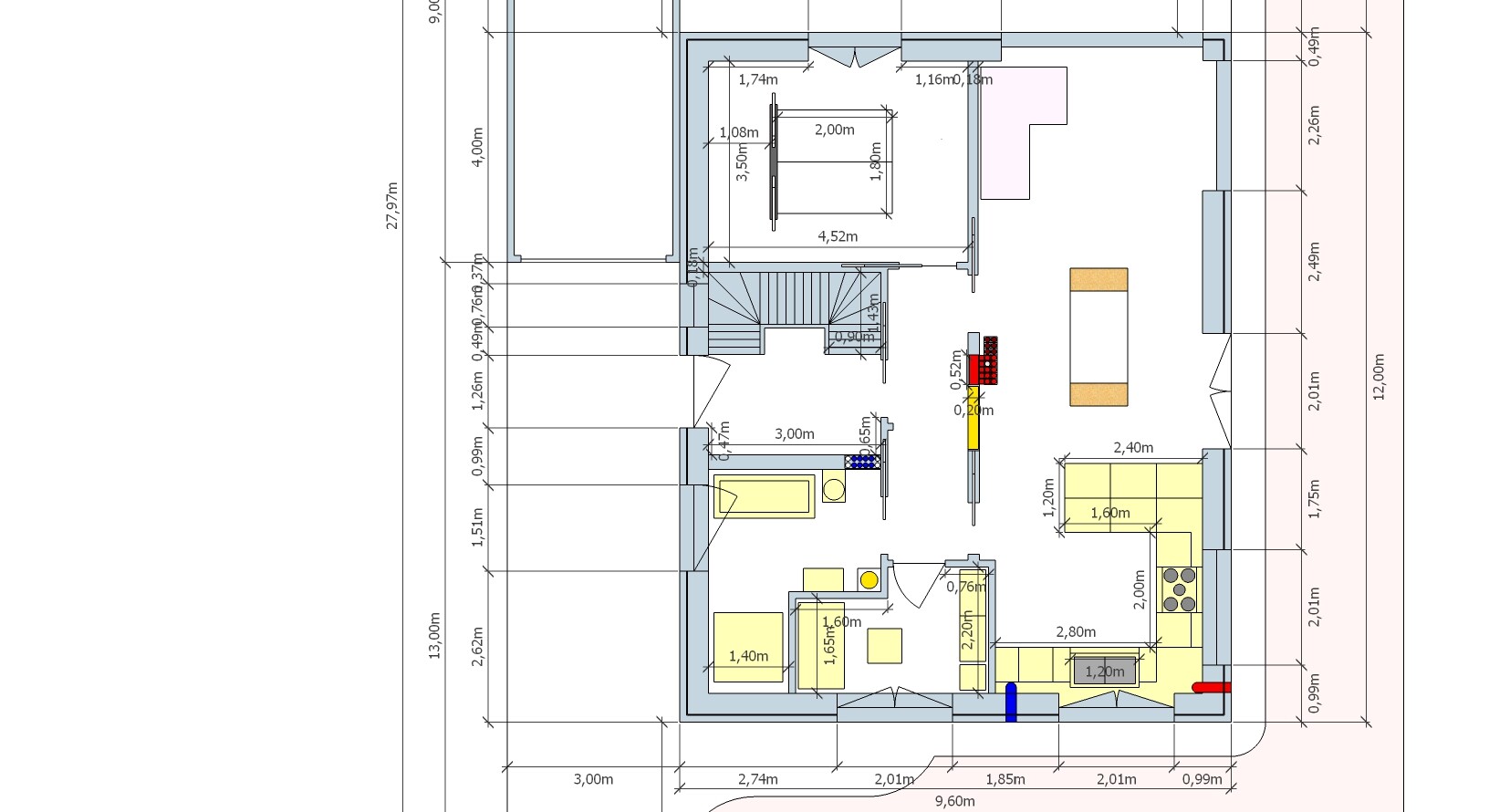
I rearranged the staircase and at the same time adjusted the bathroom and the study (for now, only on the ground floor). What do you think?
Regards
Johannes
Similar topics