
ᐅ 12 x 9.6 m, 2 full stories, basement, attic, 4 children's bedrooms
Created on: 26 Apr 2018 22:24
J
Johannes L
Hello everyone,
After more than six years of searching, we will soon be able to purchase a plot of land, so it’s time to advance the planning.
Since we are still undecided whether to build with an architect or a developer, we started drawing ourselves and have been diligently browsing internet forums like this one. The floor plans below are the result, thanks to SketchUp.
I hope we understand the floor area ratio correctly, meaning the basement is not included. Otherwise, we have a problem...
Development plan/restrictions
Plot size 15.6 x 29.95 m = 436 sqm (51.2 x 98.3 ft = 4,692 sq ft)
Slope no
Site coverage ratio 0.4 = 174.4 sqm (1,878 sq ft)
Floor area ratio 0.8 = 348.8 sqm (3,753 sq ft)
Building envelope, building line and boundary 12 m depth (39 ft)
Setbacks 3 m (10 ft) on right and left
Number of parking spaces only in front of the garage planned
Number of storeys 2 full storeys
Roof type Gable roof 42 degrees
Style brick + Wienerberger Poroton T7 P 36.5
Orientation garden facing east-northeast
Maximum height restrictions 10 m (33 ft) high
Other requirements finished floor level at least 30 cm (12 inches) above reference mark
Client requirements
Style, roof shape, building type gable roof is mandatory
Basement, number of storeys 2 full
Number and ages of occupants 6 (37, 36, 6, 4, 2, 0)
Space requirements on ground and upper floors (see plan)
Office: family use or home office? both
Guests sleeping per year the attic provides enough space
Open or closed architecture
Traditional or modern design it will be a smart home with KNX, photovoltaic system, heat pump, possibly battery storage…
Open kitchen, kitchen island open kitchen
Number of dining seats 6
Fireplace no
Music/stereo wall I was thinking of multi-room audio, i.e. one ceiling speaker per room
Balcony, roof terrace no
Garage, carport garage
Utility garden, greenhouse later
Additional wishes/particulars/daily routine, also reasons why certain things are required or excluded The house should be divisible in 25 years, hence the staircase placement. There is a kitchen shown on the upper floor, but it will only be relevant in 25 years. I roughly marked the ventilation system, indicating where ceiling or wall outlets might be and where ducts lead to the upper floors. The two offices are important. The master bedroom on the ground floor is future-proof. Everyone gets old!
House design
Who designed the plan: us amateurs
What do you like most? Why? four equally sized children’s rooms
What do you like least? Why? the upstairs hallway might be somewhat dark
Price estimate according to architect/planner: if only we knew
Personal price limit for the house including fittings: 400 + building allowance
Preferred heating technology: ground-source heat pump
If you have to give up features or extensions
- what can you do without: I hope we don’t have to
- what can you not do without: we definitely want to keep the base dimensions and the basement is a must, but we may have to save on components.
Why is the design like it is now? 4 children’s rooms, two offices, ground floor master bedroom, divisibility in 25 years…
What do you think makes it particularly good or bad? that’s what we want to know from you
What is the most important/basic question about the floor plan in 130 characters?
What would you do differently and why?
After more than six years of searching, we will soon be able to purchase a plot of land, so it’s time to advance the planning.
Since we are still undecided whether to build with an architect or a developer, we started drawing ourselves and have been diligently browsing internet forums like this one. The floor plans below are the result, thanks to SketchUp.
I hope we understand the floor area ratio correctly, meaning the basement is not included. Otherwise, we have a problem...
Development plan/restrictions
Plot size 15.6 x 29.95 m = 436 sqm (51.2 x 98.3 ft = 4,692 sq ft)
Slope no
Site coverage ratio 0.4 = 174.4 sqm (1,878 sq ft)
Floor area ratio 0.8 = 348.8 sqm (3,753 sq ft)
Building envelope, building line and boundary 12 m depth (39 ft)
Setbacks 3 m (10 ft) on right and left
Number of parking spaces only in front of the garage planned
Number of storeys 2 full storeys
Roof type Gable roof 42 degrees
Style brick + Wienerberger Poroton T7 P 36.5
Orientation garden facing east-northeast
Maximum height restrictions 10 m (33 ft) high
Other requirements finished floor level at least 30 cm (12 inches) above reference mark
Client requirements
Style, roof shape, building type gable roof is mandatory
Basement, number of storeys 2 full
Number and ages of occupants 6 (37, 36, 6, 4, 2, 0)
Space requirements on ground and upper floors (see plan)
Office: family use or home office? both
Guests sleeping per year the attic provides enough space
Open or closed architecture
Traditional or modern design it will be a smart home with KNX, photovoltaic system, heat pump, possibly battery storage…
Open kitchen, kitchen island open kitchen
Number of dining seats 6
Fireplace no
Music/stereo wall I was thinking of multi-room audio, i.e. one ceiling speaker per room
Balcony, roof terrace no
Garage, carport garage
Utility garden, greenhouse later
Additional wishes/particulars/daily routine, also reasons why certain things are required or excluded The house should be divisible in 25 years, hence the staircase placement. There is a kitchen shown on the upper floor, but it will only be relevant in 25 years. I roughly marked the ventilation system, indicating where ceiling or wall outlets might be and where ducts lead to the upper floors. The two offices are important. The master bedroom on the ground floor is future-proof. Everyone gets old!
House design
Who designed the plan: us amateurs
What do you like most? Why? four equally sized children’s rooms
What do you like least? Why? the upstairs hallway might be somewhat dark
Price estimate according to architect/planner: if only we knew
Personal price limit for the house including fittings: 400 + building allowance
Preferred heating technology: ground-source heat pump
If you have to give up features or extensions
- what can you do without: I hope we don’t have to
- what can you not do without: we definitely want to keep the base dimensions and the basement is a must, but we may have to save on components.
Why is the design like it is now? 4 children’s rooms, two offices, ground floor master bedroom, divisibility in 25 years…
What do you think makes it particularly good or bad? that’s what we want to know from you
What is the most important/basic question about the floor plan in 130 characters?
What would you do differently and why?
kaho674 schrieb:
Because of the desired divisibility in old age.
...
Yes, I also think that’s a good idea. It’s worth giving it some more thought. So, living, cooking / dining + guest bathroom with shower only on the ground floor, with the rest on the 1st and 2nd floors. Later, the elderly would live downstairs, where part of the former living area must function as a bedroom, and the grandchildren’s family would live on the 1st and 2nd floors. You’re forgetting that even after a possible division of the house, people still want to live comfortably and not in cramped spaces.
Our child is around 30, grandchildren exist, and my parents are in their mid-70s. Like us, they also have a house.
I don’t believe anyone in our family would want to downsize or turn the living room into a bedroom.
Everything on one level—yes, of course.
But no splitting of the main living area or living room or anything like that.
J
Johannes L1 May 2018 10:02Good morning and thank you for the new designs. I like them as well. However, I find the master bedroom a bit small, and the bathrooms are not aligned vertically. In this respect, I prefer the previous version a little more.
Divisibility is definitely an important aspect. In my parents’ and in-laws’ houses, the layouts are either not divisible at all or, in one case, the attic apartment is simply too small for a family.
This is especially frustrating in the latter case, as the house has more than 200 square meters (over 2100 square feet) and could potentially work well as a multi-generational home with a different layout.
Apart from that, if none of the children end up staying in the house, the upper floors (first and attic floors) could be rented out easily. The property is about 5 km (3 miles) from Münster city center with excellent access to the highway and train, without any noise from them. This is a very desirable residential location, where you can easily find tenants at any time.
If the ground floor is to be remodeled later, the structural stability must be taken into account. As it is designed in version 18, non-load-bearing partition walls could be added at any time. Whether this will be done or if the space will be left open remains to be seen.
Divisibility is definitely an important aspect. In my parents’ and in-laws’ houses, the layouts are either not divisible at all or, in one case, the attic apartment is simply too small for a family.
This is especially frustrating in the latter case, as the house has more than 200 square meters (over 2100 square feet) and could potentially work well as a multi-generational home with a different layout.
Apart from that, if none of the children end up staying in the house, the upper floors (first and attic floors) could be rented out easily. The property is about 5 km (3 miles) from Münster city center with excellent access to the highway and train, without any noise from them. This is a very desirable residential location, where you can easily find tenants at any time.
If the ground floor is to be remodeled later, the structural stability must be taken into account. As it is designed in version 18, non-load-bearing partition walls could be added at any time. Whether this will be done or if the space will be left open remains to be seen.

ypg schrieb:
No one in our family wants to downsize or turn the living room into a bedroom.
Everything on one level, yes, of course.
But no halving of the open-plan living area or the living room or anything like that. Well, that varies a lot. My sister recently renovated her house so that her daughter, her son-in-law, and their child now live on the first floor plus the attic, and she and her husband moved to the ground floor. In the process, they reduced their living space by about one-third. She said it was a relief. However, she (and this applies to many older couples) needs two bedrooms in old age because the husband snores so much that they can no longer sleep in the same room. So simply partitioning off a room wouldn’t have been enough.
kaho674 schrieb:
Well, that varies a lot. My sister recently renovated her house so that her daughter, her husband, and their child now occupy the first floor plus the attic, and they moved down to the ground floor. In the process, they reduced their living space by about one third. She said it was a relief... It also depends on how big it was before. We also made sure it would be rather smaller than larger, but in the end, it still turned out to be around 50 m² (over 530 sq ft). However, you can’t expect to live a “completely different life” in old age and give up a TV corner or dining table. Sure, the table can be smaller, but meals don’t only come from delivery services, and you’re not going to eat in bed either.
But this idea of turning the living room into a bedroom as an alternative plan—I never understood that, except in cases where a widow moves into the ground-floor living room of a terraced house for care reasons, so the caregiver can reach her more quickly.
Sorry for going off-topic @Johannes L
But it’s actually not off-topic, since you are on the right track with the idea of splitting the house.
J
Johannes L1 May 2018 10:51My father would not want to downsize, but my mother would.
Apart from that, I have adjusted the upper floor again.
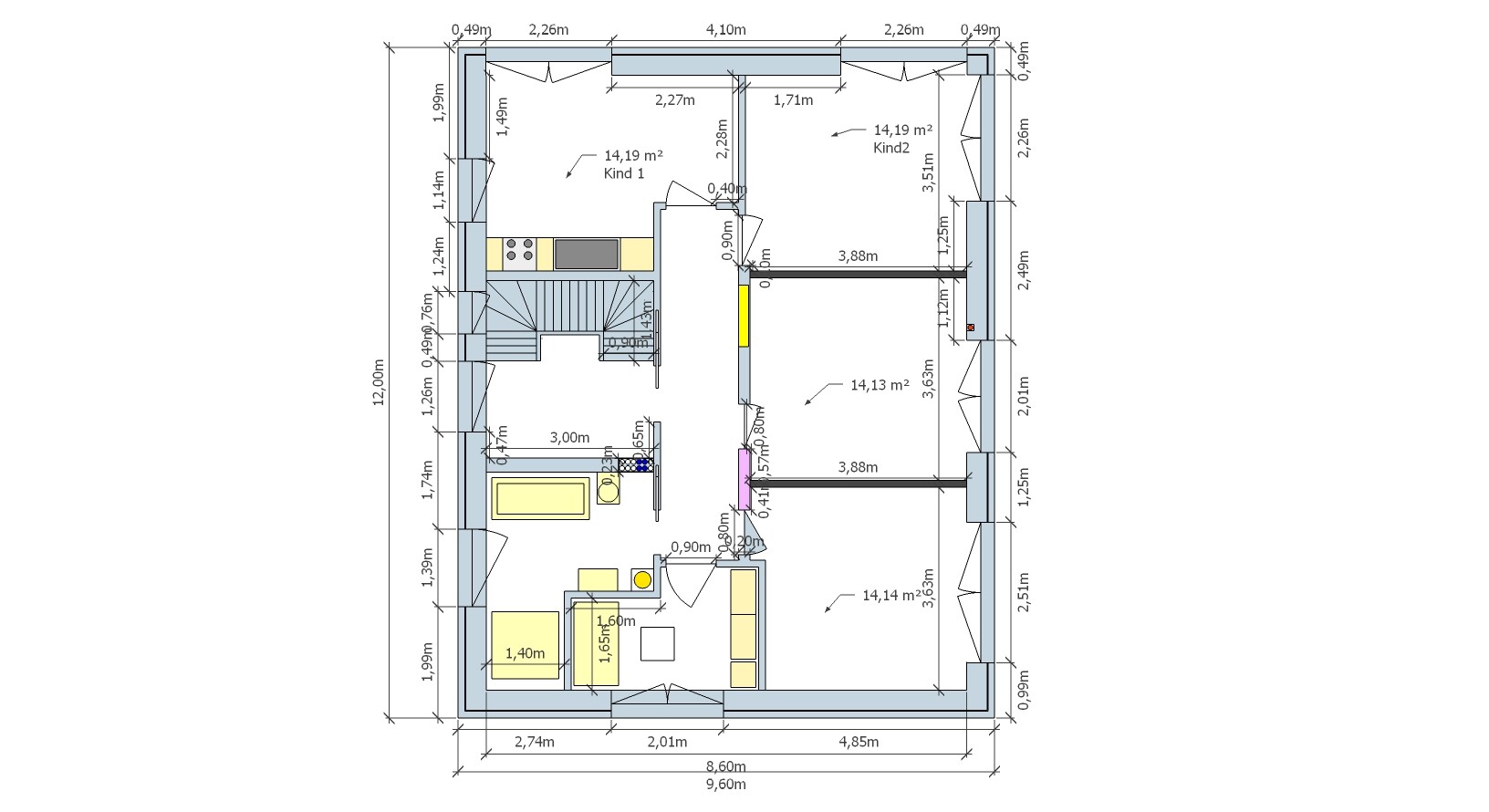
Apart from that, I have adjusted the upper floor again.
Similar topics