
Hello,
According to our builder, there will be a step of 12cm (5 inches) from the hallway down to the basement rooms because only screed without insulation (4cm [1.5 inches] thick) will be installed in the basement. The basement rooms are not within the thermal envelope, but the hallway is.
He has offered to install floor insulation in the basement rooms as well to reach a uniform floor height of 16cm (6.3 inches). This would cost an additional 4090€.
Is this justified, and is there possibly a more practical way to avoid this step?
"Installation of insulation without underfloor heating on the slab in the basement, total floor construction 160 mm (6.3 inches), consisting of:
Composite panel compact EPS-DEO 032, 30 mm (1.2 inches)
Thermal insulation EPS 035, 60 mm (2.4 inches)
Edge insulation strips
Supply and installation"
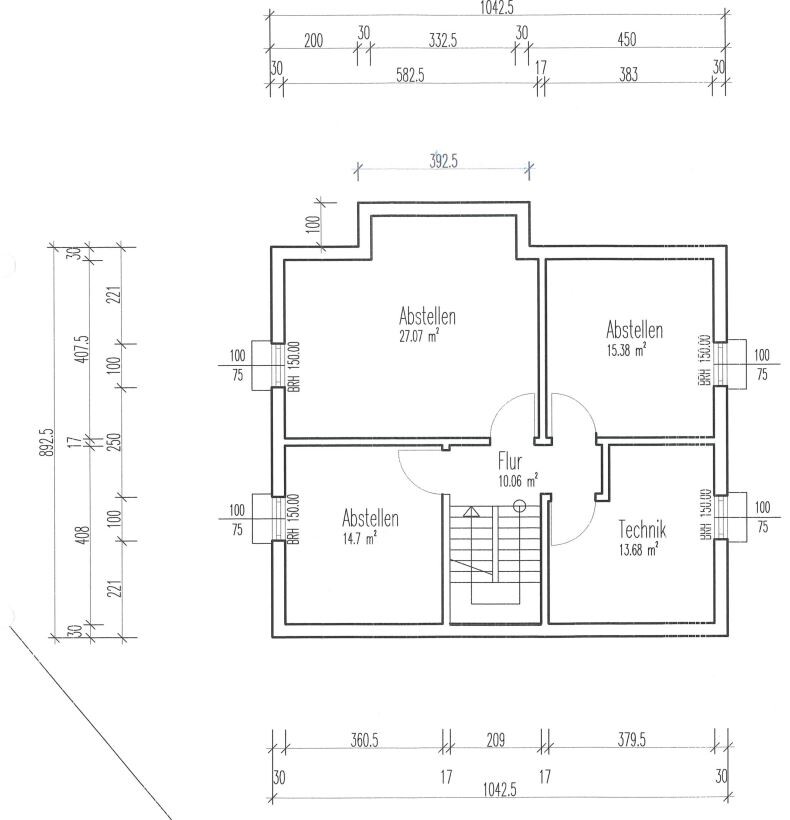
According to our builder, there will be a step of 12cm (5 inches) from the hallway down to the basement rooms because only screed without insulation (4cm [1.5 inches] thick) will be installed in the basement. The basement rooms are not within the thermal envelope, but the hallway is.
He has offered to install floor insulation in the basement rooms as well to reach a uniform floor height of 16cm (6.3 inches). This would cost an additional 4090€.
Is this justified, and is there possibly a more practical way to avoid this step?
"Installation of insulation without underfloor heating on the slab in the basement, total floor construction 160 mm (6.3 inches), consisting of:
Composite panel compact EPS-DEO 032, 30 mm (1.2 inches)
Thermal insulation EPS 035, 60 mm (2.4 inches)
Edge insulation strips
Supply and installation"

But then the hallway is not inside the thermal envelope but simply a huge thermal bridge, if not to say a gap, in the thermal envelope.
I rather suspect that your general contractor made a mistake in the planning (your reference to the incorrect building energy code calculation, which, as described, also doesn't make sense because as a basement used for living space, perimeter insulation would have been necessary).
Is the basement ceiling insulated now?
I rather suspect that your general contractor made a mistake in the planning (your reference to the incorrect building energy code calculation, which, as described, also doesn't make sense because as a basement used for living space, perimeter insulation would have been necessary).
Is the basement ceiling insulated now?
M
masterflok13 Feb 2024 19:33How can anyone plan something so illogical?!
I don’t know how far along your building project is, but if I were you, I would fully include the basement within the thermal envelope and leave it at that. Then increase the perimeter insulation on the basement walls to 12cm (5 inches) and insulate the floor slab, which will save you all the hassle of insulating the interior (ceiling, walls, and doors leading to the hallway).
For comparison, XPS insulation at 12cm (5 inches) instead of 8cm (3 inches) only costs about 5 euros more per square meter. The installation cost is the same. Inside, it balances out whether the insulation is applied to the ceiling or under the screed in terms of cost.
A huge advantage: you gain much more versatile use of the basement.
I don’t know how far along your building project is, but if I were you, I would fully include the basement within the thermal envelope and leave it at that. Then increase the perimeter insulation on the basement walls to 12cm (5 inches) and insulate the floor slab, which will save you all the hassle of insulating the interior (ceiling, walls, and doors leading to the hallway).
For comparison, XPS insulation at 12cm (5 inches) instead of 8cm (3 inches) only costs about 5 euros more per square meter. The installation cost is the same. Inside, it balances out whether the insulation is applied to the ceiling or under the screed in terms of cost.
A huge advantage: you gain much more versatile use of the basement.
Similar topics