
ᐅ 10x10 m urban villa (approximately 1,670 sq ft, 6 rooms), fine-tuning welcome
Created on: 20 Aug 2017 14:34
C
Changeling
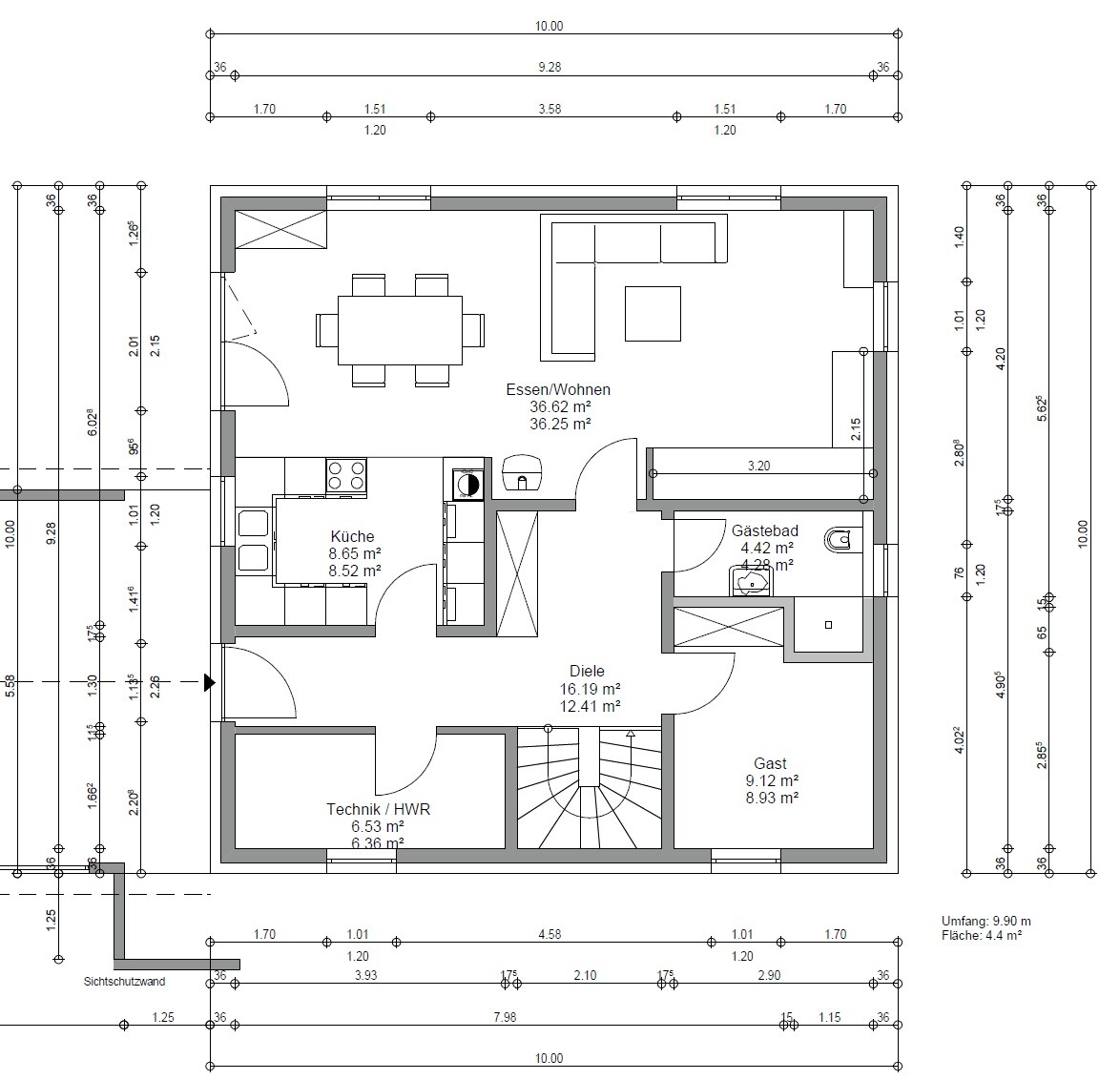
Ground Floor:
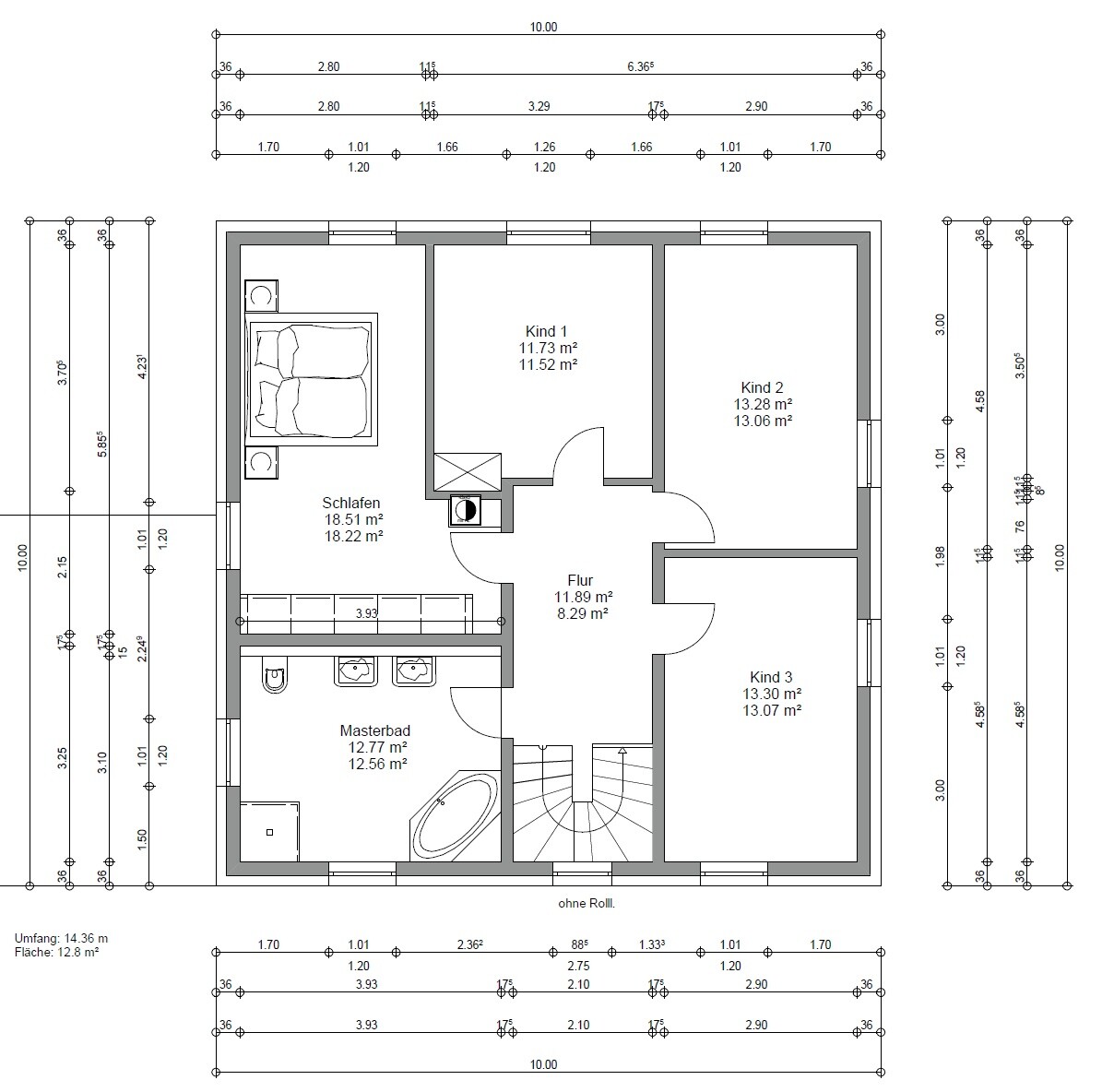
Upper Floor:
Outdoor Areas:

Positioned on the Plot:

Development Plan / Restrictions:
The plot may only be built on the southern half; otherwise, there are no particular restrictions.
Plot size: 900 square meters (approx. 30 x 30 meters / 98 x 98 feet)
Slope: No, only on the west side does the land slope down 3 meters (10 feet) toward the street at the end of the plot. On the north side, there is a retaining wall because the plot is about 2 meters (7 feet) above street level there. Therefore, access by vehicle is only possible from the south.
Clients’ Requirements
Style, Roof Shape, Building Type: A two-story urban villa with a pyramid hip roof (square hipped roof), since the upper floor has no sloped ceilings.
Basement: No basement, as it is too expensive, impractical, and involves additional construction risks.
Number of Occupants, Age: 2 adults (30 years old), 1 child (3 years old), with 1-2 more children planned.
Living Room: A large, open living area was important to us as this is where life happens. A computer corner is planned in the lower right corner since we spend more time at the computer than watching TV. We also work a lot from home and do not want to be confined to a separate room.
Fireplace: Yes.
Guest Room: Also used as storage space, which is especially useful since there is no basement.
Kitchen: The stove and sink are not in their final positions yet – a cooking island is undesirable because of the extractor hood and impractical due to splashing.
Technical / Utility Room: Also serves as a pantry and should be filled with shelves up to the ceiling.
Children’s Rooms: Size should be adequate.
Bedroom: Almost too large, but necessary due to the large wardrobe and double bed.
Bathroom: The design is still at an early stage; for example, the shower is planned as a built-in enclosure without a cabin.
Terrace: Important to us, along with a covered area so we can leave items outside occasionally.
Garage, Carport: As large as possible! It should be a wooden carport, fully closed at the front with sectional doors, and open or closed at the rear as needed. We currently use our garage as a "second living room" and for storing garden tools and similar items. Due to the long car, space will be tight; likely the terrace will be slightly smaller and the carport deeper (or the roof overhang on the left extended). The additions on the far left are planned later as a garden shed or similar and are therefore not a fixed part of the house. The covered connection to the house is a must, so we can enter without getting wet. The lower part facing the street is purely for privacy and is not a solid wall.
Garden: We will build our greenhouse ourselves as we have it now.
House Design:
Planning by: Planner from a construction company; outdoor areas added by us.
What do you particularly like? Why?: The numerous outbuildings and large carport for space, the large living room with open kitchen (also for space). Also, the level access to the terrace (which we don’t have currently).
What do you dislike? Why?: The basement level feels a bit cramped (utility room/kitchen small), while the upper floor is very spacious, but so far this is the best solution.
Cost Estimate by Architect/Planner: $290,000 USD with a maximum of +10% overrun.
Insulation / Construction: Unfortunately, it is built only to the 2016 Energy Saving Ordinance (EnEV) standards; I would have preferred better insulation, but it is likely too expensive. The masonry consists of calcium silicate blocks (20 cm / 8 inches outside + 16 cm / 6 inches EPS (polystyrene) insulation boards).
Heating System: Ground-source heat pump (brine-water) with earth probe; gas connection would be too expensive and we do not want oil heating.
If you had to give up features / expansions
- Could you do without: At most one fewer children’s room; the rest should stay as is...
- Could you not do without: Everything? That would be difficult.
Why did the design turn out the way it is?
We reviewed suggestions from the planner, spent a weekend designing alternatives ourselves, and ultimately found the current compromise. It includes essentially all our wishes.
The design could have been better if the house orientation had been different; otherwise, the kitchen/terrace/dining area wouldn’t all have to be squeezed next to the carport. However, since the street is on the south side and the northern half of the plot cannot be built on, the house must be positioned as it is and the terrace on the south side to catch the sun. We do not want the carport on the east side, as that would place the house further toward the center of the plot and make the terrace fully visible from the neighboring house to the south.
A similar-sized building plot on the east side will be developed with another single-family urban villa.
What is the most important / fundamental question regarding the floor plan in 130 characters?
What do you think? What could be improved or is missing? Any concerns?
Upper Floor:
Outdoor Areas:
Positioned on the Plot:
Development Plan / Restrictions:
The plot may only be built on the southern half; otherwise, there are no particular restrictions.
Plot size: 900 square meters (approx. 30 x 30 meters / 98 x 98 feet)
Slope: No, only on the west side does the land slope down 3 meters (10 feet) toward the street at the end of the plot. On the north side, there is a retaining wall because the plot is about 2 meters (7 feet) above street level there. Therefore, access by vehicle is only possible from the south.
Clients’ Requirements
Style, Roof Shape, Building Type: A two-story urban villa with a pyramid hip roof (square hipped roof), since the upper floor has no sloped ceilings.
Basement: No basement, as it is too expensive, impractical, and involves additional construction risks.
Number of Occupants, Age: 2 adults (30 years old), 1 child (3 years old), with 1-2 more children planned.
Living Room: A large, open living area was important to us as this is where life happens. A computer corner is planned in the lower right corner since we spend more time at the computer than watching TV. We also work a lot from home and do not want to be confined to a separate room.
Fireplace: Yes.
Guest Room: Also used as storage space, which is especially useful since there is no basement.
Kitchen: The stove and sink are not in their final positions yet – a cooking island is undesirable because of the extractor hood and impractical due to splashing.
Technical / Utility Room: Also serves as a pantry and should be filled with shelves up to the ceiling.
Children’s Rooms: Size should be adequate.
Bedroom: Almost too large, but necessary due to the large wardrobe and double bed.
Bathroom: The design is still at an early stage; for example, the shower is planned as a built-in enclosure without a cabin.
Terrace: Important to us, along with a covered area so we can leave items outside occasionally.
Garage, Carport: As large as possible! It should be a wooden carport, fully closed at the front with sectional doors, and open or closed at the rear as needed. We currently use our garage as a "second living room" and for storing garden tools and similar items. Due to the long car, space will be tight; likely the terrace will be slightly smaller and the carport deeper (or the roof overhang on the left extended). The additions on the far left are planned later as a garden shed or similar and are therefore not a fixed part of the house. The covered connection to the house is a must, so we can enter without getting wet. The lower part facing the street is purely for privacy and is not a solid wall.
Garden: We will build our greenhouse ourselves as we have it now.
House Design:
Planning by: Planner from a construction company; outdoor areas added by us.
What do you particularly like? Why?: The numerous outbuildings and large carport for space, the large living room with open kitchen (also for space). Also, the level access to the terrace (which we don’t have currently).
What do you dislike? Why?: The basement level feels a bit cramped (utility room/kitchen small), while the upper floor is very spacious, but so far this is the best solution.
Cost Estimate by Architect/Planner: $290,000 USD with a maximum of +10% overrun.
Insulation / Construction: Unfortunately, it is built only to the 2016 Energy Saving Ordinance (EnEV) standards; I would have preferred better insulation, but it is likely too expensive. The masonry consists of calcium silicate blocks (20 cm / 8 inches outside + 16 cm / 6 inches EPS (polystyrene) insulation boards).
Heating System: Ground-source heat pump (brine-water) with earth probe; gas connection would be too expensive and we do not want oil heating.
If you had to give up features / expansions
- Could you do without: At most one fewer children’s room; the rest should stay as is...
- Could you not do without: Everything? That would be difficult.
Why did the design turn out the way it is?
We reviewed suggestions from the planner, spent a weekend designing alternatives ourselves, and ultimately found the current compromise. It includes essentially all our wishes.
The design could have been better if the house orientation had been different; otherwise, the kitchen/terrace/dining area wouldn’t all have to be squeezed next to the carport. However, since the street is on the south side and the northern half of the plot cannot be built on, the house must be positioned as it is and the terrace on the south side to catch the sun. We do not want the carport on the east side, as that would place the house further toward the center of the plot and make the terrace fully visible from the neighboring house to the south.
A similar-sized building plot on the east side will be developed with another single-family urban villa.
What is the most important / fundamental question regarding the floor plan in 130 characters?
What do you think? What could be improved or is missing? Any concerns?
C
Changeling22 Aug 2017 12:48Evolith schrieb:
Of course, we upgraded some things. For the main bathroom, however, we just couldn’t settle for the standard option. Especially not when there were such beautiful fixtures on display. And I’m usually pretty strict about stuff like this.
Then there was something on top of the roof shingles (which we simply overlooked), and we also didn’t realize that a walk-in level shower would be significantly more expensive. In total, we only ended up spending about 4,000 more. I’m really curious about the final result. I think we’ll break even overall, but time will tell.
Evolith schrieb:
Power outlets: we ended up with 80. And I really tried to be frugal. Don’t forget to ask about network and TV/satellite outlets. Ours were only partly included. We will add the network outlets separately; I’d rather skip TV and satellite. Streaming is the future. I’ve had good experiences with that; satellite not so much.
Evolith schrieb:
Entrance: We absolutely wanted a nice covered area so that we could get from the car to the house without getting our feet wet. In the end, we settled for a recessed entrance with about 2 meters (6.5 feet) of distance from the carport to the door. What can I say… that’s more than enough! I can comfortably stand dry there and wait for the cats to come in the evening.
Hallway: We have just one child so far, but I already love our spacious hallway. We didn’t even realize we were missing it. We managed without it for years. But here I can easily push the stroller inside and take it apart. The little one can walk a safe 2 meters (6.5 feet) before I remind him to take off his muddy shoes. Guess how practical this will be with three kids plus groceries.
You’d also rather welcome guests in the hallway than have to direct them through the carport or a side entrance. We’re probably a bit particular. But look at the photo of our current carport/garage. We do everything “outside” there, and have for years, and we love it. Colleagues even envy us. Honestly, this is the first time on this forum I’ve seen it criticized and we just can’t understand why…
Yes, the hallway should have enough space for coats and shoes, but since we have to limit ourselves anyway, we’re putting it there because 1) you can store many things in it, and 2) a large hallway takes away space from the other rooms.
I’m happy to accept not having the long corridor like in our original plan, that makes sense (and is a waste of space). But I don’t want more than necessary there.
Evolith schrieb:
Third kids’ bedroom: Don’t stress so much about planning that room now. Better to designate a guest room that can be converted into a kids’ room later. That way, you don’t have a guest room, but so what? You’re building the house for your family, not the guests. If a third child never comes, the guest room stays as is. You remain flexible in your family planning.
With 10 by 10 meters (33 by 33 feet), you simply have to make compromises. That’s a compromise we would consider. However, in that case we’d probably rather skip the guest room downstairs and enlarge the living room and utility room instead. We find about 13 square meters (140 square feet) per bedroom upstairs sufficient, plus we also need the “potential kids’ room” as storage space upstairs. That’s what it was originally intended for, as a third child is not even planned at this point.
Evolith schrieb:
Utility room: This is really tight. We have 8 square meters (86 square feet) and it’s enough for the ventilation system, heat pump, washer and dryer, hookups, and a large litter box for the cats. Oh, and a shoe rack. But that’s it. I love my separate 4 square meter (43 square feet) storage room. Shoes belong in the carport!
Just kidding — we are currently enlarging the utility room in the new design. That should work then.
Evolith schrieb:
Ventilation system: Are you really planning to build without one? How will you ventilate your house? You won’t be opening windows every two hours, right? Are you aiming for any kind of energy efficiency standard like KfW? We’re building according to the 2016 Energy Saving Ordinance (EnEV).
Want to and can… I’d prefer a central ventilation system, but it’s incredibly expensive (and I won’t recoup the cost in my lifetime). We ventilate regularly, but of course it’s not comparable to a controlled mechanical ventilation system.
Evolith schrieb:
Stairs: Don’t underestimate the importance of those few steps. You use them multiple times per day, sometimes carrying heavy loads. As I said, our current stairway is only 1.5 meters (5 feet) deep and very walkable. The stair to the finished attic is the same and just as easy to use. The basement stairs are really narrow and I definitely wouldn’t want that in the house. But otherwise? It works fine.
Evolith schrieb:
Suggestion: Would it be an idea to place the stairway to the upper floor in the living area and make it very open upwards, like a gallery? That was one option, but we didn’t want just a single door between the sleeping area and living room.
11ant schrieb:
I’d also consider a driveway possible there. I admit, I have no idea about that. Is there any overview of different road types and required distances?
No one is criticizing the great carport. It’s just not understood that you want to outsource everything. Instead of a third bedroom upstairs, you should consider whether the utility room with the laundry might be better placed upstairs. This would provide a bit more space in the bedroom for relaxation and room for laundry and similar needs on the upper floor.

Changeling schrieb:
I would prefer a centralized ventilation system if anything. But those cost a fortune (and it won’t pay off in my lifetime). We ventilate regularly, but of course, it’s nowhere near the level of a mechanical ventilation system with heat recovery. It pays off immediately when you consider what happens if mold develops. A new house is usually more humid at first. Proper ventilation here means airing out EVERYTHING thoroughly three times a day. Since both of us work full time, we won’t manage this consistently, which is why we decided to install a mechanical ventilation system despite the cost.
When calculating the payback, also be sure to include that in winter, every time you ventilate thoroughly, you lower the indoor temperature, which then needs to be reheated. So, higher heating costs. Mechanical ventilation with heat recovery saves energy in this regard. Even if you leave aside the worst-case scenario of mold growing in a new house.
Personally, with these new, highly airtight houses, I wouldn’t want to be without mechanical ventilation.

Even though I have written this many times before: a building constructed according to standards does not require ventilation in rooms where no cooking or showering takes place. Normal air exchange must be ensured without manual intervention.
Unfortunately, due to technical reasons, I do not have a mechanical ventilation system with heat recovery, and except for the bathroom and bedroom, we ventilate very irregularly in the mornings. The humidity levels fluctuate between 50 and 60 percent everywhere.
Still, I would have liked to have a mechanical ventilation system with heat recovery purely for comfort reasons, but not because of the risk of mold.
Unfortunately, due to technical reasons, I do not have a mechanical ventilation system with heat recovery, and except for the bathroom and bedroom, we ventilate very irregularly in the mornings. The humidity levels fluctuate between 50 and 60 percent everywhere.
Still, I would have liked to have a mechanical ventilation system with heat recovery purely for comfort reasons, but not because of the risk of mold.
W
winnetou7822 Aug 2017 17:22And how is that supposed to work without opening windows?
Your walls are airtight, so how is the air supposed to exchange itself?
Your walls are airtight, so how is the air supposed to exchange itself?
Similar topics