
ᐅ Floor plan of a single-family home designed as an urban villa
Created on: 20 Apr 2026 23:13
X
xDorix
Hello everyone,
Our project is about to start soon. Before all the masonry work begins, I would appreciate your feedback.
We more or less designed the floor plan ourselves after looking at various houses and layouts. We took the elements we liked from different plans and combined them to create our house design, which we have gradually refined with our structural engineer.
Development plan/restrictions
Plot size: approx. 2500m² (0.62 acres)
Slope: No
Floor area ratio: ?
Plot ratio/building coverage ratio: ?
Building envelope, building line, and boundary: ?
Edge development: ?
Number of parking spaces: 2
Number of floors: 2
Roof type: Hipped roof 24°
Style: Modern
Orientation: Living/dining area facing east
Maximum height/limits: ?
Other regulations: unknown
Homeowner requirements
Style, roof shape, building type: Modern city villa with a hipped roof, 24°
Basement, floors: No basement, 2 full floors
Number of occupants, age: Currently 2 adults (two children’s bedrooms planned)
Room requirements on ground floor and upper floor:
Ground floor: Living/dining/kitchen area, utility room, guest WC, office
Upper floor: Master bathroom, children’s bathroom, master bedroom including walk-in closet, child 1, child 2
Office: Family use or home office? Family use
Number of guests per year: ?
Open or closed architecture: ?
Conservative or modern construction method: Modern
Open kitchen, kitchen island: Open kitchen with kitchen island
Number of dining seats: 6
Fireplace: Yes
Music/stereo wall: No
Balcony, roof terrace: Terrace accessible via lift-and-slide door
Garage, carport: Double garage
Vegetable garden, greenhouse: No
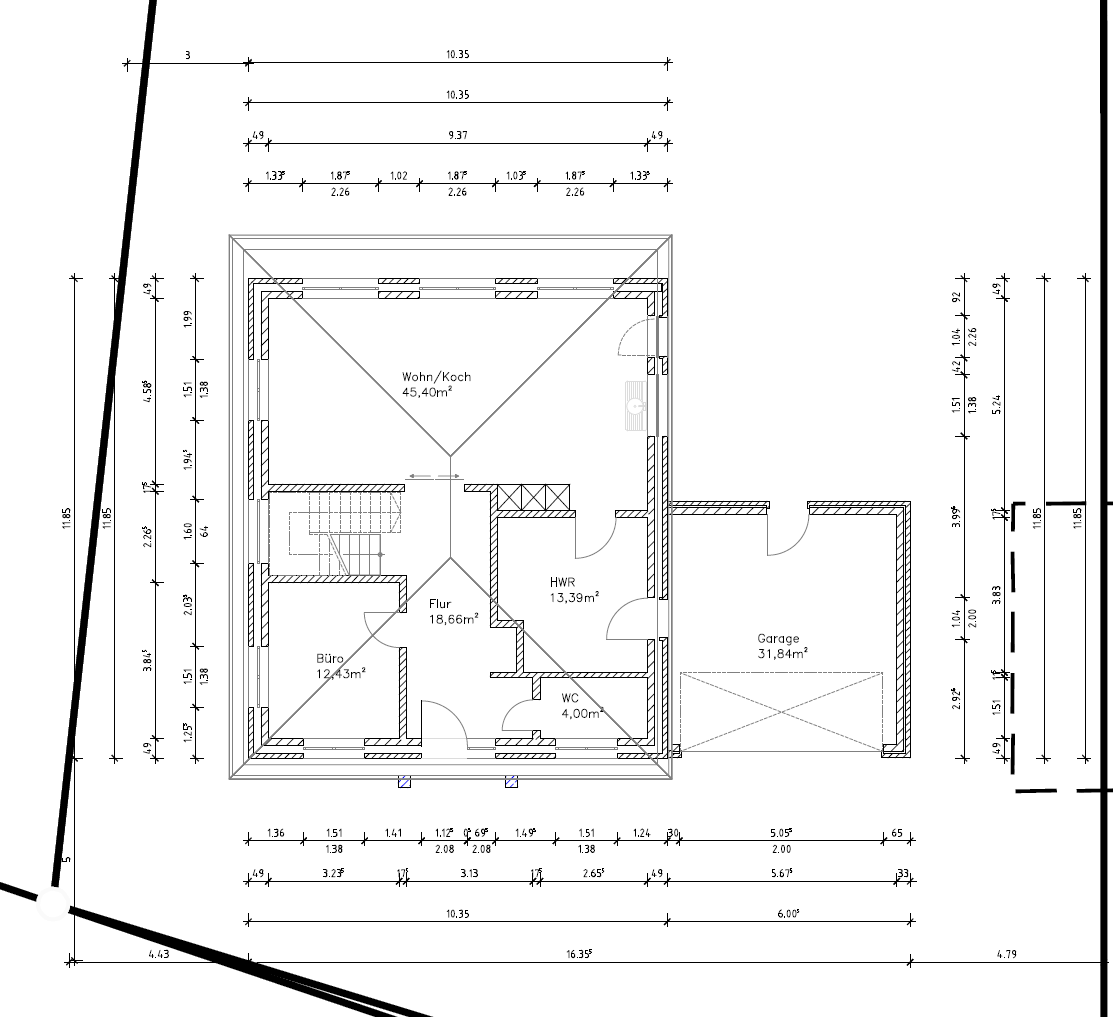
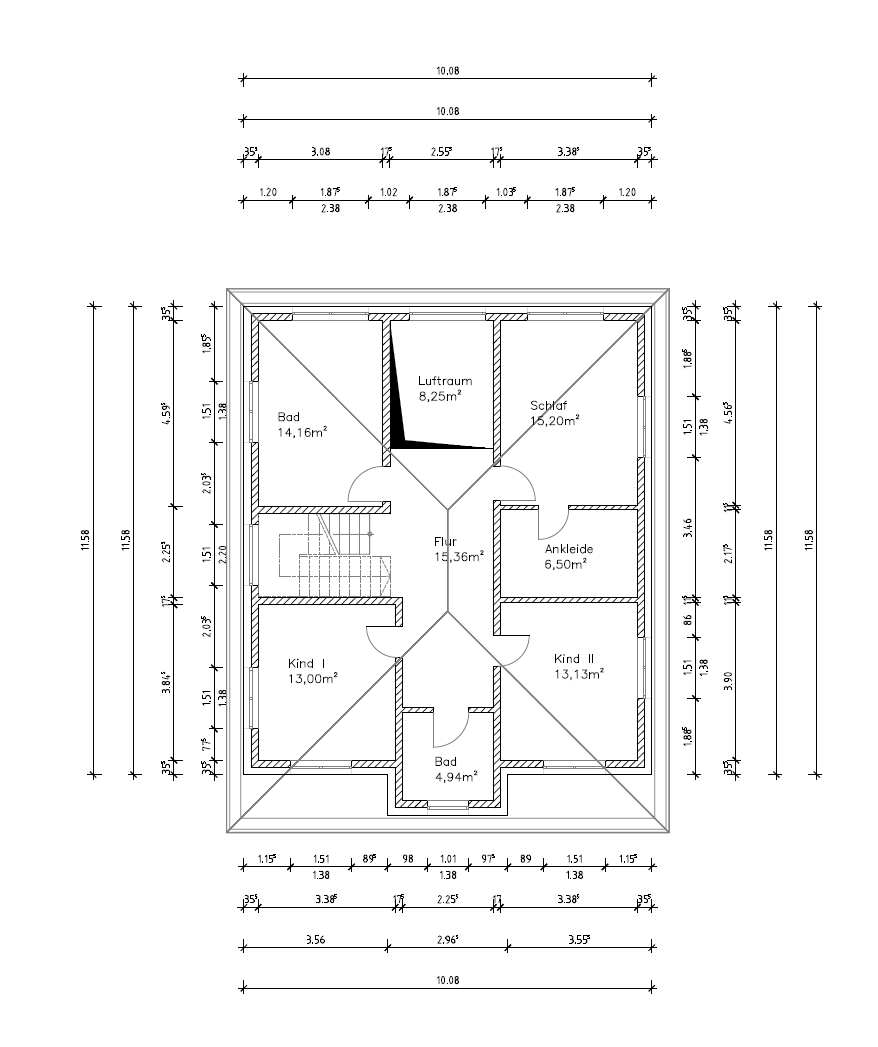
Additional wishes/particulars/daily routine, including reasons why certain things are or are not wanted: We definitely wanted a double-height space centrally located above the living/dining/kitchen area. On the upper floor, this space has a fixed window element overlooking our large plot and future garden. On the ground floor, the dining table is located directly under this double-height space.
House design
Who designed it:
- Own design based on many different floor plans
What do you like most? Why?
- The symmetry of the house’s exterior façade, the living/dining/kitchen area flooded with light through large windows including the double-height space, the open staircase with a large window, the bright and open hallway on the upper floor thanks to the double-height space.
What don’t you like? Why?
- /
Estimated price according to architect/planner: /
Personal price limit for the house, including equipment: /
Preferred heating technology: Air-to-water heat pump
If you have to give up something, which details/features
- Can you live without: /
- Can’t you live without: Double-height space, staircase, living room including kitchen
We are quite satisfied with the floor plan but would like to know if we might have overlooked something or if anything could be improved.
Regarding the kitchen, the door shown in the drawing will be removed. The kitchen unit will extend along the entire wall, and the indicated window is relatively large, facing south to allow afternoon sunlight.
Unfortunately, we do not have 3D views of the rooms like some others here have been able to share.
Ground floor:
Upper floor:
Our project is about to start soon. Before all the masonry work begins, I would appreciate your feedback.
We more or less designed the floor plan ourselves after looking at various houses and layouts. We took the elements we liked from different plans and combined them to create our house design, which we have gradually refined with our structural engineer.
Development plan/restrictions
Plot size: approx. 2500m² (0.62 acres)
Slope: No
Floor area ratio: ?
Plot ratio/building coverage ratio: ?
Building envelope, building line, and boundary: ?
Edge development: ?
Number of parking spaces: 2
Number of floors: 2
Roof type: Hipped roof 24°
Style: Modern
Orientation: Living/dining area facing east
Maximum height/limits: ?
Other regulations: unknown
Homeowner requirements
Style, roof shape, building type: Modern city villa with a hipped roof, 24°
Basement, floors: No basement, 2 full floors
Number of occupants, age: Currently 2 adults (two children’s bedrooms planned)
Room requirements on ground floor and upper floor:
Ground floor: Living/dining/kitchen area, utility room, guest WC, office
Upper floor: Master bathroom, children’s bathroom, master bedroom including walk-in closet, child 1, child 2
Office: Family use or home office? Family use
Number of guests per year: ?
Open or closed architecture: ?
Conservative or modern construction method: Modern
Open kitchen, kitchen island: Open kitchen with kitchen island
Number of dining seats: 6
Fireplace: Yes
Music/stereo wall: No
Balcony, roof terrace: Terrace accessible via lift-and-slide door
Garage, carport: Double garage
Vegetable garden, greenhouse: No
Additional wishes/particulars/daily routine, including reasons why certain things are or are not wanted: We definitely wanted a double-height space centrally located above the living/dining/kitchen area. On the upper floor, this space has a fixed window element overlooking our large plot and future garden. On the ground floor, the dining table is located directly under this double-height space.
House design
Who designed it:
- Own design based on many different floor plans
What do you like most? Why?
- The symmetry of the house’s exterior façade, the living/dining/kitchen area flooded with light through large windows including the double-height space, the open staircase with a large window, the bright and open hallway on the upper floor thanks to the double-height space.
What don’t you like? Why?
- /
Estimated price according to architect/planner: /
Personal price limit for the house, including equipment: /
Preferred heating technology: Air-to-water heat pump
If you have to give up something, which details/features
- Can you live without: /
- Can’t you live without: Double-height space, staircase, living room including kitchen
We are quite satisfied with the floor plan but would like to know if we might have overlooked something or if anything could be improved.
Regarding the kitchen, the door shown in the drawing will be removed. The kitchen unit will extend along the entire wall, and the indicated window is relatively large, facing south to allow afternoon sunlight.
Unfortunately, we do not have 3D views of the rooms like some others here have been able to share.
Ground floor:
Upper floor:
N
nordanney21 Apr 2026 14:39xDorix schrieb:
The house construction contract states 409,000 euros. A budget of 450,000 euros is available. The buffer is intended for upgrades, flooring, battery storage for the photovoltaic system (the system itself is included in the fixed price), and from now on, any additional incidental costs. Since I work in this field, I’m curious about your calculation. What is included in the 409k? What does the house price cover? What are the "additional incidental costs" from now on? Etc.
Why am I asking? I’m currently handling an inquiry from a developer who builds with their own construction business for their own portfolio. They offer properties at 2,800 €/m² (260 $/ft²) of living space at cost price (really all-inclusive). Parking spaces/garages are extra. No profit margin. Just as a comparison for why I’m skeptical about your figures.
Fortunately, this is anonymous here. So please feel free to share ;-)
xDorix schrieb:
and our builder had no objections. Well, most small construction companies will approve any request you have and will even install a shower in the kitchen if you want. The main thing is that the client feels understood because their wishes are being considered.
Whether some of these requests actually make sense from a construction perspective is something that has to be evaluated on a case-by-case basis.
Of course, a bathroom above the living area is possible. But somewhere in a corner you will end up with an ugly boxed-in soil pipe (waste pipe) where the wastewater will flow. And in case of a blockage (which can still happen nowadays), the living room will be affected when the pipe needs to be opened. This is especially problematic considering the dressing room also doesn’t have proper access, being a hidden room accessible only from the bedroom.
xDorix schrieb:
That’s true. But that would be at the expense of the utility room, which brings us to your next point. And that’s the catch: every change would negatively impact something else. So it’s a domino effect in the planning process.
xDorix schrieb:
that changes are possible but obviously must be indicated. Every change costs money and time. Not just for the permit or planning permission application, but also for the double costs incurred due to delays.
No approvals are needed for interior adjustments.
But you don’t plan a new build like a used property where walls are constantly shifted around.
xDorix schrieb:
So I wouldn’t say the deal is done yet. In that respect…
Regarding the bargain price: there are definitely differences between the low-cost providers and medium-sized companies when you look closely. Some also have a well-established reputation that consistently confirms how the cheap ones make their money. For example, Team Massiv does it with low-cost bricks that later are no longer available, and so on.
However, it is a good decision to choose a local builder rather than a nationwide chain. And it’s also perfectly valid to prefer paying for 16 square meters (around 170 square feet) of hallway instead of expensive flooring at over €40 per square meter (more than $40 per square yard). There are also people who don’t understand the concept of tactility or simply lack spatial awareness. You can see this especially with the bathroom, which in its current layout can’t be furnished properly.
Most people keep tweaking their design to achieve a comfortable balance between different aspects.
Ultimately, the house, as it stands, is livable. What doesn’t work will simply be fixed functionally. And with a bargain price like that, you’re happy to do it this way—just like with appliances: if you want to save money, you buy the previous model and are fine with it because you don’t know anything else.
But when you see the €409,000 price tag (approximately $409,000), and calculate only 150 square meters (about 1,615 square feet) at very low-cost €2,700 per square meter (roughly $250 per square foot, typical for lower-cost construction in Lower Saxony), you get only the base living area without garage, without ventilation system, without satellite, LAN, more than one two-way switch, no floor drain, and other extras that make a house comfortable. Those will then be added by the tradespeople on top. That’s not bad in itself, but it probably isn’t accounted for by you, since every builder does that. And when you compare the scopes of work (building specifications), this is standard everywhere.
Our house had a low-cost catalog price of €149,000 (2013). The final contract price with the builder, including additional items, was €190,000. Trades (tiling, plumbing, electrical) cost another €25,000. Garage €10,000, landscaping contractor €15,000 plus materials.
That results in a comparison (rounded) excluding ancillary building costs:
€150,000 / €245,000.
So with your €409,000, where do you think you’ll end up?
N
nordanney21 Apr 2026 16:15Medium schrieb:
And now you come up with the 409,000. Where could you end up? Spoiler: Leaving out the garage and landscaping, you had about a 45% increase. 45% on 409k ==> 590k
M
MachsSelbst21 Apr 2026 16:29Where does it say 150m² (1600 sq ft)? The building’s exterior dimensions are 10x12m (33x39 ft), which results in almost 200m² (2150 sq ft) of living space...
That’s why it’s such a pity that so little is made out of the 200m² (2150 sq ft), or that you don’t build 30m² (320 sq ft) less with the same utility...
Especially since two full bathrooms and one WC need to fit in, which are by far the most expensive rooms.
For Town & Country, the Flair 154 RE in the Aurich region now costs 307,000 EUR. Without a garage, without a photovoltaic system, with only the bathrooms tiled, etc.
And you’re building 20% larger, and that price is really just the Town & Country base price — you have to realistically add another 10,000 to 15,000 for that. Plus the interior work you do yourself.
That’s why it’s such a pity that so little is made out of the 200m² (2150 sq ft), or that you don’t build 30m² (320 sq ft) less with the same utility...
Especially since two full bathrooms and one WC need to fit in, which are by far the most expensive rooms.
For Town & Country, the Flair 154 RE in the Aurich region now costs 307,000 EUR. Without a garage, without a photovoltaic system, with only the bathrooms tiled, etc.
And you’re building 20% larger, and that price is really just the Town & Country base price — you have to realistically add another 10,000 to 15,000 for that. Plus the interior work you do yourself.
N
nordanney21 Apr 2026 16:33MachsSelbst schrieb:
Where does he count 150m² (1500 sq ft)? He is not actually counting, but saying that with the budget only 150m² (1500 sq ft) is possible.
H
hanghaus202321 Apr 2026 16:57nordanney schrieb:
He’s not counting at all, just saying that with the budget only 150sqm (1,615 sq ft) is possible. I agree. Better to start over again.