
Dear forum,
I am interested in a plot of land where a duplex is planned. The plot would then be shared with the other buyer. Unfortunately, the plot is not perfectly square. Now I am wondering whether, for this particular plot, a conceptual subdivision or a real subdivision would be better?
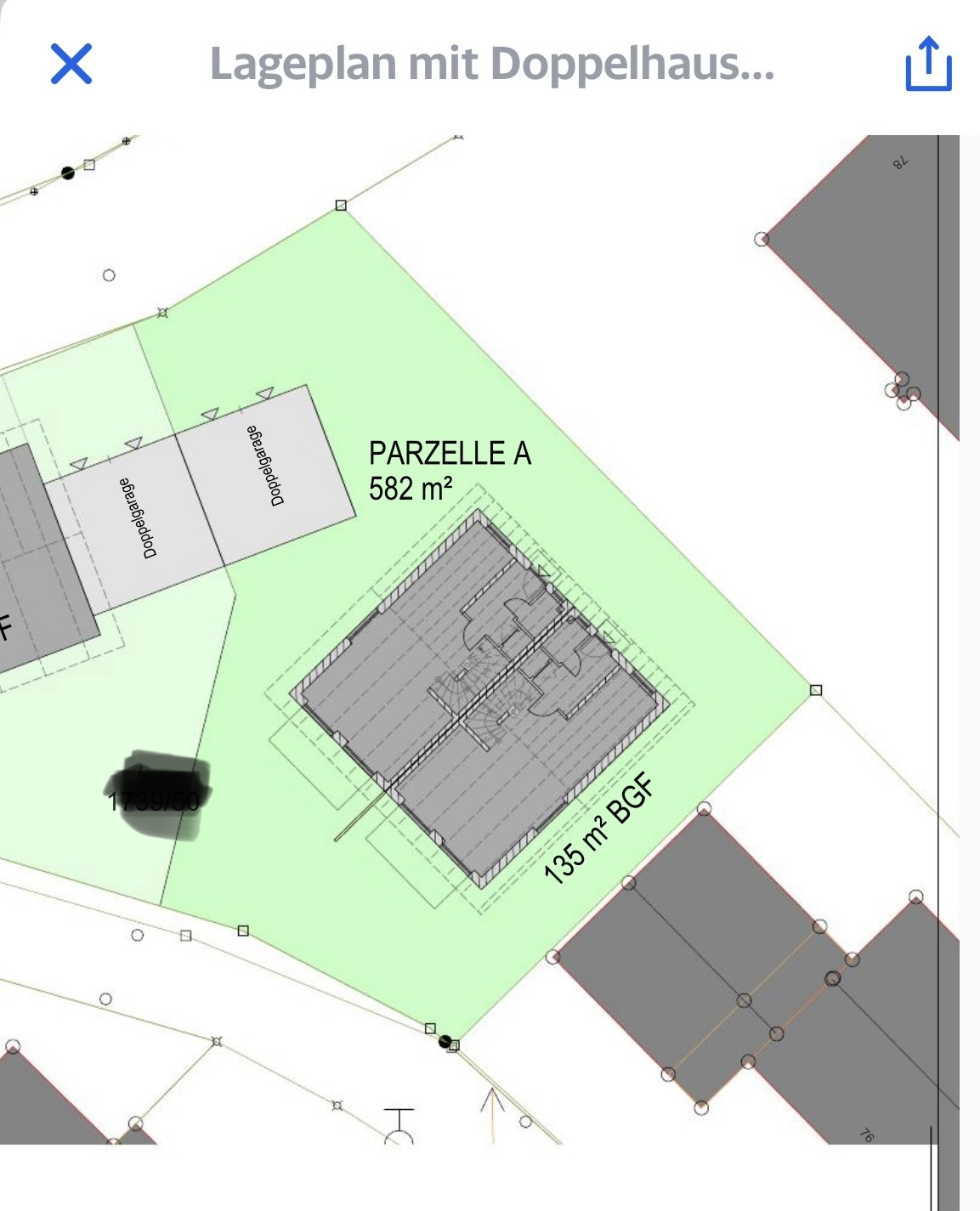
I am interested in a plot of land where a duplex is planned. The plot would then be shared with the other buyer. Unfortunately, the plot is not perfectly square. Now I am wondering whether, for this particular plot, a conceptual subdivision or a real subdivision would be better?
N
nordanney28 Jan 2026 10:00PhilB schrieb:
what do you think about the shape of the plot, whether such a semi-detached house can be built purely based on the shape of the land? And would 130 m² (1400 sq ft) of building footprint for the entire semi-detached house be too small for my requirements mentioned above? The location of the semi-detached house should be roughly like on the As for the shape? No problem. It just means the individual plot shares will be different sizes.
Whether one party ends up with the double garage and the other none is a different issue. Or whether setbacks can be maintained. Or if enough parking spaces can be provided for the right-hand unit at all. Or if such a development would be permitted in the first place (floor area ratio and so on). Etc.
I see much more interesting questions than just “will a semi-detached house fit on the plot based on its shape.”

There is only one real risk with such a small group of property owners: joint liability.
By default, you automatically form a partnership (GbR) even without any court or official registration. From an internal perspective, matters like costs are resolved through the declaration of division, but legally, each of you can be held jointly and severally liable.
For example, suppose you all agree to collectively hire a fence contractor to ensure a uniform look along the street. One neighbor prefers contractor A, while you prefer contractor B, for whatever reason. You can't reach an agreement for a while, and then one of you loses patience and simply orders their preferred contractor. The contractor completes the job and demands payment. They can claim the full amount from any one of you. If that person refuses to pay, the contractor can pursue the others for the entire sum and will likely succeed in court.
Whether and how much that person can recover from the others is then an internal matter among you, which may take time to resolve again.
In larger multi-family buildings, a property management company usually acts as the client, preventing any individual actions like this.
This is really the only aspect that makes me pause.
By default, you automatically form a partnership (GbR) even without any court or official registration. From an internal perspective, matters like costs are resolved through the declaration of division, but legally, each of you can be held jointly and severally liable.
For example, suppose you all agree to collectively hire a fence contractor to ensure a uniform look along the street. One neighbor prefers contractor A, while you prefer contractor B, for whatever reason. You can't reach an agreement for a while, and then one of you loses patience and simply orders their preferred contractor. The contractor completes the job and demands payment. They can claim the full amount from any one of you. If that person refuses to pay, the contractor can pursue the others for the entire sum and will likely succeed in court.
Whether and how much that person can recover from the others is then an internal matter among you, which may take time to resolve again.
In larger multi-family buildings, a property management company usually acts as the client, preventing any individual actions like this.
This is really the only aspect that makes me pause.
N
nordanney28 Jan 2026 10:51Tolentino schrieb:
That is actually the only thing that would make me think twice. In fact, these small communities are much easier to manage because the declaration of division allows for a lot more flexibility. For example, when it comes to fences, only neighborhood law applies—no partnership (GbR) issues.
Clearer and more explicit regarding the internal relationship, yes, but no declaration of division can override the de facto partnership and joint liability.
From an outsider’s perspective, it is not obvious whether this is a semi-detached house owned by one person with the other part rented out, or whether the driveway is owned by both parties or only one.
You automatically have a partnership when multiple people manage something together. There is no other way.
In theory, you already have a partnership if you go out to lunch together, one person orders the table and pays the bill, and then the costs are shared.
That it often works smoothly in practice, because most people you do this with are not idiots, remains undisputed.
From an outsider’s perspective, it is not obvious whether this is a semi-detached house owned by one person with the other part rented out, or whether the driveway is owned by both parties or only one.
You automatically have a partnership when multiple people manage something together. There is no other way.
In theory, you already have a partnership if you go out to lunch together, one person orders the table and pays the bill, and then the costs are shared.
That it often works smoothly in practice, because most people you do this with are not idiots, remains undisputed.
N
nordanney28 Jan 2026 12:31Tolentino schrieb:
For an outsider, it’s not clear whether this is a semi-detached house owned by one person with the other half rented out, or whether the driveway belongs to both or just one. But it doesn’t really matter. If A orders a fence for the enclosure, the invoice is issued to A, not to the A+B partnership. There is no joint liability here, especially if the other party did not agree.
By the way, condominium law (commonhold law) takes precedence over partnership law in an owners’ association. You can’t choose which law applies.
Tolentino schrieb:
You automatically have a partnership (GbR) when multiple people do something together. There’s no other way. There is no reason to do anything jointly with a semi-detached house, except maybe the fence. Driveways should remain separate. So, one.
P.S. Your theoretical example might formally be a partnership. BUT: keep in mind that a partnership requires a mutual intention to be legally bound. Therefore, the fence example is de facto not considered a partnership transaction for the two owners A and B. Not paying for heating maintenance because of joint liability? Expecting the neighbor to share the cost of a new window? No, that’s completely mistaken.
I checked again, and you are right.
I must have confused something in my memory. So, with the condominium ownership (homeowners association) fees, it is only up to the share of ownership.
In this case, the contractor can still approach you, but only for 50%.
There seems to be only an exception for municipal charges, for example, if there is only one sewage connection for the entire property.
I must have confused something in my memory. So, with the condominium ownership (homeowners association) fees, it is only up to the share of ownership.
In this case, the contractor can still approach you, but only for 50%.
There seems to be only an exception for municipal charges, for example, if there is only one sewage connection for the entire property.
Similar topics