
ᐅ Floor Plan Optimization for a Single-Family Home with a Secondary Suite
Created on: 19 Jan 2026 10:26
D
DieHnnH
Hello everyone,
We are a couple (both 34 years old) looking to build our home in a rural area of Baden-Württemberg. Important preliminary information: no children planned, but a dog. A separate apartment (granny flat) is mandatory with at least 23sqm (250 sq ft).
We would appreciate your input to help us avoid making major mistakes.
Development Plan / Restrictions
Plot size: 494sqm (5314 sq ft)
Slope: none
Site coverage ratio: 0.32
Edge building allowance: garage permitted
Number of parking spaces: 3
Number of stories: 2 full stories required
Roof style: gable roof with a pitch of 25–38°
Orientation: see plan
Additional requirement: separate apartment
Homeowners’ Requirements
Style: country house / modern Swedish style
Basement, floors: no basement, 2 full floors
Number of occupants, age: 2 adults (34), 1 planned dog, 1 person in separate apartment
Space requirements on ground floor and upper floor: 120sqm (1292 sq ft) for us plus at least 23sqm (250 sq ft) for the separate apartment
Office: home office, 1 person working fully from home
Guest stays per year: total about 5–15 nights
Open or closed layout: open
Open kitchen, kitchen island: open kitchen with kitchen island or U-shape preferred
Number of dining seats: 4–6
Fireplace: desired for coziness, small in size, probably not really necessary
Garage, carport: carport plus 2 additional parking spaces
Kitchen garden, greenhouse: small greenhouse plus kitchen garden
Other wishes / special features / daily routine, also reasons why certain things should or shouldn’t be: the most important space to us is the kitchen and living room combined as an open area. We want it to be cozy, which is very important. The building plot faces east on the edge of the village, with no further development planned in that direction. We really like this view, but we would also like the terrace to face south.
In general, we want to make the best possible use of the remaining garden and are looking for ideas on how to place the house on the plot to maximize garden usability. We understand the garden won’t be very large.
We both have home-centered hobbies that require space: my husband plays drums, I play piano—space needed upstairs. I enjoy baking, he enjoys cooking—space needed in the kitchen. I like to read—books require space too. We both enjoy gardening.
House Design
Designed by: architect (BU)
What do you like especially and why?
- Layout of the open space and size of the kitchen
- Location of the separate apartment
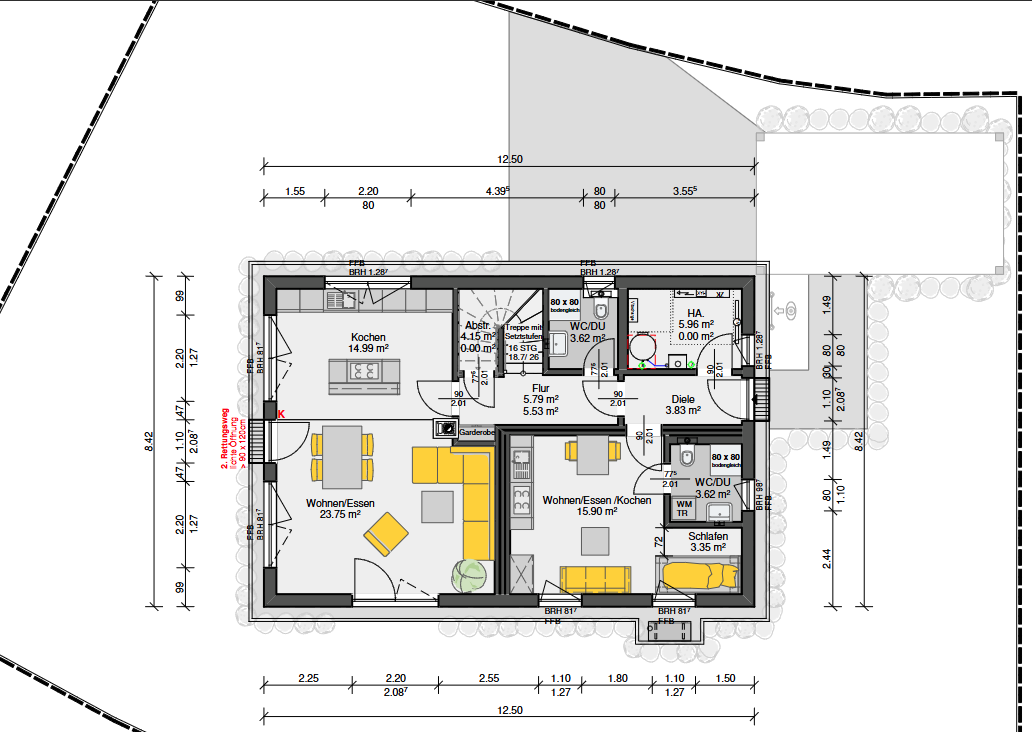
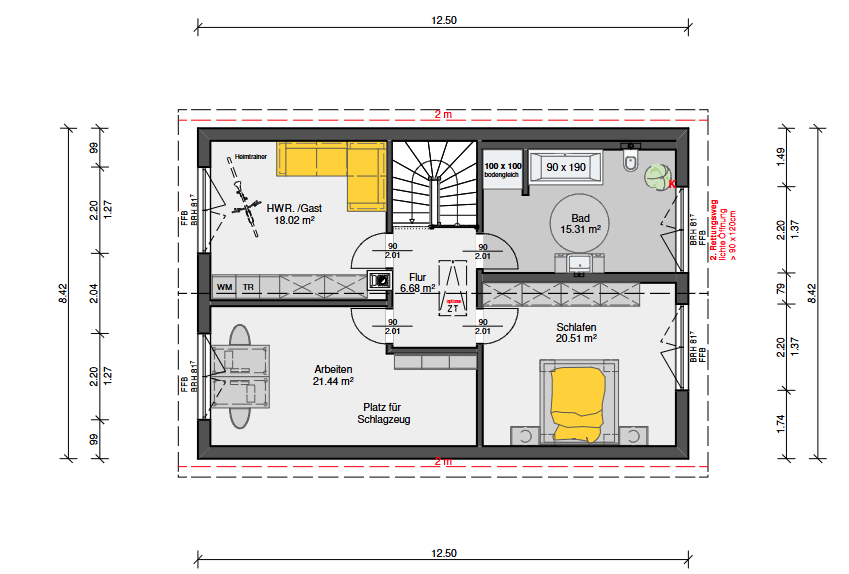
- Additional space gained upstairs. We originally considered a single-story extension for the separate apartment, but the architect said it’s more expensive than enlarging the whole house. This way, we can keep the technical room small downstairs and move the utility room completely upstairs. We would swap room usage upstairs: bedroom → utility room in the northeast, office → bedroom (this also allows a nice built-in wardrobe niche).
What do you dislike and why?
- The separate apartment has no room for a closet
- Unsure if the size of the open space is sufficient
- The bathroom is very large—like a ballroom. We considered extending the hallway to create a small extra storage room. However, this would reduce western light in the bathroom.
- We don’t like the windows and terrace doors at all yet
- Carport location: needs to be rotated and, in our opinion, moved to the boundary
Cost estimate according to architect/planner: €600,000 including secondary construction costs
Tasks we will do ourselves: roofing, purchase and installation of photovoltaic system & battery, wall and ceiling boarding, filling, painting, flooring, bathrooms
Preferred heating system: air-water heat pump with underfloor heating
If you have to give up some details / expansions
- Can give up: fireplace, so much space upstairs
- Cannot give up: separate apartment, large kitchen
Why has the design turned out this way?
Because this reflects our wishes, the separate apartment, and respects the development plan. We tried ourselves to design a squarer house to create space on the south side, but that didn’t work with the separate apartment.
We’re happy for you to roast the floor plan and welcome any improvement suggestions—thanks in advance.
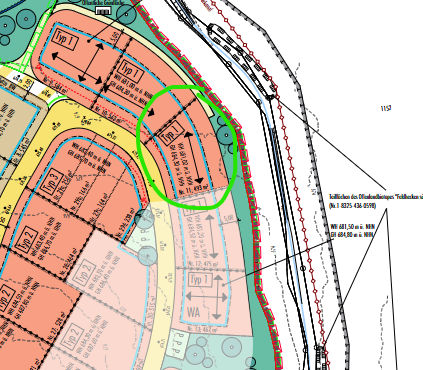
Circled in green and oriented to north.
Sunny regards
We are a couple (both 34 years old) looking to build our home in a rural area of Baden-Württemberg. Important preliminary information: no children planned, but a dog. A separate apartment (granny flat) is mandatory with at least 23sqm (250 sq ft).
We would appreciate your input to help us avoid making major mistakes.
Development Plan / Restrictions
Plot size: 494sqm (5314 sq ft)
Slope: none
Site coverage ratio: 0.32
Edge building allowance: garage permitted
Number of parking spaces: 3
Number of stories: 2 full stories required
Roof style: gable roof with a pitch of 25–38°
Orientation: see plan
Additional requirement: separate apartment
Homeowners’ Requirements
Style: country house / modern Swedish style
Basement, floors: no basement, 2 full floors
Number of occupants, age: 2 adults (34), 1 planned dog, 1 person in separate apartment
Space requirements on ground floor and upper floor: 120sqm (1292 sq ft) for us plus at least 23sqm (250 sq ft) for the separate apartment
Office: home office, 1 person working fully from home
Guest stays per year: total about 5–15 nights
Open or closed layout: open
Open kitchen, kitchen island: open kitchen with kitchen island or U-shape preferred
Number of dining seats: 4–6
Fireplace: desired for coziness, small in size, probably not really necessary
Garage, carport: carport plus 2 additional parking spaces
Kitchen garden, greenhouse: small greenhouse plus kitchen garden
Other wishes / special features / daily routine, also reasons why certain things should or shouldn’t be: the most important space to us is the kitchen and living room combined as an open area. We want it to be cozy, which is very important. The building plot faces east on the edge of the village, with no further development planned in that direction. We really like this view, but we would also like the terrace to face south.
In general, we want to make the best possible use of the remaining garden and are looking for ideas on how to place the house on the plot to maximize garden usability. We understand the garden won’t be very large.
We both have home-centered hobbies that require space: my husband plays drums, I play piano—space needed upstairs. I enjoy baking, he enjoys cooking—space needed in the kitchen. I like to read—books require space too. We both enjoy gardening.
House Design
Designed by: architect (BU)
What do you like especially and why?
- Layout of the open space and size of the kitchen
- Location of the separate apartment
- Additional space gained upstairs. We originally considered a single-story extension for the separate apartment, but the architect said it’s more expensive than enlarging the whole house. This way, we can keep the technical room small downstairs and move the utility room completely upstairs. We would swap room usage upstairs: bedroom → utility room in the northeast, office → bedroom (this also allows a nice built-in wardrobe niche).
What do you dislike and why?
- The separate apartment has no room for a closet
- Unsure if the size of the open space is sufficient
- The bathroom is very large—like a ballroom. We considered extending the hallway to create a small extra storage room. However, this would reduce western light in the bathroom.
- We don’t like the windows and terrace doors at all yet
- Carport location: needs to be rotated and, in our opinion, moved to the boundary
Cost estimate according to architect/planner: €600,000 including secondary construction costs
Tasks we will do ourselves: roofing, purchase and installation of photovoltaic system & battery, wall and ceiling boarding, filling, painting, flooring, bathrooms
Preferred heating system: air-water heat pump with underfloor heating
If you have to give up some details / expansions
- Can give up: fireplace, so much space upstairs
- Cannot give up: separate apartment, large kitchen
Why has the design turned out this way?
Because this reflects our wishes, the separate apartment, and respects the development plan. We tried ourselves to design a squarer house to create space on the south side, but that didn’t work with the separate apartment.
We’re happy for you to roast the floor plan and welcome any improvement suggestions—thanks in advance.
Circled in green and oriented to north.
Sunny regards

ypg schrieb:
Unfortunately, the quote function here works poorly. You can’t sort, select, or delete old quotes, so here without: the calcium silicate brick was incorrectly translated by the forum’s replace function – it should say knee wall. Poor Klaus Schmitz. Once again, the auto-replace function swapped the car with a train.
DieHnnH schrieb:
A full story in the upper floor is possible. We hoped to save costs by lowering the knee wall. But not at any price. If that causes other problems, like with windows for example, the question of added value has to be reassessed. No, a knee wall of 170 cm (5 ft 7 in) compared to a "100% knee wall," aka a full upper story, is not actually a lowering of the knee wall but rather a lowering of the foot rafters of a gable roof, where otherwise a trussed roof could have been used. From a window perspective, knee walls of 220 cm (7 ft 3 in) or 180 cm (5 ft 11 in) are fine as well. The price impact comes mainly from the roof construction mentioned earlier. For me, as an average-sized person who fits “95% of the population” like sitting in a VW Golf driver’s seat, a knee wall of 160 cm (5 ft 3 in) would mean that when standing, the upper window frame visually feels like a board right in front of my face. An extra 10 cm (4 in) has the same effect for taller guys nowadays. And in terms of additional costs, general contractors and home builders don’t calculate a 170 cm (5 ft 7 in) knee wall as “220 cm (7 ft 3 in) minus half a meter,” but rather as “120 cm (4 ft) plus half a meter,” and then their eyes literally see dollar signs.
ypg schrieb:
Don’t forget that many companies don’t even offer technology installations in the attic for structural reasons. Most don’t even offer a walkable attic. I used @Golfi90 as a concrete example where it was really about installation in the attic, but here I’m thinking more simply and cost-effectively about technology in the upper floor or attic under a possible loft space.
https://www.instagram.com/11antgmxde/
https://www.linkedin.com/company/bauen-jetzt/
DieHnnH schrieb:
with a 1.7m (5 ft 7 in) knee wall, normally opening windows in the southwest and northeast don’t work. That’s true. However, windows can still be installed. These would be at knee height and mainly serve an aesthetic purpose. Danwood offers such windows in their homes. I once visited a house like that or read about it on a blog, and these windows can only be opened with a key for security reasons. They are not intended for ventilation.
Here’s a quick and simple idea for inspiration:
Thank you @ypg for your time and ideas.
I already liked the initial concepts; they definitely make the upper floor feel much more comfortable. We will try to rebuild that over the weekend!
I really like the idea of having the technical room downstairs and a utility room upstairs. Laundry usually happens upstairs, etc. Downstairs, you have a robot vacuum to clean the floors, while upstairs you more often need a regular vacuum cleaner, and so on.
In your new design, you swapped the kitchen and living room. I’m still undecided about this because, in this arrangement, the kitchen becomes wider and thus a kitchen island becomes more realistic. At the same time, this allows the technical room to be located behind the kitchen. That wouldn’t work with the living room in that spot, since there would be no suitable space left for a projector screen or TV. Two good reasons to arrange it this way.
The living room would then be facing southwest, which I don’t like for two reasons:
- I prefer the living room to be darker, so north-facing works well for that
- I would rather have the view from the street into the kitchen than into the living room (depending on how the house is positioned, there may be more or less space between the house and the street)
Okay, I see that I need to study the topic of the knee wall and its effects more carefully to fully understand it.
I already liked the initial concepts; they definitely make the upper floor feel much more comfortable. We will try to rebuild that over the weekend!
I really like the idea of having the technical room downstairs and a utility room upstairs. Laundry usually happens upstairs, etc. Downstairs, you have a robot vacuum to clean the floors, while upstairs you more often need a regular vacuum cleaner, and so on.
In your new design, you swapped the kitchen and living room. I’m still undecided about this because, in this arrangement, the kitchen becomes wider and thus a kitchen island becomes more realistic. At the same time, this allows the technical room to be located behind the kitchen. That wouldn’t work with the living room in that spot, since there would be no suitable space left for a projector screen or TV. Two good reasons to arrange it this way.
The living room would then be facing southwest, which I don’t like for two reasons:
- I prefer the living room to be darker, so north-facing works well for that
- I would rather have the view from the street into the kitchen than into the living room (depending on how the house is positioned, there may be more or less space between the house and the street)
11ant schrieb:
From a cost perspective, general contractors/builders don’t calculate a knee wall 170 as “220 minus half a meter,” but rather “120 plus half a meter,” and their eyes light up at the extra dollar signs.
Okay, I see that I need to study the topic of the knee wall and its effects more carefully to fully understand it.
DieHnnH schrieb:
Ok, I see that I need to study this more to properly understand the topic of knee walls and their effects. These are very different issues: structural engineering, building regulations, and cost-related. What is unusual in your case is that you do not want to avoid a full story on level II but explicitly want it. If the overall building height allows it, achieving a full story is generally more cost-effective with a straight wall than with a high knee wall. Lowering the eave height results in a roof structure with rafters and purlins, where a truss roof would also be possible above a straight-walled upper floor. As explained in the external post, the height of the knee wall also has a secondary function as the window sill height.https://www.instagram.com/11antgmxde/
https://www.linkedin.com/company/bauen-jetzt/
Thanks @11ant for the explanation. We inquired: a knee wall height of 2m (6 ft 7 in) works with standard windows. That costs about €7000 less than 2.3m (7 ft 7 in). We don’t want a truss roof since we plan to use the attic as storage space.
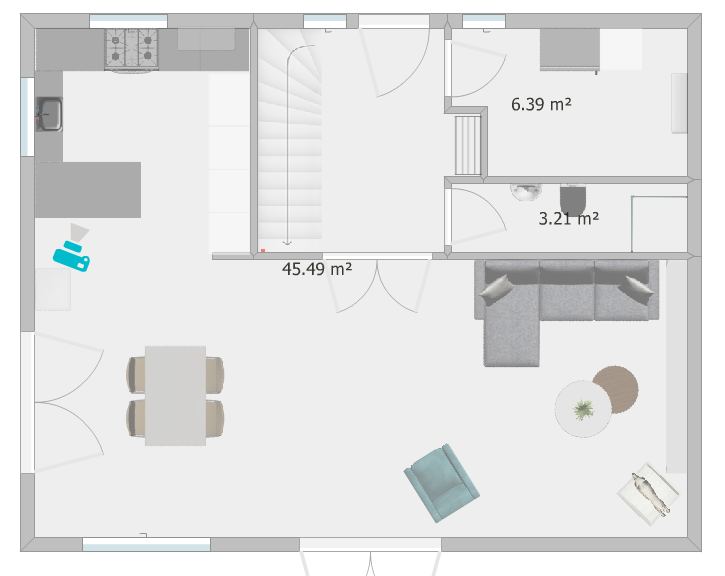
@ypg, thanks again to you as well. I tried to implement this (some windows are still missing and not quite correct, especially on the upper floor).
Ground floor
Upper floor
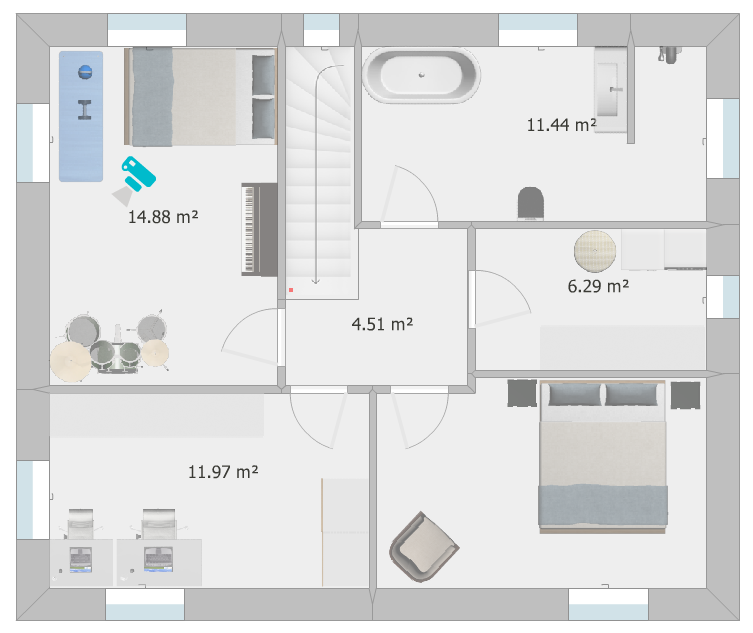
Upper floor alternative
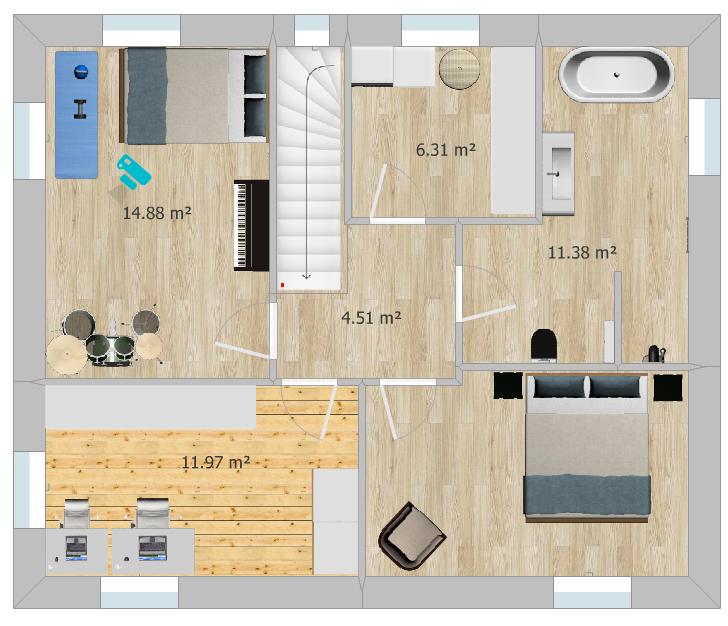
I don’t think the bathroom furniture layout is optimal in either case, but I really like having the utility room on the upper floor and the wardrobes in the study. The bed in the guest/hobby room is just a placeholder; in real life, a sofa bed will go there.
Overall, I’m quite happy with it now. What weaknesses do you still see?
@ypg, thanks again to you as well. I tried to implement this (some windows are still missing and not quite correct, especially on the upper floor).
Ground floor
Upper floor
Upper floor alternative
I don’t think the bathroom furniture layout is optimal in either case, but I really like having the utility room on the upper floor and the wardrobes in the study. The bed in the guest/hobby room is just a placeholder; in real life, a sofa bed will go there.
Overall, I’m quite happy with it now. What weaknesses do you still see?
Why are the exterior walls on the ground floor so narrow?
Well, "standard" is relative. Facade windows are possible even with a significantly lower knee wall height. With a 2m (6.6 ft) knee wall, after subtracting the ring beam and roller shutter box, the top edge of the wall opening would be at about 1.5m (5 ft) height (instead of the usual approximately 2.2m (7.2 ft)), and the top of the glazing would be at about 1.4m (4.6 ft).
That is not necessarily a strict exclusion. On the one hand, there are different types of trusses, and on the other, a fully floored attic is often as unnecessary as a full basement. It’s simply the case that with a rafter and purlin roof structure, the base purlins naturally cannot be located below the eaves. The option—emphasis on “option,” not obligation—of a truss roof depends on being able to place the bottom chord at least at the level of the boundary between the living attic space and the attic storage above. Trusses are not inferior/poor/disadvantageous: they allow the top floor ceiling to be constructed congruently or “in unison” with the base of the roof structure. In practice, this allows a more independent arrangement of the upper and ground floor layouts, among other things by enabling the use of lightweight partition walls on the upper floor where concrete ceilings would rule them out. The design and use of upper floors and attic spaces is a complex topic that requires careful consideration.
https://www.instagram.com/11antgmxde/
https://www.linkedin.com/company/bauen-jetzt/
DieHnnH schrieb:
We inquired: a knee wall height of 2m (6.6 ft) works with standard windows. That costs about €7000 less than 2.3m (7.5 ft).
Well, "standard" is relative. Facade windows are possible even with a significantly lower knee wall height. With a 2m (6.6 ft) knee wall, after subtracting the ring beam and roller shutter box, the top edge of the wall opening would be at about 1.5m (5 ft) height (instead of the usual approximately 2.2m (7.2 ft)), and the top of the glazing would be at about 1.4m (4.6 ft).
DieHnnH schrieb:
We don’t want a truss roof because we want to use the attic as storage space.
That is not necessarily a strict exclusion. On the one hand, there are different types of trusses, and on the other, a fully floored attic is often as unnecessary as a full basement. It’s simply the case that with a rafter and purlin roof structure, the base purlins naturally cannot be located below the eaves. The option—emphasis on “option,” not obligation—of a truss roof depends on being able to place the bottom chord at least at the level of the boundary between the living attic space and the attic storage above. Trusses are not inferior/poor/disadvantageous: they allow the top floor ceiling to be constructed congruently or “in unison” with the base of the roof structure. In practice, this allows a more independent arrangement of the upper and ground floor layouts, among other things by enabling the use of lightweight partition walls on the upper floor where concrete ceilings would rule them out. The design and use of upper floors and attic spaces is a complex topic that requires careful consideration.
https://www.instagram.com/11antgmxde/
https://www.linkedin.com/company/bauen-jetzt/
Similar topics