
ᐅ Modernist Concrete Villa with Cavity Wall Insulation – Experiences
Created on: 11 Sep 2018 07:32
R
rick2018
Hello everyone,
I just wanted to briefly introduce myself and say thank you.
For about a year and a half, I have been a silent reader here to gather inspiration and especially to gain more knowledge about construction technology.
Now a bit about me:
After more than a year of searching for a plot of land, I was able to purchase one from a developer who couldn’t move forward quickly with his plans.
So we found our dream plot (good location, 2500 m² (0.62 acres), slight slope, underground private spring that we have to preserve and are allowed to use).
There was an old house on the property, which we have since demolished.
There is no zoning plan, so §34 applies. During an initial informal inquiry at the building authority, almost everything we planned was rejected.
So we submitted an official preliminary building inquiry, involved the right people, and had lengthy discussions. In the end, we received a positive decision.
Therefore, there is nothing standing in the way of the building permit. The building permit should be granted within the next few weeks as there are no changes from the preliminary inquiry.
My wife (37) and I (36) want to build a Bauhaus-style villa in southern Baden-Württemberg.
It will be constructed from concrete (with core insulation) or in combination with insulated precast elements.
A lot of glass (full-glass system), textile shading, KNX, fast network both wired and wireless, strong mechanical ventilation with additional cooling coils, stainless steel pool, large cistern, and more.
The electrical planning must be 100% spot on since it’s almost impossible to make changes afterward.
Since I am friends with an architect from a larger firm, it was clear which route we would take. Such a house can basically only be realized with an architect.
I also personally know the electrician and KNX system integrator, as well as the owners and work approach of the heating, plumbing, and ventilation companies involved.
Some trades have already been contracted, and part of the equipment has already been ordered.
I’m really looking forward to getting started and to the final result. The goal is to move in by the end of 2019.
Once again, many thanks for the information I have received from you so far.
If you have any questions, just let me know.
Attached is the design, though not the final version. There have been a few minor changes.
Greetings from Swabia
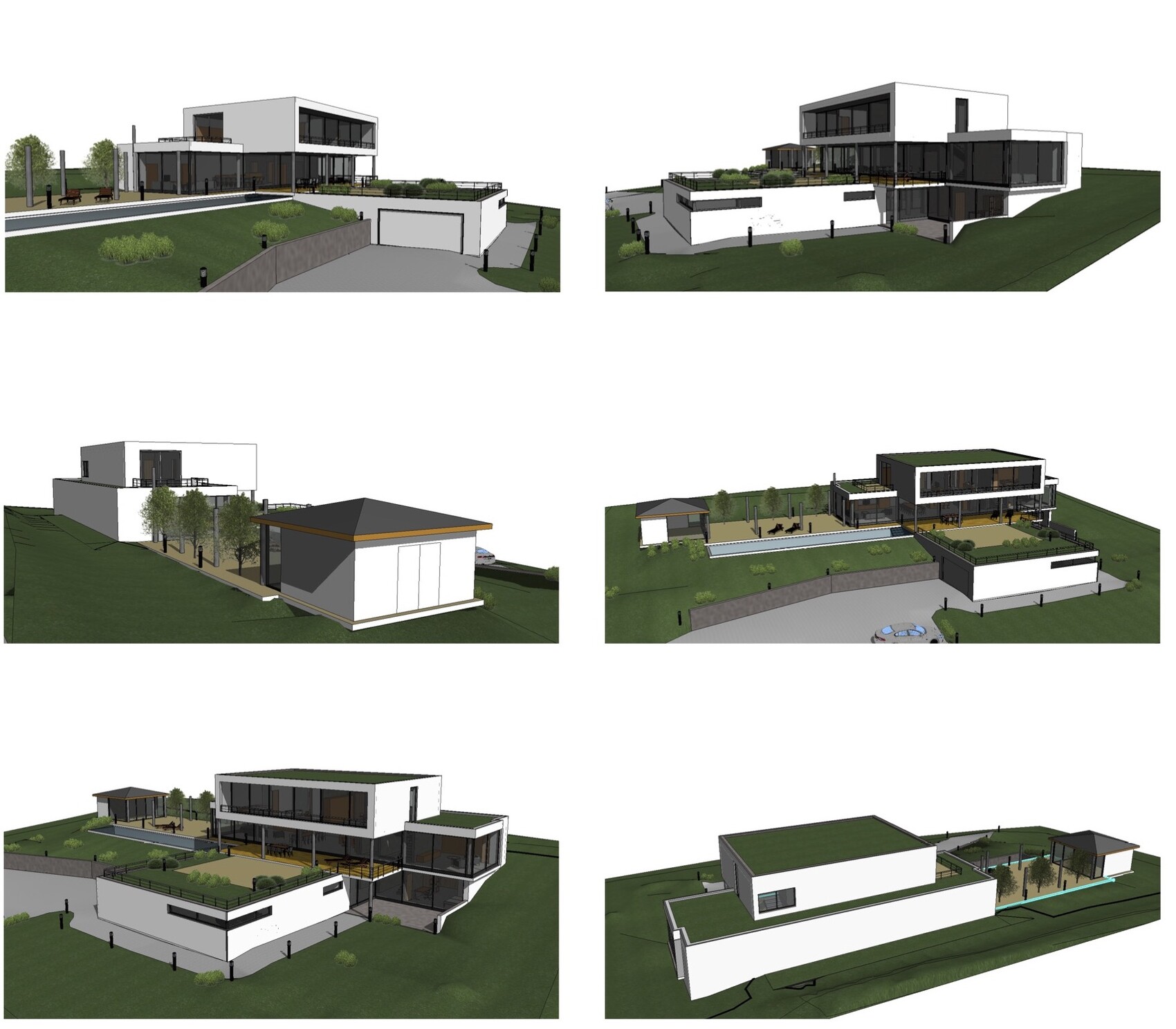
I just wanted to briefly introduce myself and say thank you.
For about a year and a half, I have been a silent reader here to gather inspiration and especially to gain more knowledge about construction technology.
Now a bit about me:
After more than a year of searching for a plot of land, I was able to purchase one from a developer who couldn’t move forward quickly with his plans.
So we found our dream plot (good location, 2500 m² (0.62 acres), slight slope, underground private spring that we have to preserve and are allowed to use).
There was an old house on the property, which we have since demolished.
There is no zoning plan, so §34 applies. During an initial informal inquiry at the building authority, almost everything we planned was rejected.
So we submitted an official preliminary building inquiry, involved the right people, and had lengthy discussions. In the end, we received a positive decision.
Therefore, there is nothing standing in the way of the building permit. The building permit should be granted within the next few weeks as there are no changes from the preliminary inquiry.
My wife (37) and I (36) want to build a Bauhaus-style villa in southern Baden-Württemberg.
It will be constructed from concrete (with core insulation) or in combination with insulated precast elements.
A lot of glass (full-glass system), textile shading, KNX, fast network both wired and wireless, strong mechanical ventilation with additional cooling coils, stainless steel pool, large cistern, and more.
The electrical planning must be 100% spot on since it’s almost impossible to make changes afterward.
Since I am friends with an architect from a larger firm, it was clear which route we would take. Such a house can basically only be realized with an architect.
I also personally know the electrician and KNX system integrator, as well as the owners and work approach of the heating, plumbing, and ventilation companies involved.
Some trades have already been contracted, and part of the equipment has already been ordered.
I’m really looking forward to getting started and to the final result. The goal is to move in by the end of 2019.
Once again, many thanks for the information I have received from you so far.
If you have any questions, just let me know.
Attached is the design, though not the final version. There have been a few minor changes.
Greetings from Swabia

@waduda78
First of all, thank you. Living in the house is excellent. We really enjoy it, and it feels like being on holiday.
Not much has changed.
1.
- There have been a few minor changes in the garden.
- For the pool, I would integrate a way to circulate the water either through the overflow channel or just the pool itself. It saves energy. I don’t see the point in retrofitting that now.
- We have a 10 kWp photovoltaic system. That was the limit back then. Today, I would install more capacity. Adding another system of 5-6 kWp doesn’t make much sense considering the installation effort.
2.
We would build the toilets exactly the same way again. None of the concerns raised here have ever been mentioned by any of our guests.
3.
We also looked at Basalte. We installed Gira G1 and a 19” (48 cm) Gira panel, which has since been replaced with one from PeaKNX.
We rarely use the panels because most functions run automatically. The rest is controlled either by voice or via mobile devices. These are mostly for guests or cleaning staff.
4.
Although you could install access points (APs) hidden, the wood and insulation would strongly block the 5 GHz network, so that’s not practical. For the 2.4 GHz network, this is less of an issue. But since you have supply and exhaust air vents, motion detectors, smoke detectors, etc., I advise against it. It’s better to use in-wall APs or install Flex-HD models recessed into the ceiling. Only a small piece is visible then.
We have a Flammkraft grill, and we are very satisfied with it. It will serve us well for many years to come.
@xMisterDx
If set up correctly, you can block out neighboring properties. You don’t have to give your child admin access...
We also have houses on the hillside above us that can partly see the pool. We don’t care at all.
There was even a case where someone in camouflage with a telephoto lens was on the other side of the hill. Too bad for them that we had guests and noticed it. The guests had their young daughters with them.
First of all, thank you. Living in the house is excellent. We really enjoy it, and it feels like being on holiday.
Not much has changed.
1.
- There have been a few minor changes in the garden.
- For the pool, I would integrate a way to circulate the water either through the overflow channel or just the pool itself. It saves energy. I don’t see the point in retrofitting that now.
- We have a 10 kWp photovoltaic system. That was the limit back then. Today, I would install more capacity. Adding another system of 5-6 kWp doesn’t make much sense considering the installation effort.
2.
We would build the toilets exactly the same way again. None of the concerns raised here have ever been mentioned by any of our guests.
3.
We also looked at Basalte. We installed Gira G1 and a 19” (48 cm) Gira panel, which has since been replaced with one from PeaKNX.
We rarely use the panels because most functions run automatically. The rest is controlled either by voice or via mobile devices. These are mostly for guests or cleaning staff.
4.
Although you could install access points (APs) hidden, the wood and insulation would strongly block the 5 GHz network, so that’s not practical. For the 2.4 GHz network, this is less of an issue. But since you have supply and exhaust air vents, motion detectors, smoke detectors, etc., I advise against it. It’s better to use in-wall APs or install Flex-HD models recessed into the ceiling. Only a small piece is visible then.
We have a Flammkraft grill, and we are very satisfied with it. It will serve us well for many years to come.
@xMisterDx
If set up correctly, you can block out neighboring properties. You don’t have to give your child admin access...
We also have houses on the hillside above us that can partly see the pool. We don’t care at all.
There was even a case where someone in camouflage with a telephoto lens was on the other side of the hill. Too bad for them that we had guests and noticed it. The guests had their young daughters with them.
X
xMisterDx20 Sep 2023 05:40This wasn’t directed at you. I just find it surprising sometimes that nowadays you’re considered paranoid if you claim the right not to be filmed 24/7 on your own small 612m² (6,588 ft²) property, and on top of that, you don’t even know what happens to the footage.
With my neighbor, I’m quite sure the cameras are connected to a NAS, so the recordings don’t just disappear after a few days like when the camera’s loop recording overwrites the oldest files.
And if that footage also goes to the cloud...
With my neighbor, I’m quite sure the cameras are connected to a NAS, so the recordings don’t just disappear after a few days like when the camera’s loop recording overwrites the oldest files.
And if that footage also goes to the cloud...
xMisterDx schrieb:
With my neighbor, I’m pretty sure the cameras are connected to a NAS, so the footage isn’t deleted after a few days because the camera’s circular buffer starts over.
If the data is also uploaded to the cloud... That’s how I understand it as well from friends who record surveillance videos. The footage is stored for a long time.
And often, there are simply no masked areas. Videos that were sent to the police after a break-in attempt were later edited to blur sensitive parts.
What I’m wondering now is how much data a camera actually generates per day after compression and motion detection. Footage without motion can be quickly deleted automatically, so only the “interesting” scenes with neighbors in view remain.
K
k-man202124 Apr 2026 22:32Hello @rick2018,
We are currently planning a new single-family house as a retirement home in Bavaria and actually want to have an elevator installed. As you probably know, there are basically two types: a home lift with a speed of 0.15m/s (0.5 ft/s) and a “regular” elevator. I assume you installed a real elevator… According to the manufacturer, it must be serviced by them at least once a year and inspected by the TÜV (technical inspection authority), even if it is rarely used. For the home lift, this regulation does not apply, but the home lift is significantly more expensive if you want more than just a platform.
How do you handle maintenance and the TÜV inspection? Unfortunately, I can’t send you a private message, otherwise I would have asked you directly.
We are currently planning a new single-family house as a retirement home in Bavaria and actually want to have an elevator installed. As you probably know, there are basically two types: a home lift with a speed of 0.15m/s (0.5 ft/s) and a “regular” elevator. I assume you installed a real elevator… According to the manufacturer, it must be serviced by them at least once a year and inspected by the TÜV (technical inspection authority), even if it is rarely used. For the home lift, this regulation does not apply, but the home lift is significantly more expensive if you want more than just a platform.
How do you handle maintenance and the TÜV inspection? Unfortunately, I can’t send you a private message, otherwise I would have asked you directly.

k-man2021 schrieb:
Hello @rick2018, Last active: 08/09/2025
k-man2021 schrieb:
A home lift is significantly more expensive if you want more than just a platform. A home lift is also not intended as a direct alternative for situations where a standard passenger elevator could be used just as well.
https://www.instagram.com/11antgmxde/
https://www.linkedin.com/company/bauen-jetzt/
@k-man2021,
yes, we have a “proper” elevator.
There are no specific regulations for private elevators. You have to meet all the same requirements as if the elevator were used daily in a hospital transporting hundreds of visitors.
This creates many challenges during construction and inspection (mirrors, independent emergency call system, key safe, elevator maintenance…).
The inspection authority (TÜV) basically only puts the approval sticker on it. Everything else is handled by the elevator manufacturer.
The TÜV inspector was only present during acceptance. I told him we would not do regular TÜV inspections. The key safe is no longer used either. Don’t undermine my security concept.
We have a maintenance contract, meaning a service technician comes once a year to check and maintain the elevator. The emergency call system is active but basically redundant. Still, it is part of the maintenance contract.
Such a maintenance contract costs between €1500 and €3000 (without parts) per year, depending on the elevator and manufacturer.
I can’t imagine a homelift would be more expensive. You’d have to compare it with an elevator with glass panelling or similar. Homelifts (0.15m/s (0.5 ft/s)) are quite slow; our elevator runs at 1 m/s (3.3 ft/s). Homelifts also have significantly lower load capacity.
We are glad to have the elevator, whether for elderly guests, cleaning staff, shopping, or transporting materials…
We have seen several times how much of a difference an elevator makes, especially when someone is ill. Not only for us but also for friends and family.
Our elevator makes about 1000 trips per year. Actually, it’s about half as many because it automatically returns to the basement when not in use. More than half the trips are made by the cleaning staff. The same model is installed multiple times in the local hospital, where it performs several hundred thousand trips per year. Apart from replacing the backup batteries, nothing else has needed to be done.
The problem is private elevators that are never maintained.
If you have the funds, definitely install one, no matter which system you choose.
Planning a shaft and intending to install an elevator later almost never happens. I don’t know of any house where this worked out. Especially since every elevator manufacturer and type has specific requirements for dimensions, overhead clearance, pit depth, etc.
I wish you great success with your project. Make sure to plan wide enough doors and design the spaces to be wheelchair and walker accessible from the start. An elevator alone helps a lot but is only one part of an age-friendly home.
yes, we have a “proper” elevator.
There are no specific regulations for private elevators. You have to meet all the same requirements as if the elevator were used daily in a hospital transporting hundreds of visitors.
This creates many challenges during construction and inspection (mirrors, independent emergency call system, key safe, elevator maintenance…).
The inspection authority (TÜV) basically only puts the approval sticker on it. Everything else is handled by the elevator manufacturer.
The TÜV inspector was only present during acceptance. I told him we would not do regular TÜV inspections. The key safe is no longer used either. Don’t undermine my security concept.
We have a maintenance contract, meaning a service technician comes once a year to check and maintain the elevator. The emergency call system is active but basically redundant. Still, it is part of the maintenance contract.
Such a maintenance contract costs between €1500 and €3000 (without parts) per year, depending on the elevator and manufacturer.
I can’t imagine a homelift would be more expensive. You’d have to compare it with an elevator with glass panelling or similar. Homelifts (0.15m/s (0.5 ft/s)) are quite slow; our elevator runs at 1 m/s (3.3 ft/s). Homelifts also have significantly lower load capacity.
We are glad to have the elevator, whether for elderly guests, cleaning staff, shopping, or transporting materials…
We have seen several times how much of a difference an elevator makes, especially when someone is ill. Not only for us but also for friends and family.
Our elevator makes about 1000 trips per year. Actually, it’s about half as many because it automatically returns to the basement when not in use. More than half the trips are made by the cleaning staff. The same model is installed multiple times in the local hospital, where it performs several hundred thousand trips per year. Apart from replacing the backup batteries, nothing else has needed to be done.
The problem is private elevators that are never maintained.
If you have the funds, definitely install one, no matter which system you choose.
Planning a shaft and intending to install an elevator later almost never happens. I don’t know of any house where this worked out. Especially since every elevator manufacturer and type has specific requirements for dimensions, overhead clearance, pit depth, etc.
I wish you great success with your project. Make sure to plan wide enough doors and design the spaces to be wheelchair and walker accessible from the start. An elevator alone helps a lot but is only one part of an age-friendly home.
Similar topics