
ᐅ Floor plan of a single-family house with two unresolved issues – design inconsistency due to access through the children's bedroom?
Created on: 24 Mar 2026 22:00
B
baustei
Hi everyone,
We are a family of four with 4-year-old twins and are in the process of realizing our own home. Our journey has been ongoing for a while now. We started with an architect who primarily helped us obtain individual exemptions from certain restrictions in the development plan.
The main challenges were:
Our planners are trying to meet our budget range by defining a cost framework depending on the gross floor area (GFA). As a result, we have gone through several iterations to reduce the GFA slightly from what was originally planned.
Below, we share our current status and would really appreciate any constructive feedback.
Development Plan / Restrictions:
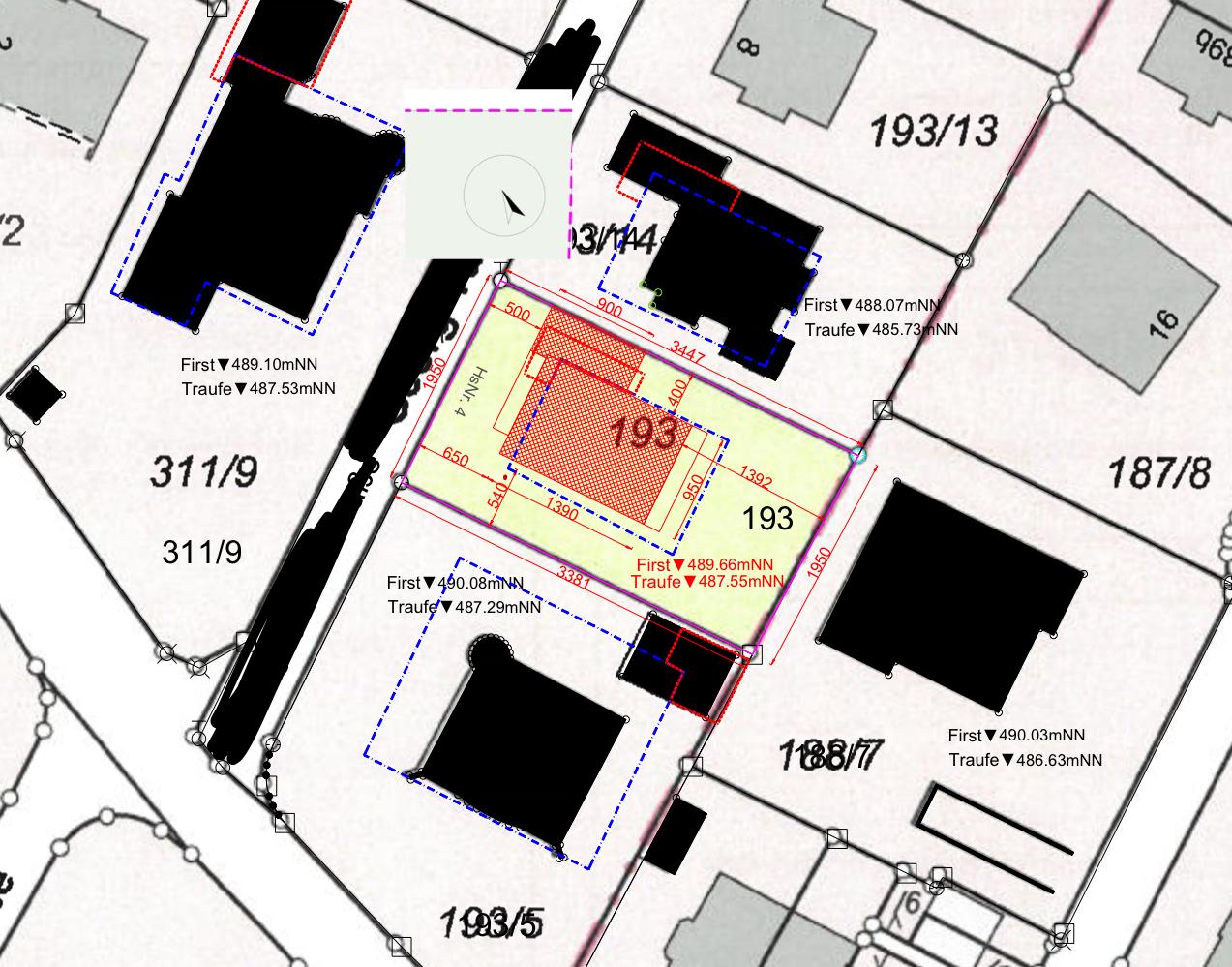
Size / Location of the plot: 660 square meters (7,104 sq ft), no slope
Floor space index: 0.2
Floor area ratio: 0.4
Building envelope, building line and boundary: see image
Roof type: gable roof with 20-24° pitch
Orientation: northwest/southeast
Construction type: currently planned as solid wood construction
Client requirements
House design
What we dislike / open for discussion:
Best regards,
T&S
We are a family of four with 4-year-old twins and are in the process of realizing our own home. Our journey has been ongoing for a while now. We started with an architect who primarily helped us obtain individual exemptions from certain restrictions in the development plan.
The main challenges were:
- Building height – we were allowed to deviate from the ground floor (GF) and attic floor (AF) with knee wall of 1.80m (5 ft 11 in), so we can now plan the GF and first floor (FF) with ceiling heights up to 2.8m (9 ft 2 in)
- Garages and setback issues: we are allowed to build the garage higher than originally planned – but this is not the issue we want to discuss here.
Our planners are trying to meet our budget range by defining a cost framework depending on the gross floor area (GFA). As a result, we have gone through several iterations to reduce the GFA slightly from what was originally planned.
Below, we share our current status and would really appreciate any constructive feedback.
Development Plan / Restrictions:
- Upper Bavarian region ;-)
- Remaining restrictions include a 60cm (24 inches) setback from the garage to the neighboring property
- We have to include a roof overhang that we would have preferred to avoid
Size / Location of the plot: 660 square meters (7,104 sq ft), no slope
Floor space index: 0.2
Floor area ratio: 0.4
Building envelope, building line and boundary: see image
Roof type: gable roof with 20-24° pitch
Orientation: northwest/southeast
Construction type: currently planned as solid wood construction
Client requirements
- Modern, high ceilings, intelligent use of space and storage, open living/dining area
- No basement
- 2 adults, 2 children
- Regular visits from grandparents or family
- 1-2 home office spaces (one also doubles as a fitness room)
- Sauna
- Fireplace
- Open kitchen – cooking integrated into the living space
- Sunken living room (2 steps down so that you can sit around the fireplace)
- Children’s bedrooms ideally symmetrical, or at least similarly sized
House design
- Designed by an architect who would work with the executing company for turnkey construction. Dedicated planning contract signed up to detailed design so far.
- What we like: overall, we are happy with the zoning, although we had to scale down from the original design for budget reasons – especially the ground floor plan differs only marginally from our initial, self-drawn sketches
- Note: the designs show zoning. The exact planning of the window areas will be done next.
- Heating system: heat pump
- Cost estimate: turnkey including planning approx. 900,000€
What we dislike / open for discussion:
- 1. On the ground floor, the living/dining/kitchen area seems small in relation to the overall house. Recently, we extended the house by 30cm (12 inches) to enlarge the children’s rooms on the first floor. As a result, the guest area also gained 30cm (12 inches). We would prefer to allocate these 30cm (12 inches) to the living room but have not yet received feedback regarding potential additional costs due to structural or load-bearing issues, as the vertical walls on the GF/FF would no longer align.
- 2. Upstairs, we are happy to have symmetrical children’s bedrooms. The hallway (shown in green) will be open to the roof and illuminated by skylights. The children’s rooms will have a gallery where, for example, beds can be placed. Attached are two alternatives for the first floor. They differ only in the access to the children’s rooms: “rectangular” or “diagonal.” In the diagonal variant, the children’s rooms gain about 1.3 sqm (14 sq ft) of floor space, while the gallery loses some space. Additionally, with the diagonal option, there is the question of whether the hallway height above the children’s room entrance doors should be continued or closed off, which would benefit the gallery spaces in the children’s rooms. Our planner has a strong opinion here but also acknowledges the advantages of the opposite. We would really appreciate your opinion.
- We would welcome any other feedback as well
Best regards,
T&S
baustei schrieb:
The couch should be placed more to the left along the wall. Where do you see a couch here?? #10 "Where do you see a sofa here?"
baustei schrieb:
The back row is about 4.20 meters (14 feet) with a passage door at the back. No, just take a look at what remains of a 4.20-meter (14-foot) wall for the kitchen.
There are two tall cabinets in the actual row, and what’s left? Not 130cm (51 inches), minus the sink.
The rest is workspace buffer.
baustei schrieb:
The kitchen island is about 2.30 x 1.20 meters It’s 110 x 200 cm (43 x 79 inches). That’s not overly large, and if you exclude the stove, there are 70cm (28 inches) on each side.
Cutting board, salt and pepper, oil, and the cooking app on the phone to the left; there’s 70cm (28 inches) on the right. For placing or working? Ask your wife.
baustei schrieb:
On the front side, there is only the coffee machine, Next to the faucet… Electricity next to water fits in tight spaces—and the dirty dishes are temporarily stored in the pantry?
These kitchens—even if they get posted a dozen more times on Instagram and sold by kitchen specialists—are not sufficient for a four-person household or one that regularly hosts meals! And that’s not an assumption.
Where is the oven in the kitchen layout shown?
And again, the just-about-standard tall cabinet passage, which wastes 90cm (35 inches) of floor space in the actual kitchen. A pantry area, for example, could just as well be accessed from the hallway, combined with the utility room, or arranged in some other way.
And again, the just-about-standard tall cabinet passage, which wastes 90cm (35 inches) of floor space in the actual kitchen. A pantry area, for example, could just as well be accessed from the hallway, combined with the utility room, or arranged in some other way.
kbt09 schrieb:
Where is the oven in the kitchen layout shown? I have corrected my mistake: there are 60-70cm (24-28 inches) on each side. My error was that I had also included a tall oven cabinet.
However, this does not make the kitchen wider or more functional. I also see a downdraft extractor, which turns the standard cooktop into an 80cm (31.5 inches) unit.

baustei schrieb:
11ant wrote:
A reduction in dimensions absolutely must happen! baustei schrieb:
That is certainly part of the challenge. My quote was shortened; the full version was:
11ant schrieb:
A reduction in dimensions absolutely must take place in the non-drawing conceptual phase before moving on to the drafting stage!
If the reduction is only applied to the drawn plan, it inevitably leads to bottlenecks, shifts up to the crushing of functional space, and other “life-threatening” complications! ... and I am afraid it was not just shortened quoted, but also misunderstood.
baustei schrieb:
We started with an architect who put every idea into an initial draft (internal gutters, photovoltaics integrated into the roof, an Audi R8 in front of the garage, talking about 70k kitchens), without keeping the previously communicated budget in mind. Now we are somewhere else—naturally ending up with the initial sketches that were not feasible (but they did give us exemptions from the building permit / planning permission requirements). An R8 means nothing; other architects use templates with S212s or 7 Series cars. Funny enough, the note “bauseits” (client to provide) was never included *LOL*. Internal gutters were a very short-lived trend around 1980 for understandable reasons. Who knows what the genius sees as the benefit of the exemptions. I still suspect that showing the "initial planning" would be helpful. “Integrated” photovoltaics makes sense insofar as I have never understood why so many people treat photovoltaics in new builds like a retrofit add-on. No one needs the nonsensical “double-layer” with, to put it mildly, “redundant” roof tiles under the panels.
baustei schrieb:
We have tried to resolve this (to some extent) now. What we don’t know—keyword load transfer—is whether it makes sense / is possible to achieve load transfer through the walls drawn in black. Kids’ rooms get more light—less convoluted entrance. Graph paper is a good way to improve clarity. The downgrading of the non-load-bearing walls will follow later. Regarding the question about the “solid wood” walls (whatever exactly is meant here), I see no response. Dimensions like 4.28 or 1.69 meters (about 14 ft and 5.5 ft) are nonsense: at this stage, all measurements should consistently be taken as approximate and rounded to the nearest double decimeter (20cm / 8 inches). Anything else is misleading or at least confusing false precision.
https://www.instagram.com/11antgmxde/
https://www.linkedin.com/company/bauen-jetzt/

Similar topics